

Only 2–4% of first-time website visitors become leads, according to Propellant Media's real-estate retargeting overview, leaving approximately 96–98% without a form submission. That's the practical reason to run real estate retargeting ads. But reaching those visitors again isn't the same as persuading them, and a platform claiming credit for an inquiry isn't proof that its ad caused it.
Summary
Create an AI Video Tours from PhotosTry it For Free

Why Real Estate Retargeting Ads Exist in the First Place
A property-page visit signals interest, not readiness. Someone might be checking the floor plan, comparing the location with another listing, or deciding whether the monthly payment feels manageable. Asking every visitor to book immediately ignores those different jobs.
Retargeting gives the agent another opportunity to answer the question that prevented an inquiry. The follow-up might introduce an open house, explain an availability change, show the outdoor space, or make scheduling easier. The useful unit isn't another impression. It's another reason to return.
Before launching, ask:
That distinction should shape the campaign before anyone briefs a designer. Decide which behaviors justify follow-up, which outcomes count as progress, and what evidence would convince you that advertising helped.
A retargeting campaign can look efficient because it reaches people already likely to inquire. The media buyer's job is to determine whether the campaign helps those people act, rather than appearing nearby when they do.
Retargeting gives the agent another opportunity to answer the question that prevented an inquiry. The follow-up might introduce an open house, explain an availability change, show the outdoor space, or make scheduling easier. The useful unit isn't another impression. It's another reason to return.
Follow up on interest rather than buying it again
Think of retargeting as a follow-up layer attached to your acquisition strategy. Search, referrals, organic social, and other real-estate lead sources bring people into the funnel. Retargeting should help interested visitors move forward, not receive automatic credit for everything those channels started.Before launching, ask:
- What did the visitor inspect? A listing gallery deserves a different response from a general market article.
- What useful information can the next ad add? Repeating the hero photo without a new reason to click isn't much of a follow-up.
- What action should happen next? A floor-plan download, availability request, and booked showing require different levels of commitment.
Practical rule: Retarget the unanswered question, not merely the browser that loaded the page.
Separate commercial intent from technical identity
Consider a prospect who browses on a laptop, returns on a phone, and eventually contacts the agent directly. Commercially, that's a continuing search. For measurement, don't assume every interaction will resolve into a connected identity.That distinction should shape the campaign before anyone briefs a designer. Decide which behaviors justify follow-up, which outcomes count as progress, and what evidence would convince you that advertising helped.
A retargeting campaign can look efficient because it reaches people already likely to inquire. The media buyer's job is to determine whether the campaign helps those people act, rather than appearing nearby when they do.
Pixels, Events, and the Tracking Foundation You Need
Start with an event map, not an installation checklist. Installing Meta Pixel, Google Ads tags, and TikTok Pixel is only useful if the signals distinguish browsing from business outcomes.
Build the map around actions your website and CRM can verify. Use consistent internal names, even if the platforms require different destination event names.
Define “meaningful gallery engagement” around an actual interaction your site can capture. Don't invent a threshold because another brokerage uses it.
Keep form submission, tour confirmation, and qualified lead separate. A confirmation-page visit shouldn't become a booked tour unless the scheduling system confirms the appointment.
For Google Ads, distinguish observational website actions from the conversion action used for bidding. Evaluate enhanced conversions only within your consent, eligibility, and data-handling requirements.
For TikTok, build the corresponding Pixel and server-side Events API mapping. Confirm the event names and parameters against current implementation documentation instead of copying Meta's configuration verbatim.
Use a launch test with concrete acceptance criteria:
Build the map around actions your website and CRM can verify. Use consistent internal names, even if the platforms require different destination event names.
Define the funnel before configuring platforms
| Website or CRM action | Recommended measurement role |
|---|---|
| Listing-page view | Identify property interest |
| Meaningful gallery engagement | Separate inspection from a page load |
| Price or availability viewed | Record attention to decision-critical details |
| Form started | Identify an unfinished inquiry |
| Form successfully submitted | Record a received inquiry |
| Tour confirmed | Record a scheduling outcome |
| Lead qualified | Record an agent-reviewed opportunity |
Keep form submission, tour confirmation, and qualified lead separate. A confirmation-page visit shouldn't become a booked tour unless the scheduling system confirms the appointment.
Configure and test the same business logic everywhere
For Meta, map browser activity through Meta Pixel and plan any corresponding server-side delivery through Conversions API. Where browser and server implementations report the same action, require your developer to verify deduplication rather than assuming both records represent separate inquiries.For Google Ads, distinguish observational website actions from the conversion action used for bidding. Evaluate enhanced conversions only within your consent, eligibility, and data-handling requirements.
For TikTok, build the corresponding Pixel and server-side Events API mapping. Confirm the event names and parameters against current implementation documentation instead of copying Meta's configuration verbatim.
Use a launch test with concrete acceptance criteria:
- Submission integrity: Fire the inquiry event after successful delivery, not when someone clicks the button.
- CRM continuity: Preserve campaign identifiers and the property reference through lead routing.
- Consent handling: Confirm that browser and server implementations respect the visitor's applicable choices.
- Failure behavior: Test rejected forms, duplicate submissions, external scheduling pages, and unavailable listings.
Audience Segmentation That Matches Real Estate Intent
Don't put every visitor into the same audience and ask creative to compensate. A person who inspected a floor plan needs different information from someone who started an inquiry and stopped.
Stackmatix's real-estate retargeting benchmark compilation places high-intent retargeting conversion rates around 5–12%, compared with roughly 1–3% for cold traffic. Those figures are directional benchmarks. Your own audience definitions and what you count as a conversion will shift the comparison.
Treat these as operating rules to adapt. Match audience membership to the listing's availability, the visitor's action, and the brokerage's actual follow-up process.
Use exclusions to make that hierarchy explicit:
Review housing-advertising restrictions before building audiences. A platform's general targeting options may be unavailable or inappropriate for a housing campaign, and demographic assumptions or sensitive characteristics make poor shortcuts for purchase intent.
Build segments from behavior you can verify in your CRM. Imagined buyer profiles belong in a different conversation.
Stackmatix's real-estate retargeting benchmark compilation places high-intent retargeting conversion rates around 5–12%, compared with roughly 1–3% for cold traffic. Those figures are directional benchmarks. Your own audience definitions and what you count as a conversion will shift the comparison.
Real Estate Retargeting Audience Segmentation
| Segment | Window | Exclusions | Creative Job |
|---|---|---|---|
| Listing viewers | Short, tied to active inventory | Inquiry submitters and unavailable listings | Give a property-specific reason to return |
| Deep-engagement visitors | Active research period | Higher-intent audiences | Explain layout, amenities, or location |
| Form abandoners | Brief, recent-intent window | Successful submissions | Remove scheduling or contact friction |
| Past leads | CRM-stage-based eligibility | Active negotiations, opted-out contacts, closed clients | Offer relevant inventory or renewed consultation |
| Closed clients | Excluded from acquisition retargeting | All active property-acquisition campaigns | Use a separate relationship campaign if appropriate |
| Lookalike or expansion audiences | Prospecting eligibility (recency does not apply) | Existing leads and customers | Introduce the offer without implying prior interest |
Build an audience hierarchy
Give the most specific eligible segment priority. A form abandoner shouldn't simultaneously receive a generic brokerage introduction and a property reminder from competing ad sets.Use exclusions to make that hierarchy explicit:
- Higher intent wins: Remove inquiry starters from the broader listing-viewer campaign.
- CRM stages override browsing: Once an agent is actively handling a prospect, stop serving acquisition messages that ask them to introduce themselves again.
- Inventory changes override recency: A recently viewed property stops being a useful offer once it becomes unavailable.
- Expansion stays separate: Lookalikes and similar audiences belong in prospecting budgets. Keep their spending and results apart from retargeting.
Review housing-advertising restrictions before building audiences. A platform's general targeting options may be unavailable or inappropriate for a housing campaign, and demographic assumptions or sensitive characteristics make poor shortcuts for purchase intent.
Build segments from behavior you can verify in your CRM. Imagined buyer profiles belong in a different conversation.
Creative Recipes That Earn the Second Click
The second ad should add information. Replaying the same carousel can be reasonable when the visitor needs a reminder, but it is a weak default when the obstacle is uncertainty about layout, condition, or availability.
Use lifestyle imagery as an invitation to inspect the property, not a substitute for showing it accurately.
If location is the question, show factual neighborhood information and direct viewers to details they can verify. Don't make unsupported claims about school eligibility, investment returns, or who belongs in the area.
Royal LePage Brookside Realty's resource on social media marketing for Maple Ridge agents is a useful companion when developing locally relevant messaging rather than generic property promotion.
Use lifestyle imagery as an invitation to inspect the property, not a substitute for showing it accurately.
A listing teaser for interested browsers
Open with the strongest relevant space rather than a logo animation. If the listing's distinction is an unusually usable terrace, show the terrace and its connection to the living area.- Hook: Lead with a concrete property feature the visitor may have missed.
- Structure: Show that feature, establish how it fits the home, and identify the listing clearly.
- CTA: Invite the viewer to inspect the full gallery or floor plan.
An updated tour for unresolved questions
Build the next version around a verified change or a specific objection. A price update should show the current asking price consistently across the ad and destination. A layout question calls for a clear sequence through connected rooms, not faster transitions.If location is the question, show factual neighborhood information and direct viewers to details they can verify. Don't make unsupported claims about school eligibility, investment returns, or who belongs in the area.
Royal LePage Brookside Realty's resource on social media marketing for Maple Ridge agents is a useful companion when developing locally relevant messaging rather than generic property promotion.
A booking ad for inquiry starters
Strip this version down. Identify the property, explain what happens after the request, and send the visitor directly to the scheduling action.A booking ad should reduce uncertainty about the next step, not introduce another tour of the brokerage.A talking AI avatar can explain the process, while a lifestyle clip can introduce the setting. Neither should invent property features, impersonate a real client, or imply footage documents something it doesn't. Judge the format by whether it clarifies the decision.
Choosing the Right Platform for Each Retargeting Job
Platform choice is a measurement decision before it is a creative one. Run spend where you can still connect exposure, site behavior, and a booked appointment with signals you are allowed to use; if the path is already breaking across devices, extra placements mostly add reporting noise.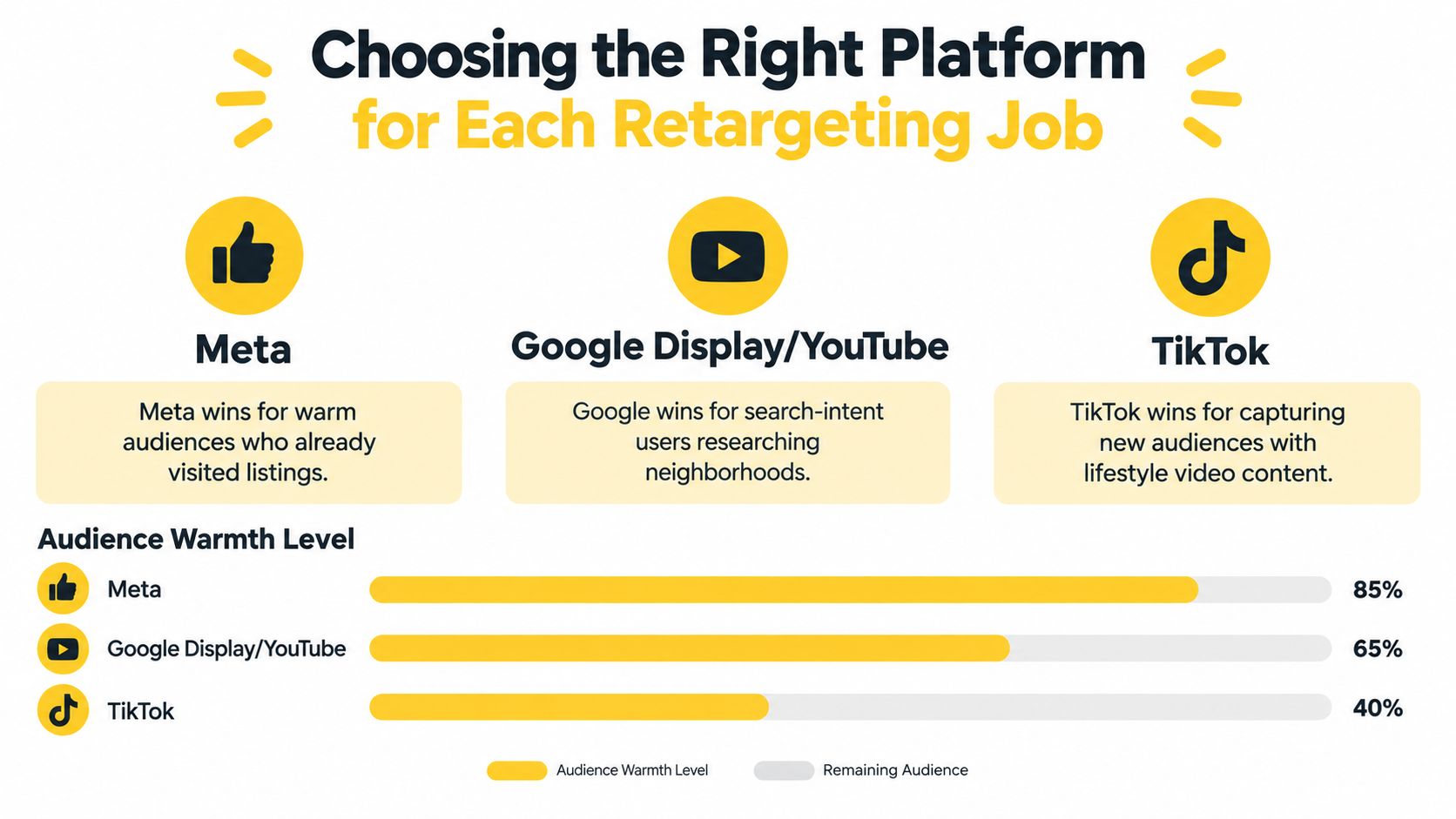
Meta earns the first test when the follow-up depends on rooms, floor plans, agent explanation, or an invite to see the home again. Keep expansion away from the warm pool, keep frequency visible at the ad level, and align paid creative with a consistent real-estate Instagram marketing approach so the property presentation does not feel stitched together.
Google Display and YouTube need separate expectations. Display has to return the visitor with almost no explanation, while YouTube can carry a longer objection if the first seconds make the question clear. Treat search research, customer lists, and site remarketing as different eligibility problems, and check consent and audience availability before assuming the pool exists.
TikTok belongs in the plan only when two things are true: enough prior visitors are reachable there, and you can make a vertical clip that resolves one specific concern. Otherwise it buys reach without improving the answer.
Add a platform when it brings eligible people you cannot reach, a format that explains what current ads cannot, or a cleaner read on the same qualified outcome. If none of those is clear, keep the account concentrated and judge it on appointments, not dashboard coverage.
| Platform | Job worth testing | Trade-off to watch |
|---|---|---|
| Meta | Visual reminders and property-specific follow-up | Warm campaigns can become repetitive without distinct creative |
| Google Display and YouTube | Display reminders or more explanatory video follow-up | Separate placement performance and attribution assumptions |
| TikTok | Native vertical follow-up for a demonstrably reachable audience | Requires suitable creative and enough eligible audience activity |
Google Display and YouTube need separate expectations. Display has to return the visitor with almost no explanation, while YouTube can carry a longer objection if the first seconds make the question clear. Treat search research, customer lists, and site remarketing as different eligibility problems, and check consent and audience availability before assuming the pool exists.
TikTok belongs in the plan only when two things are true: enough prior visitors are reachable there, and you can make a vertical clip that resolves one specific concern. Otherwise it buys reach without improving the answer.
Add a platform when it brings eligible people you cannot reach, a format that explains what current ads cannot, or a cleaner read on the same qualified outcome. If none of those is clear, keep the account concentrated and judge it on appointments, not dashboard coverage.
Budgeting, Bidding, and Frequency Discipline
Say your remarketing pool holds 900 eligible visitors. No bid strategy turns that into a bigger audience, and no budget forces Meta or Google to surface warm prospects who do not exist. Size the spend to the pool first, and let the brokerage's growth targets drive prospecting budgets instead.
Allocation diagrams in planning decks are illustrations. Treat their percentages and exposure limits as a starting sketch, then let your account's reach, eligibility, and response set the numbers.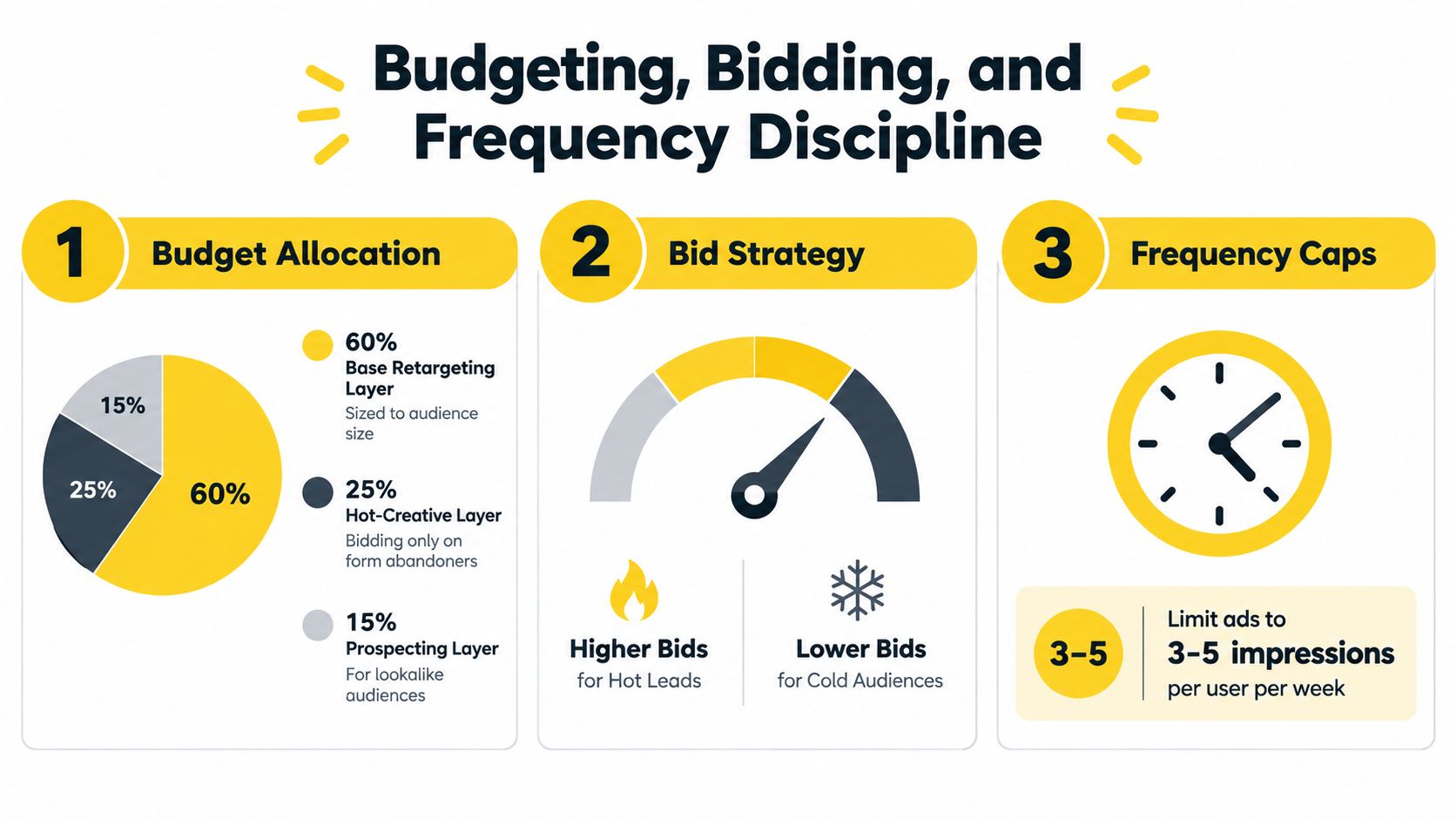
Exclude confirmed tour-bookers from any ad set that asks them to book again. When they need appointment details, handle it through your normal customer communication. Paying for another acquisition impression only pollutes your frequency data.
For bidding, pick the deepest reliable event the account can support. When qualified-lead feedback arrives inconsistently, the bidding system is learning from noisy signals. Fix the feedback loop and review lead quality by hand until it stabilizes.
Where direct caps are unavailable, work the controls you do have, roughly in this order:
Allocation diagrams in planning decks are illustrations. Treat their percentages and exposure limits as a starting sketch, then let your account's reach, eligibility, and response set the numbers.
Fund the audience before the ambition
Split the retargeting budget into three jobs: a base layer for eligible property visitors, a smaller intent-focused layer for unfinished inquiries, and a controlled allowance for creative testing. Keep prospecting separate, including any lookalike activity, so warm-pool delivery stays readable on its own.Exclude confirmed tour-bookers from any ad set that asks them to book again. When they need appointment details, handle it through your normal customer communication. Paying for another acquisition impression only pollutes your frequency data.
For bidding, pick the deepest reliable event the account can support. When qualified-lead feedback arrives inconsistently, the bidding system is learning from noisy signals. Fix the feedback loop and review lead quality by hand until it stabilizes.
Set exposure controls before delivery starts
Treat frequency discipline as an operating process: set a conservative starting cap where the buying setup allows one, then inspect whether further exposure produces useful action. Platforms that sell on reach will keep serving past the point of useful recall, so the cap is your call to make and yours to revisit.Where direct caps are unavailable, work the controls you do have, roughly in this order:
- Budget restraint: Reduce spend when delivery repeatedly reaches the same people without additional qualified response.
- Audience control: Shorten eligibility when the offer becomes time-sensitive or less relevant.
- Creative rotation: Swap exhausted messages for ads carrying new information; a recolor alone rarely resets attention.
- Schedule testing: Restrict delivery hours only when your own response and appointment data support it.
Buying discipline: Don't raise the budget to solve a creative or audience problem.If the campaign already reaches its full eligible audience and extra delivery adds no qualified outcomes, redirect the budget rather than forcing more impressions.
Measuring Retargeting When Privacy Splits the Path
A prospect can see an ad on a phone and later inquire from a laptop. Don't assume the advertising report will reconstruct that path, and don't assume an unmatched inquiry had no advertising influence.
Google's guidance on remarketing and measurement describes an approach involving first-party data, AI-based solutions, and privacy-preserving technologies, while retaining interaction metrics such as clicks and views. The practical response is to build a defensible measurement process, not promise perfect identity resolution.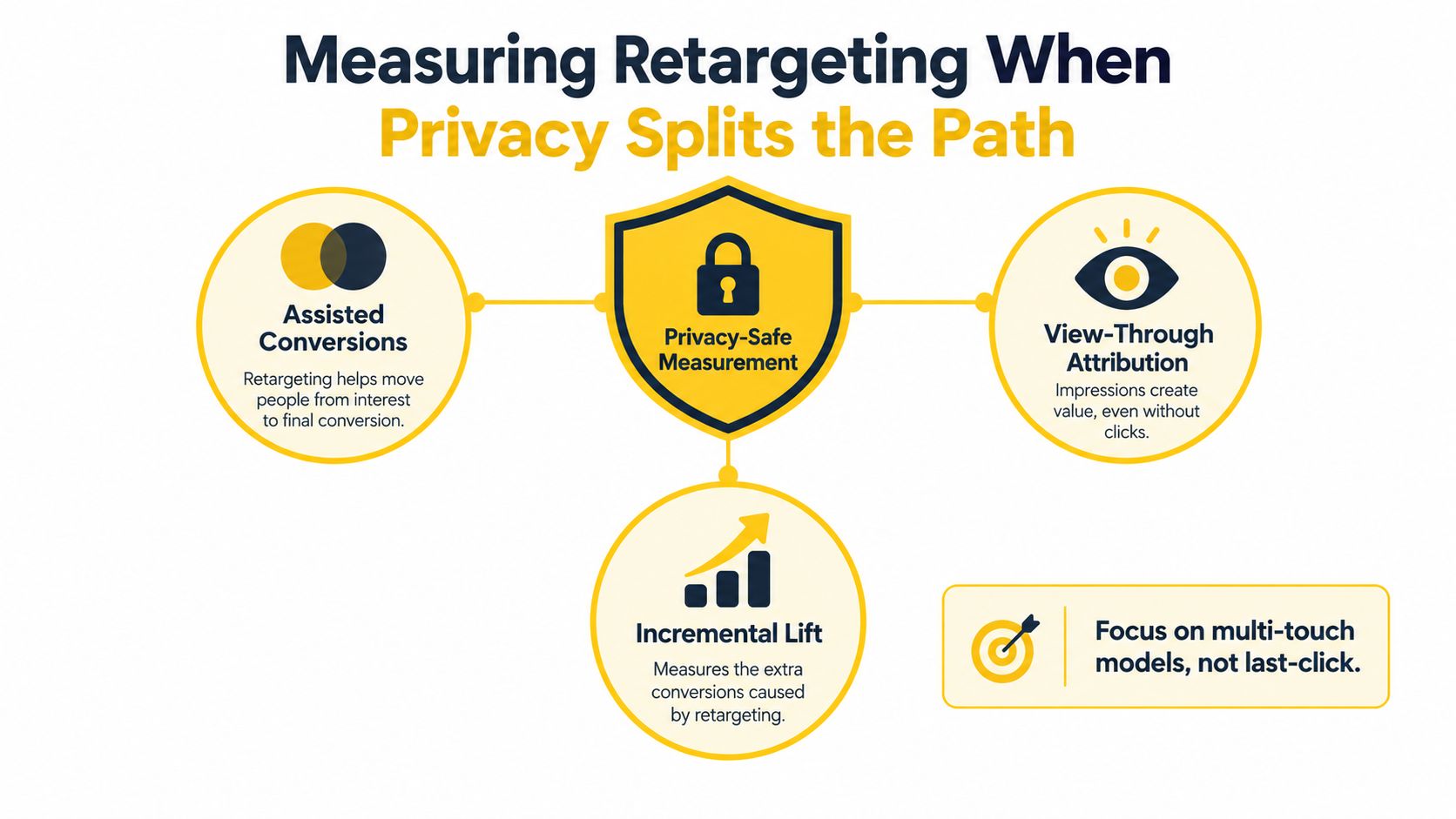
Keep click-through, view-through, and CRM-confirmed outcomes in separate reporting columns. A view-through conversion indicates attributed exposure under the platform's rules. It doesn't establish that the impression caused the inquiry.
LocaliQ's real-estate search advertising benchmarks also demonstrate why subcategory matters: property-management, rental, brokerage, and agent campaigns shouldn't share an unqualified blended target. Compare the same offer, conversion definition, attribution window, and lead-quality rules wherever possible.
Review results on a regular operating cadence, but allow enough time for inquiries to become appointments. A calendar deadline alone doesn't make a small sample conclusive.
Before launch, confirm:
VideoTour.ai turns property photo sets into ready-to-share video tours, with editable captions, music, motion, and branding. Visit VideoTour.ai to create a listing teaser or updated tour, then test it against a clearly defined retargeting audience and qualified-appointment goal.
Google's guidance on remarketing and measurement describes an approach involving first-party data, AI-based solutions, and privacy-preserving technologies, while retaining interaction metrics such as clicks and views. The practical response is to build a defensible measurement process, not promise perfect identity resolution.
Use the CRM as the outcome ledger
Record the initial source, available campaign identifiers, inquiry property, qualification result, and appointment status. Capture consented first-party information through useful inquiry forms, saved-search tools, or availability requests.Keep click-through, view-through, and CRM-confirmed outcomes in separate reporting columns. A view-through conversion indicates attributed exposure under the platform's rules. It doesn't establish that the impression caused the inquiry.
LocaliQ's real-estate search advertising benchmarks also demonstrate why subcategory matters: property-management, rental, brokerage, and agent campaigns shouldn't share an unqualified blended target. Compare the same offer, conversion definition, attribution window, and lead-quality rules wherever possible.
Test for contribution rather than dashboard ownership
When volume and operations permit, use a carefully designed holdout or comparable-market test. Keep prospecting, landing pages, and agent follow-up stable enough that differences remain interpretable.Review results on a regular operating cadence, but allow enough time for inquiries to become appointments. A calendar deadline alone doesn't make a small sample conclusive.
Before launch, confirm:
- Measurement: The primary outcome is defined and test inquiries reach the CRM.
- Eligibility: Audience membership respects consent and the intended CRM stage.
- Inventory: Sold, rented, or withdrawn listings trigger appropriate suppression.
- Exposure: Delivery controls and review triggers are documented.
- Creative: Each version has a distinct audience, message, and destination.
- Evaluation: Someone owns the reconciliation between platform reports and qualified appointments.
VideoTour.ai turns property photo sets into ready-to-share video tours, with editable captions, music, motion, and branding. Visit VideoTour.ai to create a listing teaser or updated tour, then test it against a clearly defined retargeting audience and qualified-appointment goal.