

The best AutoReel alternatives in 2026 are VideoTour.ai, Reel-E, BetterSpace, vProp, Amplifiles and Imoframe. VideoTour.ai has the lowest published cost per video in this comparison when you use its full plan allowance. The right choice also depends on how many listing photos each tool accepts and whether you need an unbranded MLS export.
In 2025, 39% of surveyed U.S. REALTORS® said social media generated the highest number of quality leads among the technologies they used, according to the National Association of REALTORS®. A still gallery doesn't feed that channel. A short video does.
The six tools differ less on effects than on what one payment buys, whether that's a video, a credit, an image or a whole listing, and that single difference decides your cost per listing.
Those six tools price the same work differently, so the only honest comparison is each provider's published plan price divided by the number of videos included. Every tool here is judged on price per finished video, photos accepted per video, voiceover and voice cloning, avatars, unbranded MLS export, and free trial terms. Plans change without notice, so every number in this comparison is dated to November 2026 and worth re-checking on the provider's own page before you commit.
Summary
Create an AI Video Tours from PhotosTry it For Free
What AutoReel does well, and why agents switch
AutoReel is a dedicated real estate reel app with templates that make it straightforward to turn listing photos into short videos. Its effective cost depends on the plan: the Growth tier works out to about $15.48 per included video (roughly €16 at some exchange rates), while other tiers cost more or less per video. Agents looking elsewhere are usually comparing cost per listing and photo limits, which AutoReel lists by plan.
1. VideoTour.ai
VideoTour.ai has the lowest published cost per finished listing video in this comparison when you use the full plan allowance. It pairs an unbranded MLS viewing link with voice cloning and talking avatars on the same plan. The link does not remove names or logos embedded in the video, so check your MLS rules before sharing it. It accepts up to 60 photos per video, the highest ceiling here.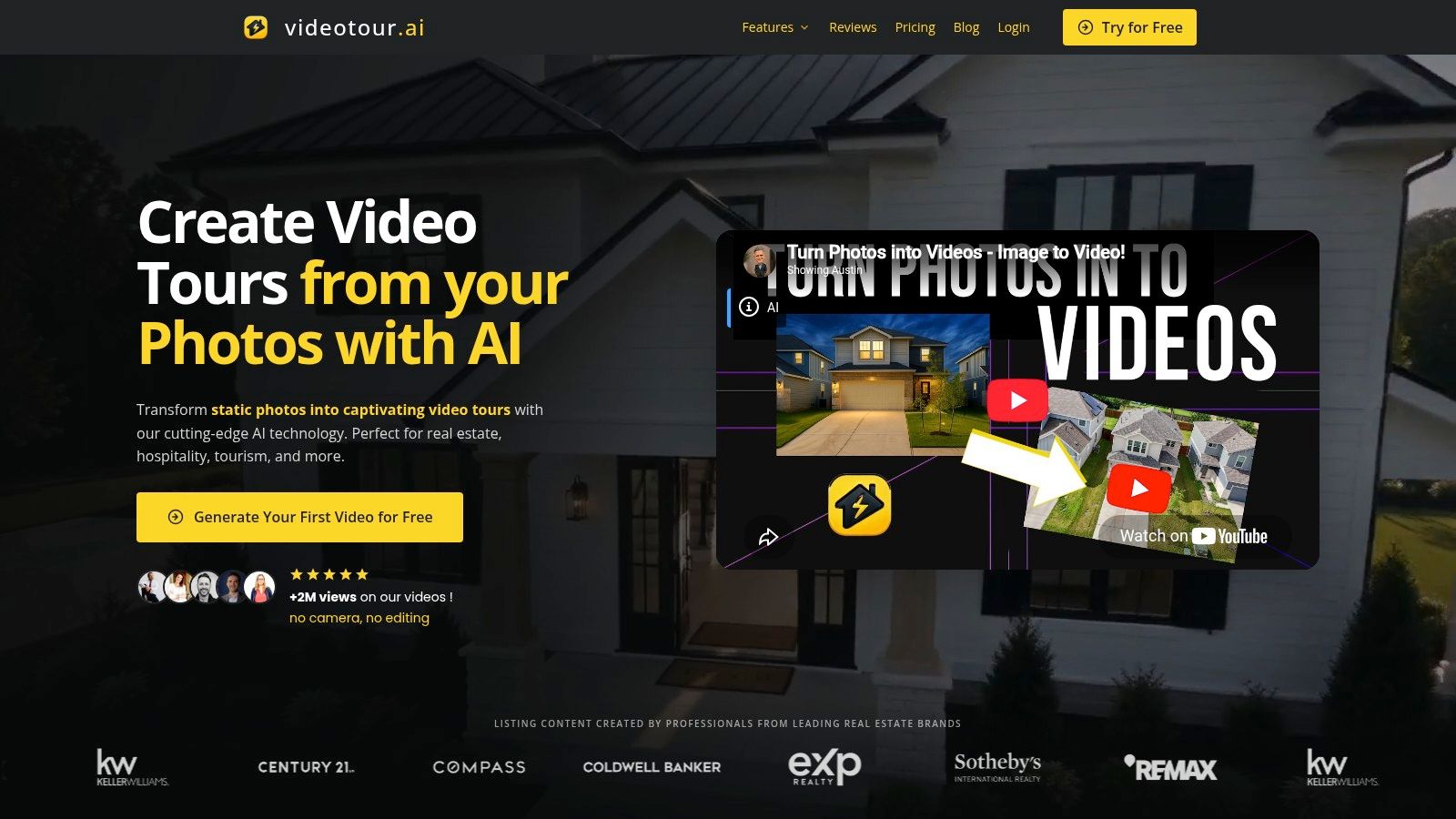 To start, paste an individual listing URL from Zillow, Redfin or Realtor.com and select Import Listing to pull in its photos and details, or upload up to 60 photos yourself. The tool writes a script from the listing details, then adds music, captions, voiceover and photo motion. VideoTour.ai offers a 16:9 tour plus vertical, square or horizontal social cuts. Videos have no VideoTour.ai watermark on any plan, including the free video. There's no timeline to learn.
That pricing competes with the videographer line of the marketing budget, not the still photographer. A hired videographer runs into the hundreds of dollars per property and takes days to deliver, which is why most agents reserve video for their best listings. At a few dollars per video, the same tool becomes viable for every listing, including the ones that will sit on the market for a week.
For an agent holding a library of past listing photos, the switch is a test, not a migration. Old shoots become new videos in one upload, so the back catalog gets a second life on social while the next new listing goes through the normal flow.
Pros
To start, paste an individual listing URL from Zillow, Redfin or Realtor.com and select Import Listing to pull in its photos and details, or upload up to 60 photos yourself. The tool writes a script from the listing details, then adds music, captions, voiceover and photo motion. VideoTour.ai offers a 16:9 tour plus vertical, square or horizontal social cuts. Videos have no VideoTour.ai watermark on any plan, including the free video. There's no timeline to learn.The Math Behind $2.90 a Video
Independent is $29 a month billed yearly or $39 billed monthly for 10 videos, which is about $2.90 a video on annual billing. Agency is $59 a month for 40 videos and two users, about $1.47 a video, and Enterprise is $99 a month for 200 videos and five users, about $0.49. Nothing else in this list lands in that range per video. Plan details are current on the VideoTour.ai pricing page.That pricing competes with the videographer line of the marketing budget, not the still photographer. A hired videographer runs into the hundreds of dollars per property and takes days to deliver, which is why most agents reserve video for their best listings. At a few dollars per video, the same tool becomes viable for every listing, including the ones that will sit on the market for a week.
For an agent holding a library of past listing photos, the switch is a test, not a migration. Old shoots become new videos in one upload, so the back catalog gets a second life on social while the next new listing goes through the normal flow.
Pros
- Sixty photos per video. Full photo sets fit in one pass, so you don't cut rooms to hit a limit.
- MLS link and social cuts from one listing. An unbranded MLS viewing link plus vertical, square and horizontal cuts for Instagram, TikTok, Facebook and YouTube. Names or logos inside the video remain visible, so check your MLS rules.
- Voice cloning and talking avatars included. Your own cloned voice or an AI presenter, without buying a second subscription.
- One free video and 50 AI credits, no credit card. The free account includes one video and 50 AI credits, not a monthly video allowance. The free video has no VideoTour.ai watermark, so you can judge output on a live listing before paying anything.
- Review still matters. AI scripts and motion need a check against the property's actual story before posting.
- Premium animations use optional AI credit packs. Default animations are free, and free accounts get one video.
Practical rule: Run one live listing through the free first video and inspect the MLS export for agent branding before you publish. The tour goes to the MLS. The reel goes to Instagram. Treat them as two deliverables from one upload.If you want to see the output shapes before you spend anything, the AI real estate video maker page shows tours and reels side by side.
2. Reel-E
Reel-E is the tool to pick when the video is only part of the job. One upload returns widescreen, vertical and square versions, each in branded and unbranded form, plus edited photos and a single-property website with a lead form and analytics. Plans start at $59 per month, or $44 per month billed yearly, for three new listings a month.
That per-listing model fits a market where listing video is still the exception. NAR's 2025 Home Buyers and Sellers Generational Trends report shows agents used video to market homes for 12% of buyers overall, with virtual tours at 16%. Most agents have not standardized video yet, which is why a plan that bundles photos and a website can feel like better value than a video-only subscription.
If all you need is the vertical cut, how to create a reel for Instagram covers the framing and caption choices that decide whether it gets watched.
That per-listing model fits a market where listing video is still the exception. NAR's 2025 Home Buyers and Sellers Generational Trends report shows agents used video to market homes for 12% of buyers overall, with virtual tours at 16%. Most agents have not standardized video yet, which is why a plan that bundles photos and a website can feel like better value than a video-only subscription.
What the Subscription Actually Buys
The three-format export is the strongest feature for listing marketing, because the MLS file and the Instagram file shouldn't look the same. Narration comes from AI voices or your own recording, and the property website carries the lead capture that a plain video file can't.- Edited photos included. Cleaning up listing images sits inside the same workflow as the video.
- Branded and unbranded exports. The unbranded version is what the MLS needs.
- Lead capture and analytics. A single-property site gives you traffic data a video file never shows.
If all you need is the vertical cut, how to create a reel for Instagram covers the framing and caption choices that decide whether it gets watched.
3. BetterSpace
BetterSpace leads with a free plan that advertises two videos a month, which is more than most agents need to judge output. Paid plans shown start at $29 per month, and video creation sits beside virtual staging in the same product.
That matters because most firms don't supply this tooling. NAR's 2025 Profile of Real Estate Firms reports 18% of firms using video, against 65% using multiple-listing technology, with video reported by 21% of firms with 101 or more agents, 21% of firms with 2 to 100 agents, and 10% of one-agent firms. When the brokerage doesn't provide it, the agent buys it, and a free tier is how most of them will test it.
If you're still mapping the category, video tour software breaks down the workflow types before you pay for one.
That matters because most firms don't supply this tooling. NAR's 2025 Profile of Real Estate Firms reports 18% of firms using video, against 65% using multiple-listing technology, with video reported by 21% of firms with 101 or more agents, 21% of firms with 2 to 100 agents, and 10% of one-agent firms. When the brokerage doesn't provide it, the agent buys it, and a free tier is how most of them will test it.
Where the Credit Model Bites
Paid plans meter video through a credit balance, so your video allowance shifts with whatever else you spend on staging. Photo limits also vary by plan, which means the tier you start on may not accept a full 40-photo luxury set.- Staging plus video in one place. Useful for vacant listings where the room needs furniture before it needs motion.
- Team-oriented plans. Better suited to brokerages than single-seat tools.
- Integrations with ChatGPT and Claude. You can trigger a build from a chat prompt if that's how you work.
If you're still mapping the category, video tour software breaks down the workflow types before you pay for one.
4. vProp
vProp advertises five free videos, and they're watermarked. Its entry credit pack was listed at $19, per its pricing materials as of November 2026; check how many credits your chosen video type consumes before treating that as a per-video price. Membership options are available for regular volume. The draw is narration: AI scripts, voice cloning and avatar presenters in one product.
Test the avatar hardest. Only 29% of recent buyers rated listing videos as "very useful", against 81% for photos, according to a real estate video marketing statistics roundup. A presenter reading a script doesn't fix a video that fails to show the layout clearly.
For a wider view of what each category of tool is for, the real estate video marketing tools guide sorts them by job rather than by price.
Test the avatar hardest. Only 29% of recent buyers rated listing videos as "very useful", against 81% for photos, according to a real estate video marketing statistics roundup. A presenter reading a script doesn't fix a video that fails to show the layout clearly.
Credit Math and Video Types
Some video types consume more than one credit, so the $19 entry-pack price is not a fixed per-video rate, per its pricing materials as of November 2026. Price your standard listing, with narration and an avatar, before you compare it against a flat per-video plan.- Free videos to try. Five watermarked videos are enough to judge output on two or three real listings.
- Individual purchases or membership. You're not forced into a recurring charge for a slow quarter.
- Credits cover more than video. Virtual staging and marketing materials draw on the same balance.
For a wider view of what each category of tool is for, the real estate video marketing tools guide sorts them by job rather than by price.
5. Amplifiles
Amplifiles charges by the image: $1.50 per image pay-as-you-go, or subscriptions from $29 per month. No commitment, and a tight photo set is cheap. Twenty animated images at $1.50 is $30, which is where per-image pricing stops feeling like a bargain on a full listing.
If you want to understand what separates an assembled slideshow from a generated video, this automated video maker breakdown covers the mechanics.
Why 4K Rarely Reaches Instagram
Export settings are where this tool wins on paper and loses in practice. Instagram's own developer documentation limits Reels to 1,920 pixels horizontal resolution, 25 Mbps and 300 MB, accepts 23 to 60 FPS, and recommends 9:16 to avoid cropping or blank space, per Meta's Instagram platform documentation. Amplifiles exports up to 4K, and that file belongs on YouTube or the listing page, not in the feed. Higher-resolution exports also consume credits.- No subscription required. Pay only for the images you animate.
- Free credits for new users. Enough to run a small listing end to end.
- Self-service or done-for-you. A human-edited deliverable is available when you're out of time.
If you want to understand what separates an assembled slideshow from a generated video, this automated video maker breakdown covers the mechanics.
6. Imoframe
pricing page
Imoframe is a per-property option with no recurring subscription. Its pricing page lists $79 for a property with up to 20 photos, with a higher custom price for 21 to 40 photos as of November 2026. Check the current quote before budgeting a larger listing.
Distribution is the fit. HubSpot's 2025 marketing research identifies short-form video as the top-performing content format, and YouTube's help documentation says square or vertical videos uploaded after December 8, 2025 can be Shorts when they run no more than three minutes. A vertical Imoframe clip can sit in that window. It just will not narrate the listing.
The Ten-Photo Ceiling
Imoframe uses 10 selected photos by default, though its pricing page lists a property package of up to 20 photos; check which photos appear in the finished cut and what additional selections cost. Music and on-screen listing details take the place of a voiceover. A short set may suit a land parcel or rental, but a larger condo needs more deliberate shot selection.- No subscription. A per-property price for agents who list irregularly; check the current quote before ordering.
- Vertical or horizontal formats. You choose the shape per video.
- Shot re-dos. Fix a sequence without buying the video again.
AutoReel alternatives compared on published pricing (November 2026)
Compare these tools on price per finished video. A low monthly fee still costs more if it only covers a handful of listings.
Twenty photos on Amplifiles is about $30. Reel-E holds near $14.67 per listing on annual billing. I would pick VideoTour.ai when the photo set is long: it is the only published price here under $3 that also covers up to 60 photos, cloning, avatars, and an unbranded MLS file. Imoframe's published property package starts at $79 for up to 20 photos, though its default video selection uses 10.
| Tool | Published price | What that price includes |
|---|---|---|
| AutoReel (baseline) | About $15.48 per included video on Growth; effective rate varies by plan | Dedicated real estate reel templates; plan-specific photo limits (pricing) |
| VideoTour.ai | About $0.49 to $2.90 per video on stated plans; first video free | Up to 60 photos, voice cloning, talking avatars, and an unbranded MLS viewing link, listing import from Zillow, Redfin or Realtor.com |
| Reel-E | About $14.67 per listing on the annual plan | AI or recorded narration, plus unbranded exports |
| BetterSpace | Paid plans from $29/month | Two free videos a month and an optional voiceover |
| vProp | Entry credit pack listed at $19 per its pricing materials as of November 2026; video cost varies by credits used | Voice cloning and avatar presenters, plus five free watermarked videos |
| Amplifiles | $1.50 per image, about $30 for twenty images | Voiceover options and free credits for new users |
| Imoframe | $79 per property with up to 20 photos, per its pricing page as of November 2026 | Uses 10 selected photos by default, with no narration |
Choosing the Right AutoReel Alternative and Switching Without Losing Listings
Match the tool to your listing count, not to a feature list. At one or two listings a month, compare the cost of a per-property purchase with a subscription: Imoframe avoids a recurring charge but starts at $79 per property on its published pricing, while VideoTour.ai offers a free first video. At three to ten listings, a monthly plan can lower the cost per video if you use the allowance; VideoTour.ai's Independent and Agency tiers have the lowest stated rates here. At higher volume, Enterprise drops the per-video cost to about $0.49 when its full allowance is used, the lowest published figure in this comparison.
Photo volume decides more than effects. If your photographer delivers 35 to 60 frames, the tool must accept them in one pass, and a 10-photo ceiling forces you to throw away the story. Voice cloning and avatars are worth paying for if your face or voice is part of your brand. They're not worth paying for if the listing is the star.
To switch without losing listings:
underwriting tools for flippers and wholesalers
Before you render anything, put the listing details through the video script generator, then sharpen the opening line with the hook generator.
Is there a free AutoReel alternative? Yes. VideoTour.ai gives the first video free with no credit card, and BetterSpace advertises two free videos a month.
Which option is cheapest per video? VideoTour.ai's Enterprise plan at about $0.49 per video if you use its full stated allowance. The same tool runs about $1.47 on Agency and $2.90 on Independent annual billing when you use every included video.
Do these tools make an unbranded MLS version? VideoTour.ai and Reel-E both offer unbranded or MLS-facing exports. Imoframe and Amplifiles are social-first, and vProp's MLS handling isn't stated on its published materials.
Can I move my AutoReel projects into another tool? Not the finished videos. You re-upload the original photos, which is why you should download them before cancelling.
Do I need voice cloning? Only if you want your own voice on every listing without recording. A cloned voice reads a fresh script per property.
Which tool handles 60 photos? VideoTour.ai accepts up to 60 per video, the highest stated limit in this comparison. Reel-E's plans allow 20 or 40 photos per listing, depending on the tier. Imoframe uses 10 selected photos by default, though its property package can include up to 20. Other tools' limits vary by plan, so confirm before committing a large photo set.
How long does switching take? One afternoon for the first listing, then minutes per listing once your branding is saved.
VideoTour.ai turns the listing photos you already have into an MLS-ready tour plus vertical, square and horizontal reels, with voice cloning, talking avatars and AI staging on the same plan, and the first video is free with no credit card. Plans start at $29 a month billed yearly for 10 videos, which is about $2.90 per finished video. Take one current listing from your AutoReel library and run it through at VideoTour.ai to compare the output before your next listing goes live.
Photo volume decides more than effects. If your photographer delivers 35 to 60 frames, the tool must accept them in one pass, and a 10-photo ceiling forces you to throw away the story. Voice cloning and avatars are worth paying for if your face or voice is part of your brand. They're not worth paying for if the listing is the star.
To switch without losing listings:
- Export what belongs to you. Pull your original photo sets out of AutoReel before you cancel. Rendered videos rarely travel between tools, but photos always do.
- Run one live listing through the new tool. Watch the first five seconds next to your AutoReel version, because that's where a buyer decides.
- Confirm the unbranded MLS version before posting. Brokerage name, license number and phone belong on the social cut, not the MLS file.
- Keep the reel and the tour separate. One answers a buyer's search, the other interrupts a scroll. They're different deliverables from the same photos, and editing the tour after generation does not rewrite a reel that already exists.
underwriting tools for flippers and wholesalers
Before you render anything, put the listing details through the video script generator, then sharpen the opening line with the hook generator.
Is there a free AutoReel alternative? Yes. VideoTour.ai gives the first video free with no credit card, and BetterSpace advertises two free videos a month.
Which option is cheapest per video? VideoTour.ai's Enterprise plan at about $0.49 per video if you use its full stated allowance. The same tool runs about $1.47 on Agency and $2.90 on Independent annual billing when you use every included video.
Do these tools make an unbranded MLS version? VideoTour.ai and Reel-E both offer unbranded or MLS-facing exports. Imoframe and Amplifiles are social-first, and vProp's MLS handling isn't stated on its published materials.
Can I move my AutoReel projects into another tool? Not the finished videos. You re-upload the original photos, which is why you should download them before cancelling.
Do I need voice cloning? Only if you want your own voice on every listing without recording. A cloned voice reads a fresh script per property.
Which tool handles 60 photos? VideoTour.ai accepts up to 60 per video, the highest stated limit in this comparison. Reel-E's plans allow 20 or 40 photos per listing, depending on the tier. Imoframe uses 10 selected photos by default, though its property package can include up to 20. Other tools' limits vary by plan, so confirm before committing a large photo set.
How long does switching take? One afternoon for the first listing, then minutes per listing once your branding is saved.
VideoTour.ai turns the listing photos you already have into an MLS-ready tour plus vertical, square and horizontal reels, with voice cloning, talking avatars and AI staging on the same plan, and the first video is free with no credit card. Plans start at $29 a month billed yearly for 10 videos, which is about $2.90 per finished video. Take one current listing from your AutoReel library and run it through at VideoTour.ai to compare the output before your next listing goes live.