

A real estate marketing agency makes sense when you need scalable, MLS-safe, multi-format listing media plus disciplined lead-response workflows that go beyond static photos. The buyer is already online, and the agency's job is to make the property look clear, credible, and worth a fast response before that buyer ever calls.
Most sellers and agents still underestimate how early the decision gets made. By the time the first phone call lands, the prospect has usually compared photos, scanned details, and formed a short list. If the listing doesn't answer those questions quickly on a phone, you've already lost the easiest version of the deal.
Most sellers and agents still underestimate how early the decision gets made. By the time the first phone call lands, the prospect has usually compared photos, scanned details, and formed a short list. If the listing doesn't answer those questions quickly on a phone, you've already lost the easiest version of the deal.
Summary
Create an AI Video Tours from PhotosTry it For Free

Why Modern Home Buyers Decide Before They Meet an Agent
A listing can look strong at an open house and still stall online if the first screen is weak. That is where pipelines usually start to show stress, fewer serious calls, more casual clicks, and buyers who look interested but never move to a showing.
The online search is the front door. In the NAR digital download, the 2025 NAR Profile of Home Buyers and Sellers says 52% of buyers found the home they purchased online and 70% used a mobile or tablet device during the search. The same report says the buyer journey lasted a median of 10 weeks, buyers viewed seven homes, and two were viewed online only.
That changes the job an agency is really being hired to do. It is not just marketing, it is helping shape early decision-making before an agent ever gets the call.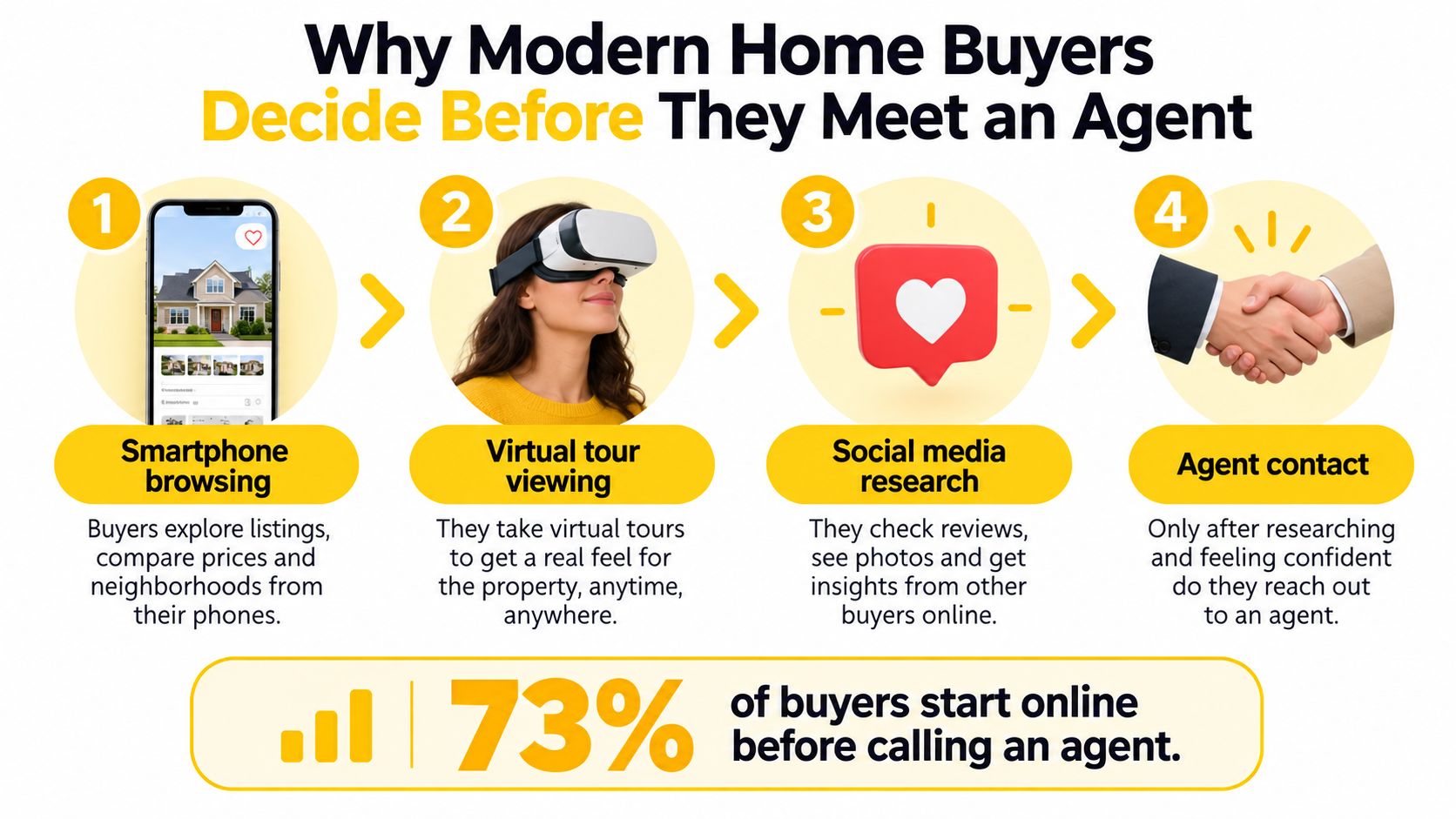
A listing that cannot answer those questions in a few seconds on mobile tends to generate curiosity instead of intent. It may still get views, but views do not route to qualified appointments unless the lead response is fast and the information is clear enough to support the next step.
Agencies sit at the point where media production, distribution, and measurement meet. The work is not only making assets, it is shaping them so they hold up under the way buyers search, compare, save, and share.
The online search is the front door. In the NAR digital download, the 2025 NAR Profile of Home Buyers and Sellers says 52% of buyers found the home they purchased online and 70% used a mobile or tablet device during the search. The same report says the buyer journey lasted a median of 10 weeks, buyers viewed seven homes, and two were viewed online only.
That changes the job an agency is really being hired to do. It is not just marketing, it is helping shape early decision-making before an agent ever gets the call.
What the buyer sees first
The first impression usually happens on a small screen, often in the middle of a quick swipe through competing listings. The marketing has to explain appearance, layout, features, and location before there is any conversation.A listing that cannot answer those questions in a few seconds on mobile tends to generate curiosity instead of intent. It may still get views, but views do not route to qualified appointments unless the lead response is fast and the information is clear enough to support the next step.
Agencies sit at the point where media production, distribution, and measurement meet. The work is not only making assets, it is shaping them so they hold up under the way buyers search, compare, save, and share.
What a Real Estate Marketing Agency Actually Does
A good real estate marketing agency treats a listing like a system, not a one-off post. The work usually combines listing distribution, search visibility, mobile-first creative, social media, lead generation, and digital follow-up, because each part affects whether a prospect becomes a qualified inquiry.
The practical output is usually more than a logo on a video. One property can become a horizontal listing video, a vertical social clip, a mobile landing page, a feed version for paid placements, and a follow-up asset for the agent's CRM. That matters because buyers value different content types differently, and presentation has to stay accurate while it's adapted across formats.
The strongest agencies also build the local discovery layer. If you need help optimise Google Business Profile property, for example, that's part of the broader visibility work, not a separate vanity task. Search, maps, listings, and social all reinforce each other when they're handled as one campaign.
The useful test is simple. Does the campaign help the buyer understand the home quickly, and does it help the agent get a real response quickly? If the answer is no, the campaign is probably optimized for appearance instead of outcomes.
A lot of agencies still over-index on content volume. The better ones tie creative production to inquiry quality, response speed, and handoff discipline, which is where the money is.
The practical output is usually more than a logo on a video. One property can become a horizontal listing video, a vertical social clip, a mobile landing page, a feed version for paid placements, and a follow-up asset for the agent's CRM. That matters because buyers value different content types differently, and presentation has to stay accurate while it's adapted across formats.
The strongest agencies also build the local discovery layer. If you need help optimise Google Business Profile property, for example, that's part of the broader visibility work, not a separate vanity task. Search, maps, listings, and social all reinforce each other when they're handled as one campaign.
The workflow behind the deliverables
Source materials usually start with photos, floor plans, property notes, branding, and the listing copy. The agency then turns those inputs into platform-specific assets, because what works in an MLS environment doesn't always work in a Reel or a YouTube Short.The useful test is simple. Does the campaign help the buyer understand the home quickly, and does it help the agent get a real response quickly? If the answer is no, the campaign is probably optimized for appearance instead of outcomes.
A lot of agencies still over-index on content volume. The better ones tie creative production to inquiry quality, response speed, and handoff discipline, which is where the money is.
Service Packages, Video Production, and Listing Tours Explained
A typical agency package starts with the listing campaign itself, then adds media formats around it. Some teams handle strategy, copy, and distribution in-house, while production is handled by a specialist partner or a platform that turns supplied photos into motion assets. That split is normal, and it's often cheaper than forcing one team to do everything badly.
For teams looking at photo-to-video workflows, this photo-to-video maker overview is useful because it shows how stills can become a listing tour without rebuilding the whole campaign from scratch. That matters when the goal is to scale listing output without turning every home into a custom production project.
The key isn't “video versus photos,” it's how the formats work together. Buyers still value listing photos and detailed property information highly in online search, while virtual tours and video add motion, sequencing, and platform fit. In other words, the video should support the listing, not replace the listing logic.
What usually sits inside a package
At the higher end, an agency may deliver listing strategy, branded templates, social cutdowns, ad-ready exports, posting calendars, and lead handoff support. At the narrower end, it may only provide the video or the editing layer, then hand the rest to the brokerage team.For teams looking at photo-to-video workflows, this photo-to-video maker overview is useful because it shows how stills can become a listing tour without rebuilding the whole campaign from scratch. That matters when the goal is to scale listing output without turning every home into a custom production project.
The key isn't “video versus photos,” it's how the formats work together. Buyers still value listing photos and detailed property information highly in online search, while virtual tours and video add motion, sequencing, and platform fit. In other words, the video should support the listing, not replace the listing logic.
A clean package keeps the core facts intact, then re-casts them into the right format for the right channel.The best proposals specify aspect ratios, revision rules, delivery timing, and what happens after the first render. If those details are vague, the hidden cost usually shows up later as rework, delays, or extra fees.
How Real Estate Marketing Agencies Price Their Work
Pricing usually comes down to scope, control, and distribution. A production-only vendor is different from a full-service agency, and a retainer is different from per-listing billing, so comparing proposals line by line is more useful than comparing the sticker price.
What changes the price most is usually not the number of pretty visuals. It's the number of versions, review cycles, team seats, distribution tasks, and whether the agency owns the lead-routing process too. If an agency is also handling the handoff, the work becomes operational, not just creative.
For a deeper look at what usually drives spend, this real estate video cost guide is a practical reference point. It helps separate what you're paying for, editing time, format complexity, and campaign support, from what you're not.
| Agency Pricing Models Compared | Typical scope | Best for |
|---|---|---|
| Retainer | Ongoing strategy, production, posting, and follow-up support | Brokerages with steady listing flow and repeating needs |
| Per-listing | Media created for one property or campaign | Agents who want clear costs tied to a single listing |
| Production-only | Video editing, formatting, and exports without distribution | Teams with in-house marketing and lead handling |
| Hybrid | Strategy plus selected production or channel support | Agencies and teams that want flexibility without full in-house staffing |
For a deeper look at what usually drives spend, this real estate video cost guide is a practical reference point. It helps separate what you're paying for, editing time, format complexity, and campaign support, from what you're not.
Where surprise costs hide
Extra re-renders, rush work, additional seats, and custom landing-page changes are common sources of friction. A proposal can look affordable until the team starts asking for the versions you need.Watch the scope, not the slogan. A cheaper package that can't deliver the right format for the right channel often becomes the more expensive option.Agencies that stay honest about revision limits and export formats usually save everyone time. The ones that don't tend to monetize confusion.
How to Evaluate a Real Estate Marketing Agency
The easiest agency to admire isn't always the easiest agency to run. A polished portfolio can hide weak workflow discipline, especially when the campaign needs approvals, disclosures, and fast lead handling.
If you're comparing options, start with the operating questions. Does the agency show MLS-safe workflows? Can it produce multiple aspect ratios without turning every re-edit into a separate project? Can it route inquiries fast enough that the lead doesn't cool off before someone answers?
For a useful benchmark on how agents think about channels and execution, this agency marketing resource is worth reviewing alongside any proposal. The point isn't to admire content, it's to verify whether the system underneath the content is usable.
The key question is whether the agency can connect the creative layer to the operational layer. If they can't show that bridge, they're selling motion, not marketing.
If you're comparing options, start with the operating questions. Does the agency show MLS-safe workflows? Can it produce multiple aspect ratios without turning every re-edit into a separate project? Can it route inquiries fast enough that the lead doesn't cool off before someone answers?
For a useful benchmark on how agents think about channels and execution, this agency marketing resource is worth reviewing alongside any proposal. The point isn't to admire content, it's to verify whether the system underneath the content is usable.
What to ask before you sign
- Ask for workflow proof. Request examples of approval steps, file handling, and how source photos become finished assets.
- Ask about disclosure habits. Find out how they handle AI edits, voiceovers, altered visuals, and client sign-off.
- Ask for measurement design. Look for reporting that connects content to leads, appointments, and CRM outcomes.
- Ask about response timing. See whether the agency supports immediate routing or only hands off a file after publishing.
The key question is whether the agency can connect the creative layer to the operational layer. If they can't show that bridge, they're selling motion, not marketing.
When to Hire an Agency Versus Using In-House Teams or DIY Tools
Not every listing needs a full external team. A smaller property with a short sales cycle and simple visuals may be fine with an in-house marketer or a self-serve tool, especially if the brokerage already has a clean process for posting, follow-up, and reporting.
But once the campaign has more moving parts, the agency starts earning its keep. That includes multi-platform distribution, compliance concerns, brand consistency across several listings, and lead routing that can't rely on a single busy agent remembering to check messages.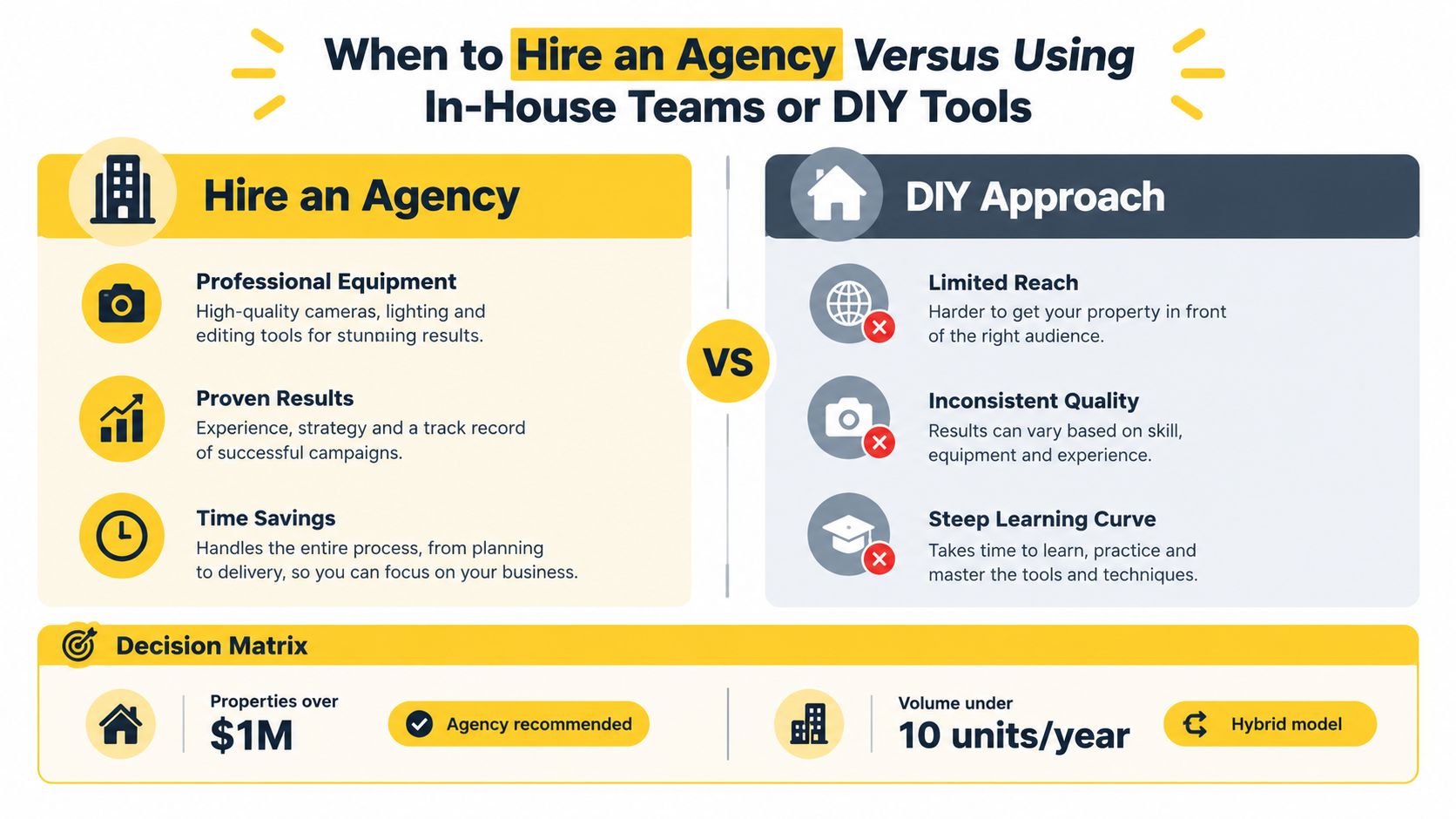
For teams comparing structure, this full-service agency breakdown is a helpful way to think about the trade-offs between control and coverage. It's especially relevant when you're deciding whether the bottleneck is production, compliance, or follow-up.
Use this rough filter:
That's why the right comparison is not agency versus DIY in the abstract. It's qualified inquiries, viewing completion, booked appointments, production friction, and the time it takes to turn a listing into a response.
But once the campaign has more moving parts, the agency starts earning its keep. That includes multi-platform distribution, compliance concerns, brand consistency across several listings, and lead routing that can't rely on a single busy agent remembering to check messages.
Choosing the right operating model
The clearest reason to hire out is risk. The North Carolina Real Estate Commission warned in December 2025 that information entered into AI systems may be retained and used for model improvement, and it recommended discussing AI use with clients, getting permission for protected information, checking ad accuracy, and maintaining procedures for compliance and retention (NCREC guidance). That makes agency governance matter just as much as creative speed.For teams comparing structure, this full-service agency breakdown is a helpful way to think about the trade-offs between control and coverage. It's especially relevant when you're deciding whether the bottleneck is production, compliance, or follow-up.
Use this rough filter:
- Hire an agency when the listing is high-stakes, the media needs multiple variants, or the lead handoff has to be immediate and trackable.
- Use in-house when the brand is stable, the team is small, and someone already owns distribution and response.
- Use DIY tools when the workload is light, the visual needs are basic, and the risk of a misstep is low.
What not to optimize for
Don't choose the model that creates the most posts. Choose the model that gets the cleanest inquiry flow. A video that gets attention but produces poor leads is a marketing cost, not a marketing asset.That's why the right comparison is not agency versus DIY in the abstract. It's qualified inquiries, viewing completion, booked appointments, production friction, and the time it takes to turn a listing into a response.
How to Decide What Your Listings Really Need
Start with the listing, not the trend. If the property is complex, compliance-sensitive, or time-sensitive, a real estate marketing agency is usually the safer choice because it can combine media production, routing, and measurement without leaving the agent to stitch everything together.
If the campaign is simple, the team is already organized, and the response workflow is tight, an in-house or hybrid setup can work. The warning sign is familiar, lots of visible activity, very little appointment quality, and no clear path from the first view to the first response.
A solid proposal should answer three things clearly, what gets made, how it gets distributed, and how leads get handled. If one of those is missing, the campaign will probably look busier than it is.
VideoTour.ai turns listing photos into ready-to-share video tours with motion, captions, music, branding, and MLS-safe options, so agencies and in-house teams can produce multi-format assets without rebuilding every campaign from scratch. If you're trying to connect faster creative output with a cleaner lead handoff, visit VideoTour.ai and see how it fits into your listing workflow.
If the campaign is simple, the team is already organized, and the response workflow is tight, an in-house or hybrid setup can work. The warning sign is familiar, lots of visible activity, very little appointment quality, and no clear path from the first view to the first response.
A solid proposal should answer three things clearly, what gets made, how it gets distributed, and how leads get handled. If one of those is missing, the campaign will probably look busier than it is.
VideoTour.ai turns listing photos into ready-to-share video tours with motion, captions, music, branding, and MLS-safe options, so agencies and in-house teams can produce multi-format assets without rebuilding every campaign from scratch. If you're trying to connect faster creative output with a cleaner lead handoff, visit VideoTour.ai and see how it fits into your listing workflow.