
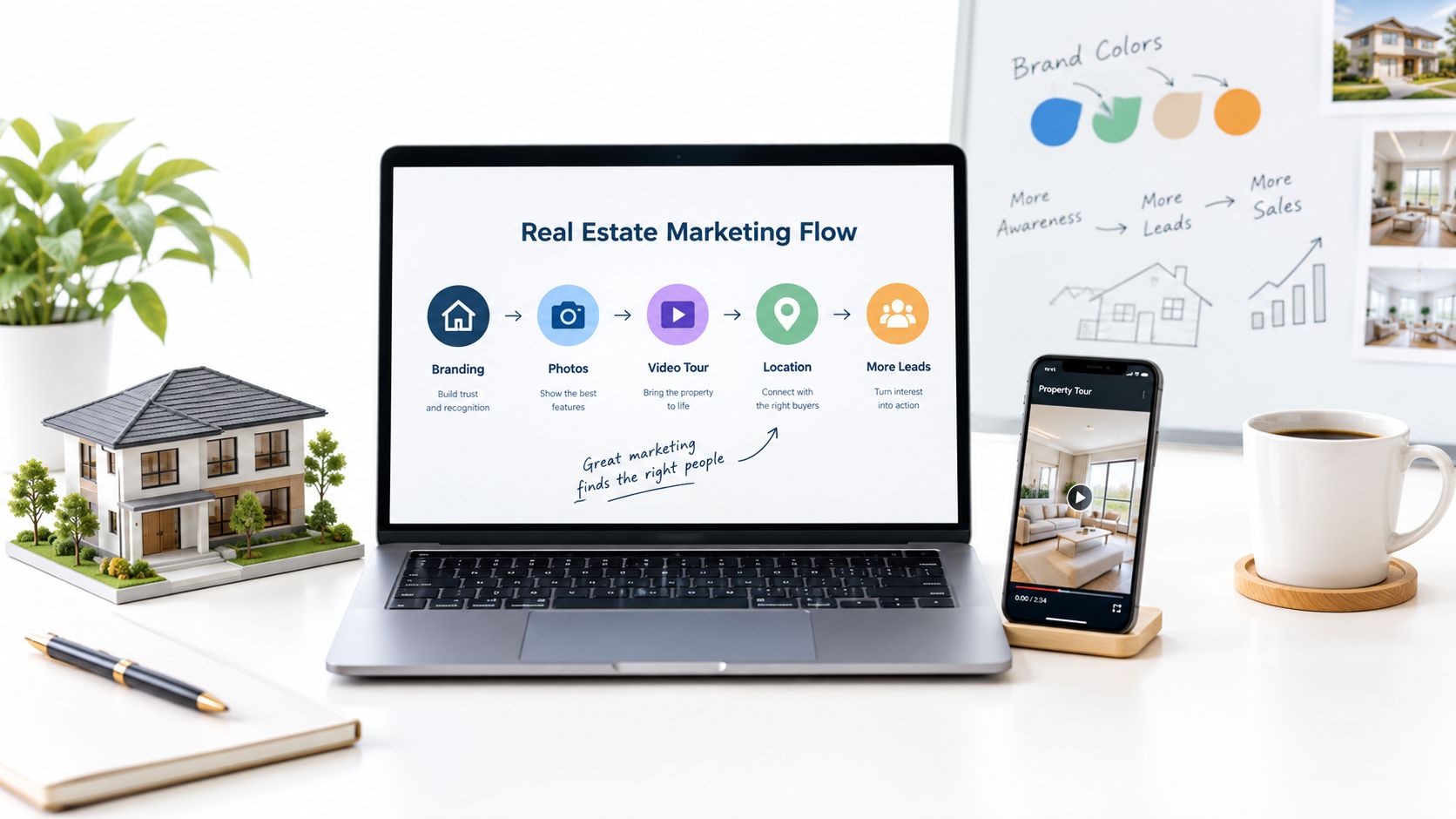
Listings with video receive 403% more inquiries and homes with video tours sell up to 31% faster according to National Association of Realtors figures. That matters because real estate agent marketing isn't really about posting more, it's about building visible trust in the places buyers already search, then using video to make the listing worth clicking in the first place.
Summary
Create an AI Video Tours from PhotosTry it For Free
Why Video and Local Search Replace Generic Posting
A new agent often starts with the wrong instinct. They post a new listing, share a sign photo, boost a few updates, and wait for the phone to ring. That approach used to work better when less of the market was online, but today it mostly creates noise.
The sharper move is to treat video and local search as two connected systems. Video earns attention because it shows layout, flow, and condition in a way photos can't. Local search earns intent because it catches the buyer who is already looking for a neighborhood, a school zone, or an agent nearby. The data supports the split, with listings that include video drawing far more inquiries and homes with video tours moving faster, while 73% of homeowners are more likely to list with an agent who uses video, according to industry reporting that cites NAR figures (REX Theme).
The sharper move is to treat video and local search as two connected systems. Video earns attention because it shows layout, flow, and condition in a way photos can't. Local search earns intent because it catches the buyer who is already looking for a neighborhood, a school zone, or an agent nearby. The data supports the split, with listings that include video drawing far more inquiries and homes with video tours moving faster, while 73% of homeowners are more likely to list with an agent who uses video, according to industry reporting that cites NAR figures (REX Theme).
Generic posting misses the real job
The mistake is thinking every post has the same job. A reel can introduce you. A neighborhood page can rank for a local query. A listing tour can turn a casual scroller into a showing request.Practical rule: if a piece of content can't be found again later, it's not doing enough work for your business.That's why checklist marketing fails. It confuses activity with distribution. Real estate agent marketing gets stronger when every asset has a clear role, one for discovery, one for trust, and one for conversion. When those roles are separated, you stop depending on luck and start building repeatable lead flow.
Building a Real Estate Brand That Attracts Sellers
Branding in this business isn't about picking a nicer logo. It's about whether a seller feels safe letting you represent their largest asset. That feeling comes from repetition, clarity, and proof that you know the market you serve.
Second, they notice visual consistency. Your thumbnails, cover images, captions, and listing graphics should look like they came from the same person. Repetition builds recognition, and recognition lowers friction when someone sees your name again in search, social, or email.
Third, they look for predictable proof. That doesn't mean bragging. It means showing neighborhood familiarity, process, and results in a way that feels calm and repeatable. A seller doesn't need fireworks. They need evidence that you can bring a listing to market without chaos.
A strong brand also shortens the selling conversation. When your posts, site, and listing materials all carry the same tone, you look established before the first call. That matters because sellers are not only choosing an agent, they're choosing the level of risk they're willing to live with.
Three signals sellers notice fast
First, sellers look for a clear market position. If your bio sounds like every other agent in town, you disappear into the crowd. A stronger line says who you help, where you work, and what kind of problem you solve.Second, they notice visual consistency. Your thumbnails, cover images, captions, and listing graphics should look like they came from the same person. Repetition builds recognition, and recognition lowers friction when someone sees your name again in search, social, or email.
Third, they look for predictable proof. That doesn't mean bragging. It means showing neighborhood familiarity, process, and results in a way that feels calm and repeatable. A seller doesn't need fireworks. They need evidence that you can bring a listing to market without chaos.
A strong brand also shortens the selling conversation. When your posts, site, and listing materials all carry the same tone, you look established before the first call. That matters because sellers are not only choosing an agent, they're choosing the level of risk they're willing to live with.
A simple positioning test
Ask whether your current public presence answers these three questions without extra explanation:- Who do you help? First-time sellers, move-up buyers, downsizers, investors, or one tight local niche.
- Where do you work? One neighborhood, one city, or a specific set of nearby markets.
- Why you? A process, a specialty, or a local perspective that other agents don't communicate as clearly.
Turning Photo Sets Into MLS-Ready Video Tours
Most agents don't need a production crew. They need a workflow that turns the photos they already have into something people genuinely watch. That is the key advantage, because a listing shoot can become a video tour, a social clip set, and a searchable property asset without starting over each time.
The value isn't just speed. It's reuse. A single listing can be turned into an MLS-safe version, a vertical social cut, and a shareable HD export without rebuilding the asset from scratch. That's the kind of workflow that fits a solo agent who's managing showings, calls, and paperwork at the same time.
For a practical workflow example, the internal guide on how agents turn listing photos into video tours is useful because it shows how the asset moves from upload to distribution without extra technical overhead.
After the first render, don't overthink perfection. Look for a clean opening, readable on-screen text, and a pace that doesn't drag. Then export the versions you need and move on to the next listing.
Start with the listing shoot, not the edit
A clean photo set is your raw material. Upload the images, order them by the natural walk-through of the property, and let the edit build motion, captions, and pacing around that sequence. VideoTour.ai is one option that turns listing photos into HD video tours with automated editing, music, captions, and branding, and it supports up to 60 photos per listing with preview and re-render options built in.The value isn't just speed. It's reuse. A single listing can be turned into an MLS-safe version, a vertical social cut, and a shareable HD export without rebuilding the asset from scratch. That's the kind of workflow that fits a solo agent who's managing showings, calls, and paperwork at the same time.
For a practical workflow example, the internal guide on how agents turn listing photos into video tours is useful because it shows how the asset moves from upload to distribution without extra technical overhead.
Treat the edit like a distribution decision
The biggest win is not prettier footage, it's derivatives. One property tour can become multiple versions for different channels, and the same underlying photos still do the work. If you want a broader content system, Crowbert's audit transform schedule content is a useful repurposing reference, because the logic is the same, one source asset feeding many outputs.After the first render, don't overthink perfection. Look for a clean opening, readable on-screen text, and a pace that doesn't drag. Then export the versions you need and move on to the next listing.
The best listing video is the one you can reuse five times without redoing the work.That's the standard. Not cinematic excess, just enough motion and structure to make the property easy to understand fast.
Matching Video Formats to Platform Behavior
Posting the same horizontal tour everywhere is a waste of good footage. Each platform rewards a different rhythm, and the format has to fit the feed or the clip loses reach before the message gets a chance to land.
The table above matters because the same source footage can serve all five uses if you plan for them early. A long hallway shot might work inside a horizontal walkthrough, while the same footage gets cropped and trimmed for a vertical teaser. That's not extra creativity, it's smarter asset planning.
Your captions should stay consistent in tone, and your thumbnail style should still look like your brand. But the edit itself should respect the channel. If you keep forcing one version into every feed, the platform does the filtering for you, and not in your favor.
Compare the platforms before you export
The clearest benchmark in real estate social content shows TikTok at 4.2% engagement and Instagram at 1.85% for real estate, which suggests that short-form video performs best when it matches the platform's native behavior (Dash Social benchmark). That doesn't mean TikTok is always the answer. It means orientation, pacing, and hook style matter more than treating every clip like a universal asset.| Platform | Preferred Orientation | Audience Intent Signal | Adjustment Priority |
|---|---|---|---|
| TikTok | Vertical | Fast discovery and broad reach | Strong first seconds, tight cuts |
| Instagram Reels | Vertical | Lifestyle and brand familiarity | Clean captions, polished cover frame |
| YouTube Shorts | Vertical | Discovery with search adjacency | Clear title text, simple pacing |
| YouTube long form | Horizontal | Deeper property review | Slower walkthrough, fuller context |
| Feed ads | Square or vertical | Retargeting and direct response | Strong CTA and readable framing |
Adjust the cut, not the message
Keep the core message stable. Change the packaging. A teaser for a new listing might open with the best room, while a neighborhood clip might start with the street, the park, or the exterior shot that signals location immediately.Your captions should stay consistent in tone, and your thumbnail style should still look like your brand. But the edit itself should respect the channel. If you keep forcing one version into every feed, the platform does the filtering for you, and not in your favor.
Winning Local Search Beyond Social Media
A lot of agents overbuild their social presence and underbuild their discoverability. That's a problem because many buyers don't begin with a scroll, they begin with a search. They type what they want, where they want it, and who they think might know the area.
That's why the question isn't whether to post more. The better question is how to make your local market easier to find. Recent industry commentary makes the same point, and the practical version is simple, short-form video alone is not enough when high-intent buyers are searching for a specific area or an agent nearby. A useful companion read is local marketing strategies for 2026, because local visibility depends on more than social habits.
The same logic applies to video SEO. A listing tour can be published with a search-friendly title, embedded on a property page, and supported by a local article that gives the video a place to rank again. The internal guide on real estate video SEO benefits is worth reviewing because it connects the video asset to discoverability instead of treating it like a one-off post.
Search intent beats posting volume
The strongest local lead flow often comes from the boring assets other agents ignore. Google Business Profile, neighborhood pages, service-area content, and hyperlocal landing pages give your name a place to rank when someone is already close to action. Social clips still matter, but they're better at creating familiarity than replacing search.That's why the question isn't whether to post more. The better question is how to make your local market easier to find. Recent industry commentary makes the same point, and the practical version is simple, short-form video alone is not enough when high-intent buyers are searching for a specific area or an agent nearby. A useful companion read is local marketing strategies for 2026, because local visibility depends on more than social habits.
Build assets that can be found twice
A neighborhood page should do more than name the area. It should answer the practical questions buyers ask, like commute, lifestyle, and the kinds of homes they'll find there. A Google Business Profile should not sit idle. It should show service areas, recent photos, and clear signals that you work locally.The same logic applies to video SEO. A listing tour can be published with a search-friendly title, embedded on a property page, and supported by a local article that gives the video a place to rank again. The internal guide on real estate video SEO benefits is worth reviewing because it connects the video asset to discoverability instead of treating it like a one-off post.
Local search wins when the buyer already knows what they want but hasn't chosen who to trust yet.That's the genuine opening. You're not competing against other agents only. You're competing against ambiguity, and searchable local content reduces that faster than another generic listing post ever will.
Creating Content That Builds Trust Across Buyer Ages
The audience is split, and smart marketing respects that split. Recent NAR-linked reporting notes that first-time buyers fell to 21% and the median buyer age rose to 59 (Taylor Scher SEO). At the same time, 51% of millennials are more likely to hire an agent with a social media presence (Pew Research Center), which means your content has to reassure one group and signal modern relevance to another.
A practical weekly rhythm for a solo agent is simple. Publish one listing or neighborhood video, one educational post, one local search asset, and one trust-building piece such as a client story or a market explanation. Volume matters less than repetition with intent.
The safer path is content that answers real concerns. How buying works. What happens at inspection. How a listing gets marketed. What the neighborhood is really like. Build around those questions, and the content starts to feel useful instead of performative. Use video as the engine, then pair it with local search assets so casual scrollers and high-intent buyers both have a way to find you.
Different buyers need different proof
Younger buyers want proof that you are active, visible, and easy to reach. Older buyers want clarity, calm, and confidence that you will not waste their time. One tone cannot carry both audiences well.A practical weekly rhythm for a solo agent is simple. Publish one listing or neighborhood video, one educational post, one local search asset, and one trust-building piece such as a client story or a market explanation. Volume matters less than repetition with intent.
Practical rule: educational content works harder than hype when buyers are cautious.Lead with useful answers. Explain the process, reduce uncertainty, and describe the market in plain language. A polished clip still helps, but it should support the answer, not replace it.
Keep the message steady
Authenticity matters more than trend chasing. If a reel feels forced, experienced buyers notice. If a market update sounds like it was written for someone else's audience, younger buyers tune out.The safer path is content that answers real concerns. How buying works. What happens at inspection. How a listing gets marketed. What the neighborhood is really like. Build around those questions, and the content starts to feel useful instead of performative. Use video as the engine, then pair it with local search assets so casual scrollers and high-intent buyers both have a way to find you.
Social Media Workflows for Busy Agents
You don't need a massive content team to stay visible. You need a process that fits between appointments, not one that competes with your calendar. Agents lose momentum when every post requires a fresh creative decision.
That workflow matters more than flashy editing. The best systems reduce the number of times you have to start from zero. If you're comparing tools or process ideas, the Expressify AI customer response guide is a helpful example of how fast response systems keep work moving when multiple people need to review something.
The goal is simple. Keep the pipeline visible, keep the edits moving, and leave your energy for the part of the business only you can do, meeting clients and closing deals.
Batch once, distribute many times
Start by batching the inputs. Upload the photos, generate the first video draft, and save the variants you know you'll use, vertical for social, horizontal for property pages, and a clean version for MLS-safe distribution. If the platform supports quick re-renders and email delivery of finished assets, use that to keep feedback loops short.That workflow matters more than flashy editing. The best systems reduce the number of times you have to start from zero. If you're comparing tools or process ideas, the Expressify AI customer response guide is a helpful example of how fast response systems keep work moving when multiple people need to review something.
Keep approval simple
Most delays come from indecision, not production. A solid workflow gives you a preview, a place to request changes, and a final render that doesn't require a second round of manual cleanup. The more you standardize the order of operations, the easier it is to stay consistent across listings.- Batch the photos: Shoot and upload once, then build multiple cuts from the same set.
- Preview before publish: Catch pacing or caption issues before you waste time posting the wrong version.
- Reuse the asset: Turn the same listing into a social clip, a listing page element, and a follow-up email visual.
The goal is simple. Keep the pipeline visible, keep the edits moving, and leave your energy for the part of the business only you can do, meeting clients and closing deals.
FAQs About Real Estate Agent Marketing
How many photos do I need for a good video tour? Enough to cover the home in a natural sequence, room to room, without making the tour feel choppy. A complete set usually works better than a few standout shots because buyers want flow, not just highlights.
Does MLS compliance require special formatting? In many cases, yes, so use MLS-safe presets when you plan to publish the video alongside the listing. That keeps the asset useful across both social and property channels without extra cleanup.
What if a seller wants revisions? Build revision time into the process and keep the feedback specific. “Make it shorter,” helps less than “open with the kitchen and remove the last hallway shot.”
Should I treat this as a test or a system? A test asks whether video helps. A system assumes it does and focuses on making production repeatable. The second approach is the one that compounds.
If you want a simpler way to turn listing photos into marketing assets, VideoTour.ai can turn property images into ready-to-share video tours without manual editing. It's a practical fit for agents who need video, social cutdowns, and MLS-friendly outputs without building a production workflow from scratch.
Does MLS compliance require special formatting? In many cases, yes, so use MLS-safe presets when you plan to publish the video alongside the listing. That keeps the asset useful across both social and property channels without extra cleanup.
What if a seller wants revisions? Build revision time into the process and keep the feedback specific. “Make it shorter,” helps less than “open with the kitchen and remove the last hallway shot.”
Should I treat this as a test or a system? A test asks whether video helps. A system assumes it does and focuses on making production repeatable. The second approach is the one that compounds.
If you want a simpler way to turn listing photos into marketing assets, VideoTour.ai can turn property images into ready-to-share video tours without manual editing. It's a practical fit for agents who need video, social cutdowns, and MLS-friendly outputs without building a production workflow from scratch.