
You're probably living this already. A new listing goes live, the photos look polished, you post them to social media, and then the feed moves on. A few likes trickle in, but the people you want, buyers, sellers, renters, and referral partners, keep scrolling because static galleries don't fit how people discover homes now.
That gap is why real estate social media marketing has stopped being a side task and become part of the core workflow. One independent 2026 roundup citing National Association of Realtors survey data says 82% of real estate businesses use social media for marketing, with 87% of agents using Facebook, 62% using Instagram, 48% using LinkedIn, and 25% using YouTube. The same source says social media is the top source of high-quality leads for 46% of real estate agents real estate social media statistics.
That shift changes the job. You're not just “posting a listing.” You're building a repeatable, video-first listing system that can move one property from photos to motion, from motion to attention, and from attention to inquiry. If you want a deeper baseline on the format shift itself, this guide works well alongside real estate video marketing statistics.
A useful way to think about it is simple. Social platforms are where your market discovers you, checks your credibility, and decides whether your next post deserves a tap, a save, or a message. If your current workflow still treats every listing like a one-off graphic, you're fighting the medium instead of using it.
That gap is why real estate social media marketing has stopped being a side task and become part of the core workflow. One independent 2026 roundup citing National Association of Realtors survey data says 82% of real estate businesses use social media for marketing, with 87% of agents using Facebook, 62% using Instagram, 48% using LinkedIn, and 25% using YouTube. The same source says social media is the top source of high-quality leads for 46% of real estate agents real estate social media statistics.
That shift changes the job. You're not just “posting a listing.” You're building a repeatable, video-first listing system that can move one property from photos to motion, from motion to attention, and from attention to inquiry. If you want a deeper baseline on the format shift itself, this guide works well alongside real estate video marketing statistics.
A useful way to think about it is simple. Social platforms are where your market discovers you, checks your credibility, and decides whether your next post deserves a tap, a save, or a message. If your current workflow still treats every listing like a one-off graphic, you're fighting the medium instead of using it.
Summary
Create an AI Video Tours from PhotosTry it For Free
Introduction Why Social Media Now Drives Real Estate Discovery
A buyer often meets a listing in a feed before they ever visit an open house. They pause on a short clip, a neighborhood walkthrough, or a quick caption about a new home, then keep scrolling until something feels worth a second look. That is why inbound marketing for real estate fits so well here, because it matches how people search, compare, and learn before they reach out.
Most agents still create content as if they were building print ads. They start with photos, shrink them into a square post, and expect the caption to carry the rest. Social platforms do the opposite, they reward posts that hold attention, earn shares, and bring people back, so a photo-only workflow often looks active while reaching too few people.
Treat social media as a distribution system for the property story, the neighborhood story, and your brand story. Once that idea clicks, the next decisions get easier. Platform choice becomes a question of audience intent. Content choice becomes a question of format fit. Measurement becomes a question of whether the system produces conversations, not just impressions.
Busy agents do not need more theory. They need a workflow that turns existing listing assets into short, branded videos fast enough to keep up with the market. Photo-to-video automation helps close that gap, so the same listing can move from stills to motion without forcing every post to start from scratch. When that system is in place, social becomes a steady source of visibility, credibility, and inquiries between closings.
Most agents still create content as if they were building print ads. They start with photos, shrink them into a square post, and expect the caption to carry the rest. Social platforms do the opposite, they reward posts that hold attention, earn shares, and bring people back, so a photo-only workflow often looks active while reaching too few people.
Practical rule: if a listing can be shown as motion, it usually deserves motion first.The format mismatch is the problem. Social media now works like a video-first listing system, where a still image is often the raw material and short video is the finished product people stop for. That is why real estate video marketing statistics matter in this conversation, they help show why motion keeps outpacing static posts in attention-heavy feeds.
Treat social media as a distribution system for the property story, the neighborhood story, and your brand story. Once that idea clicks, the next decisions get easier. Platform choice becomes a question of audience intent. Content choice becomes a question of format fit. Measurement becomes a question of whether the system produces conversations, not just impressions.
Busy agents do not need more theory. They need a workflow that turns existing listing assets into short, branded videos fast enough to keep up with the market. Photo-to-video automation helps close that gap, so the same listing can move from stills to motion without forcing every post to start from scratch. When that system is in place, social becomes a steady source of visibility, credibility, and inquiries between closings.
How Real Estate Social Media Marketing Actually Works
 A useful mental model is to think of social platforms as 24/7 digital open houses. Your post shows up in a feed, someone pauses for a few seconds, and the platform reads that pause as a signal that the content is worth showing to more people. That's why the best social posts aren't just attractive, they're built to earn watch time, shares, saves, and comments.
From attention to inquiry
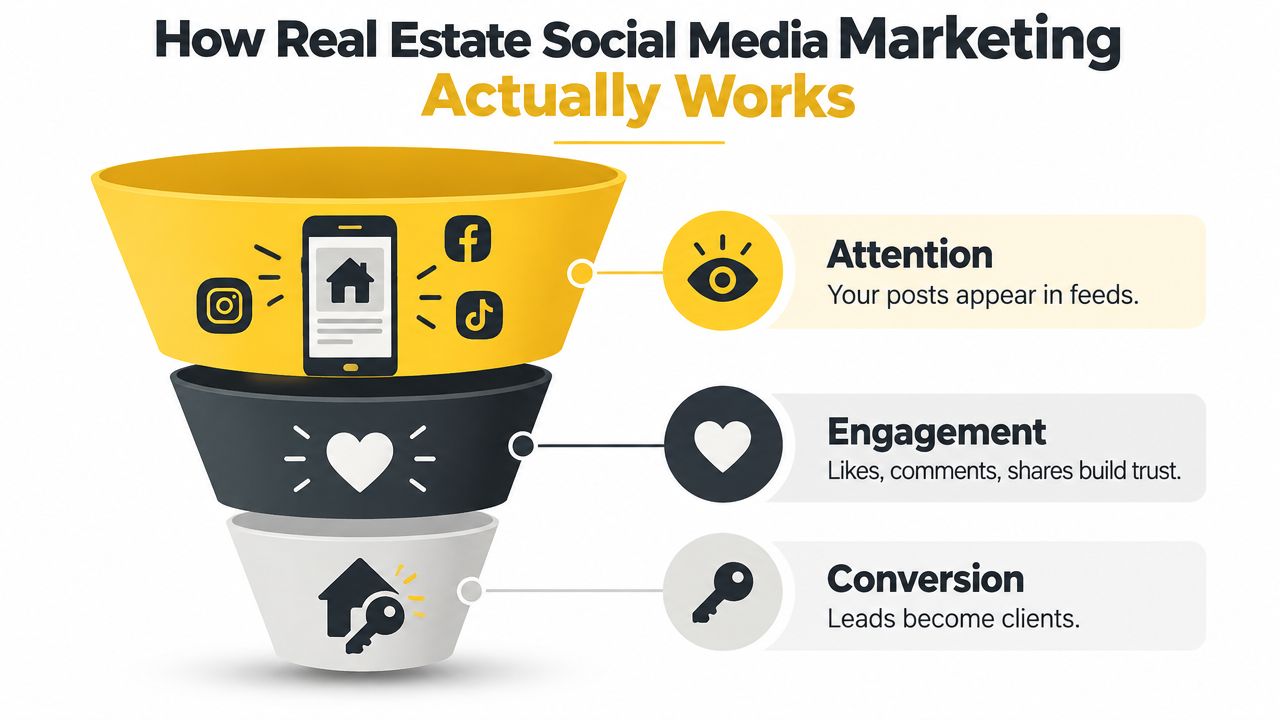
At the top of the funnel, people notice the post. The hook, thumbnail, first frame, or opening line does that work. In the middle, they engage because the listing feels relevant, useful, or easy to watch. At the bottom, they take action, often by sending a message, clicking through, or asking for details.The important part is that each step needs a different kind of content support. A listing teaser can create attention. A neighborhood clip can create trust. A clear call to action can create inquiry. If any one of those steps is missing, the post may still look good, but it won't move a buyer forward.
Organic reach, paid amplification, and community
Organic content is your day-to-day visibility engine. It's the posts, Stories, Reels, and short videos that show up because people already follow you, share you, or discover you through platform distribution. Paid amplification is the boost you give to a post when you want to push it to a tighter audience. Community building is the long game, where people start recognizing your style, your voice, and your local knowledge.Social works best when you stop asking, “Did this post go viral?” and start asking, “Did this post create the next conversation?”That distinction matters because social media for real estate is not one activity, it's a system. You need the post, the response path, and the follow-up. A strong feed without a way to capture interest is just public decoration. A strong capture path without interesting content won't get enough attention to matter.
The infographic above is useful because it keeps the sequence visible. Attention comes first. Engagement builds trust. Conversion happens when the content and the next step are both clear. Once you see the process that way, the rest of the strategy becomes more intuitive and much easier to manage.
Choosing the Right Platforms for Your Listings and Brand
The right platform depends on what you're trying to do with a listing. Facebook still matters for local community visibility and older buyer groups, Instagram fits polished property visuals and short-form discovery, TikTok rewards quick hooks and personality, YouTube works for longer tours and search-friendly property stories, and LinkedIn supports professional credibility and referral relationships. The platforms aren't interchangeable, because each one rewards a slightly different kind of attention.
The simplest way to narrow the field is to match the format to the job. If you have a visually strong home and want fast discovery, Instagram and TikTok are natural starting points. If the property needs a fuller explanation, YouTube gives you more room. If you're trying to stay visible with lenders, attorneys, investors, or business owners, LinkedIn earns its place.
If time is limited, start with two channels, not five. One should be your main discovery platform, usually Instagram or TikTok. The other should support credibility or local retention, often Facebook or YouTube. That approach keeps your workload realistic and helps you build a cleaner rhythm.
One useful outside reference on audience growth for Instagram is Sup Growth for real estate agents, especially if you're trying to understand how agents think about reach on that platform. The key takeaway is not to chase every channel. It's to pick the mix that fits your listings, your time, and your buyer behavior.
The simplest way to narrow the field is to match the format to the job. If you have a visually strong home and want fast discovery, Instagram and TikTok are natural starting points. If the property needs a fuller explanation, YouTube gives you more room. If you're trying to stay visible with lenders, attorneys, investors, or business owners, LinkedIn earns its place.
| Platform Fit for Real Estate Content | Platform | Best For | Ideal Format | Engagement Signal |
|---|---|---|---|---|
| Platform Fit for Real Estate Content | Community visibility and local trust | Short video, albums, groups | Comments and local shares | |
| Platform Fit for Real Estate Content | Polished listings and brand feel | Reels, Stories, carousels | Saves, shares, replies | |
| Platform Fit for Real Estate Content | TikTok | Discovery and personality | Vertical short video | Watch time and shares |
| Platform Fit for Real Estate Content | YouTube | Tours and evergreen property storytelling | Longer video and Shorts | Retention and search views |
| Platform Fit for Real Estate Content | Referrals and professional relationships | Short updates and thoughtful video | Profile visits and message replies |
Decision rule: choose the platform where your target clients already consume video, then repurpose outward from there.For many agents, the fastest win comes from producing one vertical video, then adapting it for other surfaces. That means the same property story can become a Reel, a Story sequence, and a YouTube Short without rebuilding everything from scratch. If you want a simple creation path, this internal guide on how to create a Reel for Instagram is a practical companion.
One useful outside reference on audience growth for Instagram is Sup Growth for real estate agents, especially if you're trying to understand how agents think about reach on that platform. The key takeaway is not to chase every channel. It's to pick the mix that fits your listings, your time, and your buyer behavior.
Content That Performs From Video Tours to Reels and Stories
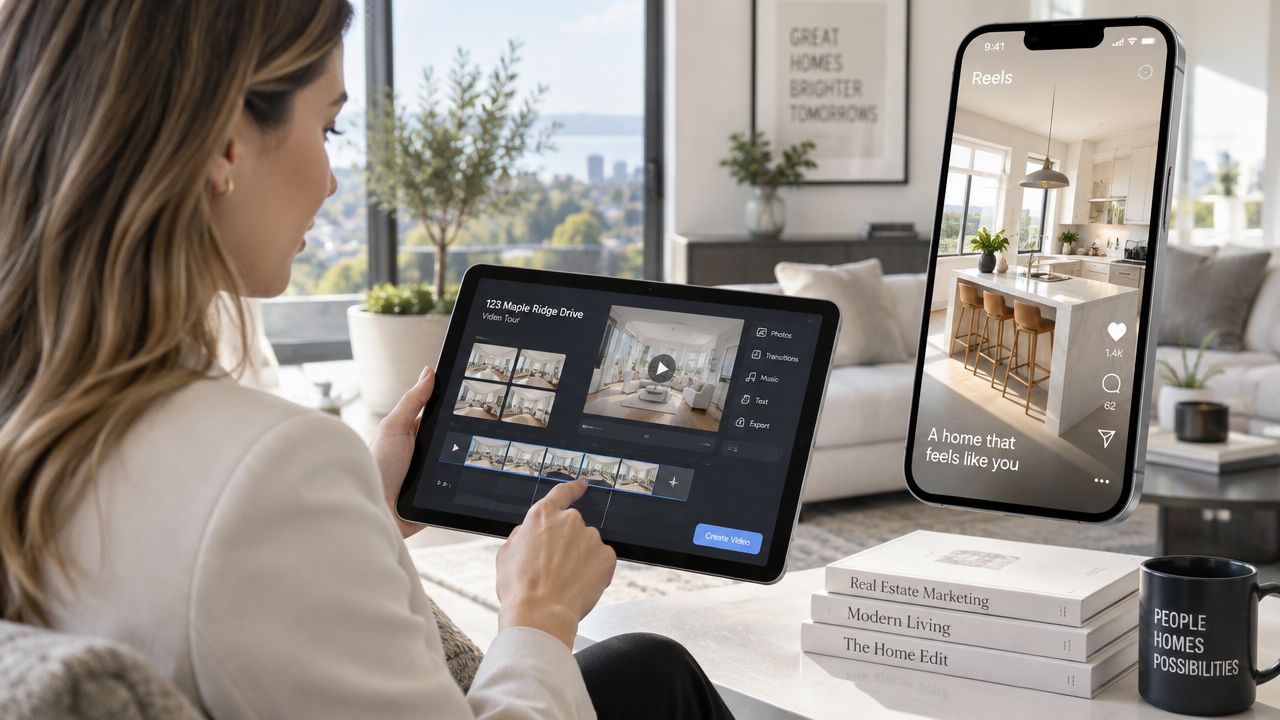 Static photos still matter, but they work best as the raw material for motion. A listing with strong images can become a video tour, a Reel, a Story, or a branded update without starting from zero. That fixes the format mismatch that keeps many agents stuck with quiet photo posts in a feed that rewards movement.
Start with the listing tour.
Upload the property photos, place them in a natural order, and shape a short walkthrough that feels like a guided showing. Keep the opening quick, the scenes focused, and the captions easy to read.
A simple sequence works well, front exterior, key interior spaces, standout features, then the closing call to action. The goal is clarity, not a full inventory of every detail. If you want a bank of prompts for what to feature, the internal guide on 15 short real estate video ideas is a useful place to start.
From there, the same tour can be reshaped for other formats.
Reels fit fast listing highlights, neighborhood snippets, and short market commentary. Stories work for behind-the-scenes moments, open house reminders, and light engagement prompts. Talking avatar videos can carry agent messaging when you want a steady delivery without re-recording yourself each time. For teams that run paid promotion, a short form video strategy for paid ads helps keep the message tight enough for quick attention spans.
Why do these formats work? Motion gives people a reason to stop. Captions help when sound is off. Music and timing make the post feel native to the platform. That combination usually beats a static carousel when the goal is discovery.
Content rule: one listing should create more than one post, because one asset should get multiple chances to be seen.Build repeatable post types.
A steady calendar does not depend on inspiration. It depends on categories you can reuse each week.
- Just listed: show the home, the strongest feature, and the opening hook.
- Just sold: use the result as social proof and keep the tone grounded.
- Neighborhood spotlight: highlight nearby places, streets, or lifestyle context.
- Behind the scenes: show staging, prep, photography day, or open house setup.
For more content prompts, the internal guide on short real estate video ideas can help you fill a weekly calendar without reinventing each post.
Scheduling Publishing and Automating Your Workflow
A lot of agents don't have a content problem, they have a production problem. The photos exist, the post idea exists, but every stage between “upload” and “published” takes too long. That's where a repeatable workflow saves more time than any one-off hack.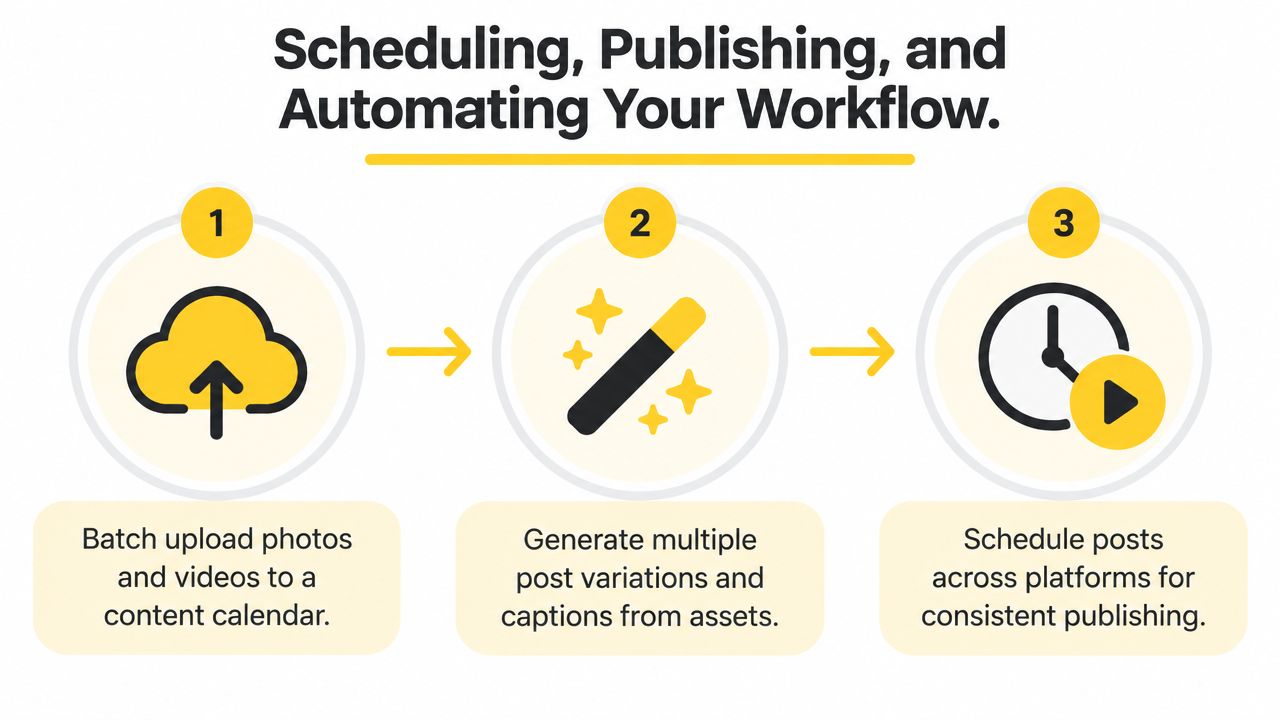
The value here is not only speed. It's consistency. When the same listing package produces multiple versions from the same source material, your branding stays tighter and your approval loop gets much shorter. You're not waiting on a designer to rebuild the post from scratch every time a caption changes.
Email notifications on render help too. They let you move on to the next listing while the current one finishes. Instead of babysitting the editor, you're managing a queue.
Batch, preview, publish
Start by batching your assets. Upload the listing photos, pick the strongest sequence, and generate the main video formats you need in one sitting. That usually means a vertical version for short-form social, plus any other aspect ratio you need for wider use.The value here is not only speed. It's consistency. When the same listing package produces multiple versions from the same source material, your branding stays tighter and your approval loop gets much shorter. You're not waiting on a designer to rebuild the post from scratch every time a caption changes.
Use revisions to tighten the final version
Slow feedback is one of the biggest reasons agents delay posting. A good workflow lets you preview in the browser, tweak the script or image order, and re-render without starting over. That matters when a seller wants one photo changed or a logo moved before the post goes out.Email notifications on render help too. They let you move on to the next listing while the current one finishes. Instead of babysitting the editor, you're managing a queue.
Build a weekly rhythm
Here's a simple operating pattern that works for solo agents and teams alike.- Monday: gather new listing photos and decide which post types each property should produce.
- Tuesday: batch the main video tours and social cuts.
- Wednesday: preview, revise, and lock in captions and branding.
- Thursday: schedule posts and Stories across the chosen platforms.
- Friday: check what rendered, what was published, and what still needs follow-up.
Operational habit: automate the repeatable parts first, then spend your time on the parts that need judgment.That's how social media marketing for real estate becomes sustainable. The goal isn't to make posting invisible. The goal is to remove the friction that causes inconsistency. Once the workflow is stable, the calendar feels less like a scramble and more like a system.
Measuring What Matters and Turning Views Into Leads
The easiest numbers to chase are usually the least useful. Likes feel good, but they don't tell you whether a buyer cared enough to watch, save, share, or ask for details. For real estate, the better question is whether the post created demand and moved someone closer to a conversation.
A 2026 benchmark report notes that real estate brand accounts average about 0.3% Instagram engagement, while TikTok is around 3.1% and roughly 75 shares per post real estate benchmark reporting. That gap matters because it shows how much platform fit shapes performance. Short-form video and shareable formats tend to travel farther than static feed-first posts in this category.
Then connect those signals to the business outcome. Did the post generate inquiries? Did those inquiries become scheduled showings? Did the follow-up path make it easy for the lead to keep moving? That's the measurement loop.
A separate benchmark report puts social media conversion near 1.0% overall, with paid social around 1.3% and organic social around 0.9%, while broader real estate lead conversion often sits in the 0.4% to 1.2% range real estate marketing statistics. The point isn't to worship a percentage. It's to remember that social is stronger for demand creation than for direct close rates.
That approach keeps your analysis tied to business reality. You're not chasing vanity. You're checking whether your video-first system is producing qualified attention that can turn into appointments.
A 2026 benchmark report notes that real estate brand accounts average about 0.3% Instagram engagement, while TikTok is around 3.1% and roughly 75 shares per post real estate benchmark reporting. That gap matters because it shows how much platform fit shapes performance. Short-form video and shareable formats tend to travel farther than static feed-first posts in this category.
Read the right signals together
Treat each metric like part of a chain. Watch time tells you whether the hook worked. Shares and saves tell you whether the content felt worth keeping or sending. Click-throughs tell you whether the call to action was clear enough to act on.Then connect those signals to the business outcome. Did the post generate inquiries? Did those inquiries become scheduled showings? Did the follow-up path make it easy for the lead to keep moving? That's the measurement loop.
A separate benchmark report puts social media conversion near 1.0% overall, with paid social around 1.3% and organic social around 0.9%, while broader real estate lead conversion often sits in the 0.4% to 1.2% range real estate marketing statistics. The point isn't to worship a percentage. It's to remember that social is stronger for demand creation than for direct close rates.
Use the post to feed the follow-up system
The strongest workflow pairs a short video tour with a clear CTA layer, then sends interested viewers to a landing page or direct inquiry path. After that, retargeting helps keep the listing in front of people who already showed interest. That's where the video stops being just content and starts functioning as a lead asset.Views are the start of the conversation, not the finish line.The practical cadence is simple. Review what happened after each post, not just during the first hour. If a hook is weak, fix the first few seconds. If the audience is wrong, adjust targeting. If clicks are fine but inquiries are thin, tighten the landing page and the next-step offer.
That approach keeps your analysis tied to business reality. You're not chasing vanity. You're checking whether your video-first system is producing qualified attention that can turn into appointments.
Putting Your Strategy Into Action This Week
A useful plan beats a perfect plan. If you want momentum, pick one listing and make it do real work across a few formats instead of trying to create a brand-new campaign from scratch. One property can become a video tour, a Reel, a Story sequence, and a follow-up post if the workflow is simple enough.
Start with a focused setup. Choose one primary platform and one secondary platform. Decide which listing gets the next video tour. Pick one reusable Reel style, one caption template, and one call to action so you're not making the same decisions every day.
A practical seven-day checklist looks like this:
VideoTour.ai helps real estate agents turn listing photos into branded video tours and social-ready reels with captions, music, motion, and multiple aspect ratios. If you want a faster way to build a video-first listing workflow, visit VideoTour.ai and see how it fits into your weekly marketing routine.
Start with a focused setup. Choose one primary platform and one secondary platform. Decide which listing gets the next video tour. Pick one reusable Reel style, one caption template, and one call to action so you're not making the same decisions every day.
A practical seven-day checklist looks like this:
- Day 1: choose the listing and the target audience.
- Day 2: gather photos and write the opening hook.
- Day 3: produce the first video version and a shorter social cut.
- Day 4: preview, revise, and confirm branding.
- Day 5: schedule the post and prepare the follow-up message.
- Day 6: monitor comments, saves, shares, and inquiries.
- Day 7: note what worked and reuse the strongest format next week.
VideoTour.ai helps real estate agents turn listing photos into branded video tours and social-ready reels with captions, music, motion, and multiple aspect ratios. If you want a faster way to build a video-first listing workflow, visit VideoTour.ai and see how it fits into your weekly marketing routine.