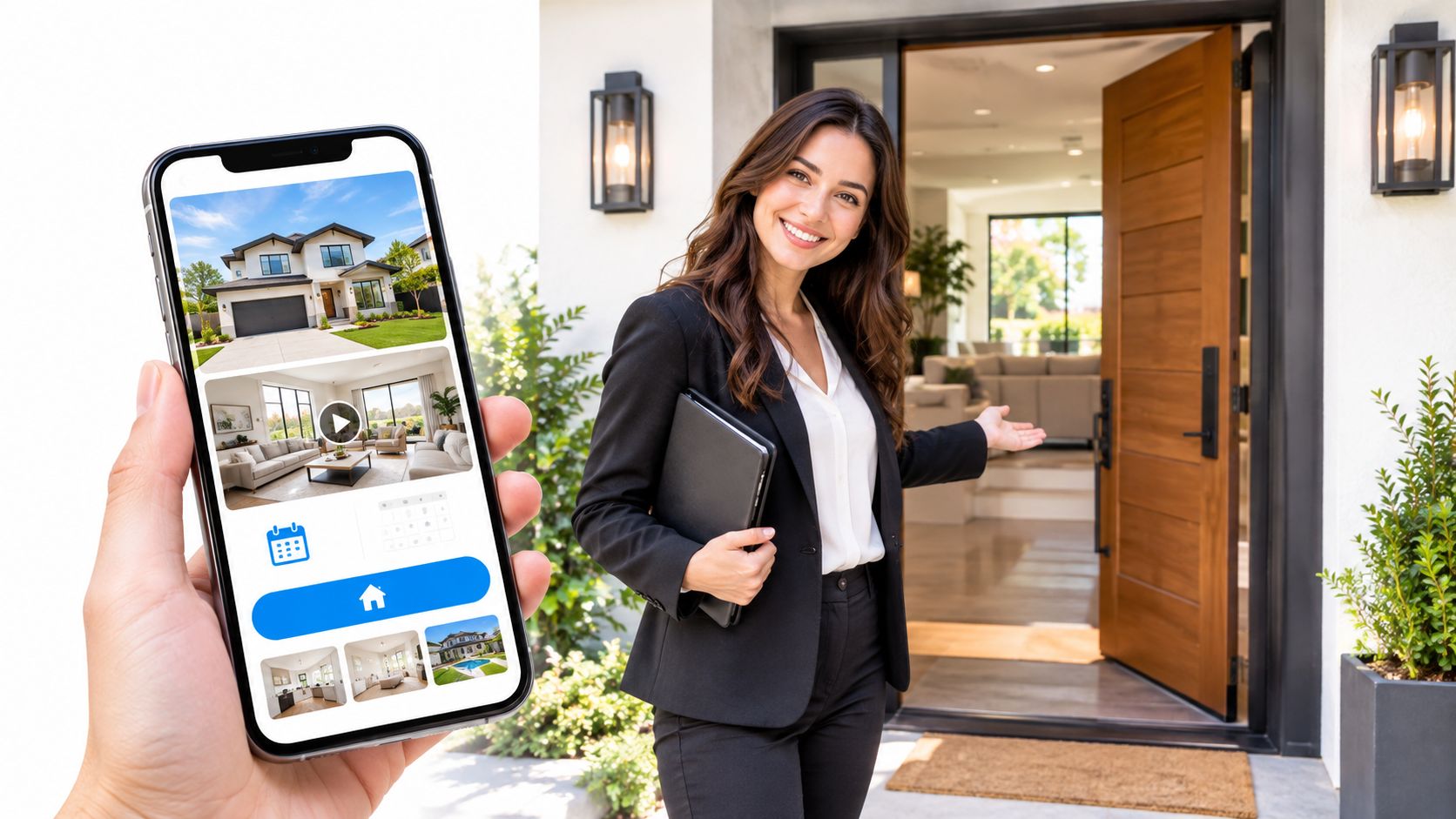
Your listing photos are ready, the seller has approved the open house, and you're about to post the familiar exterior shot with an invitation to stop by. The problem isn't the photo. It's that someone scrolling Instagram, a buyer searching Zillow, and a neighbor walking past the property need different reasons to pay attention.
A strong open house ad does more than announce a date and time. It gives a specific audience a reason to care, a clear next step, and enough visual information to make a visit feel worthwhile. Choose the channel before writing the copy, then match the message to what that person is likely to do next.
The open house ad examples below follow a property from social discovery to active search, paid promotion, personal invitations, and neighborhood traffic. Each format can use the same listing photos, adapted into a teaser or photo-based video tour without arranging another shoot.
Keep the essentials consistent: date, time, address, current price, and a property-specific reason to attend. Change the opening image, depth of information, and call to action to suit the platform. Don't ask every viewer to RSVP before they've even decided whether the home interests them.
Summary
Create an AI Video Tours from PhotosTry it For Free
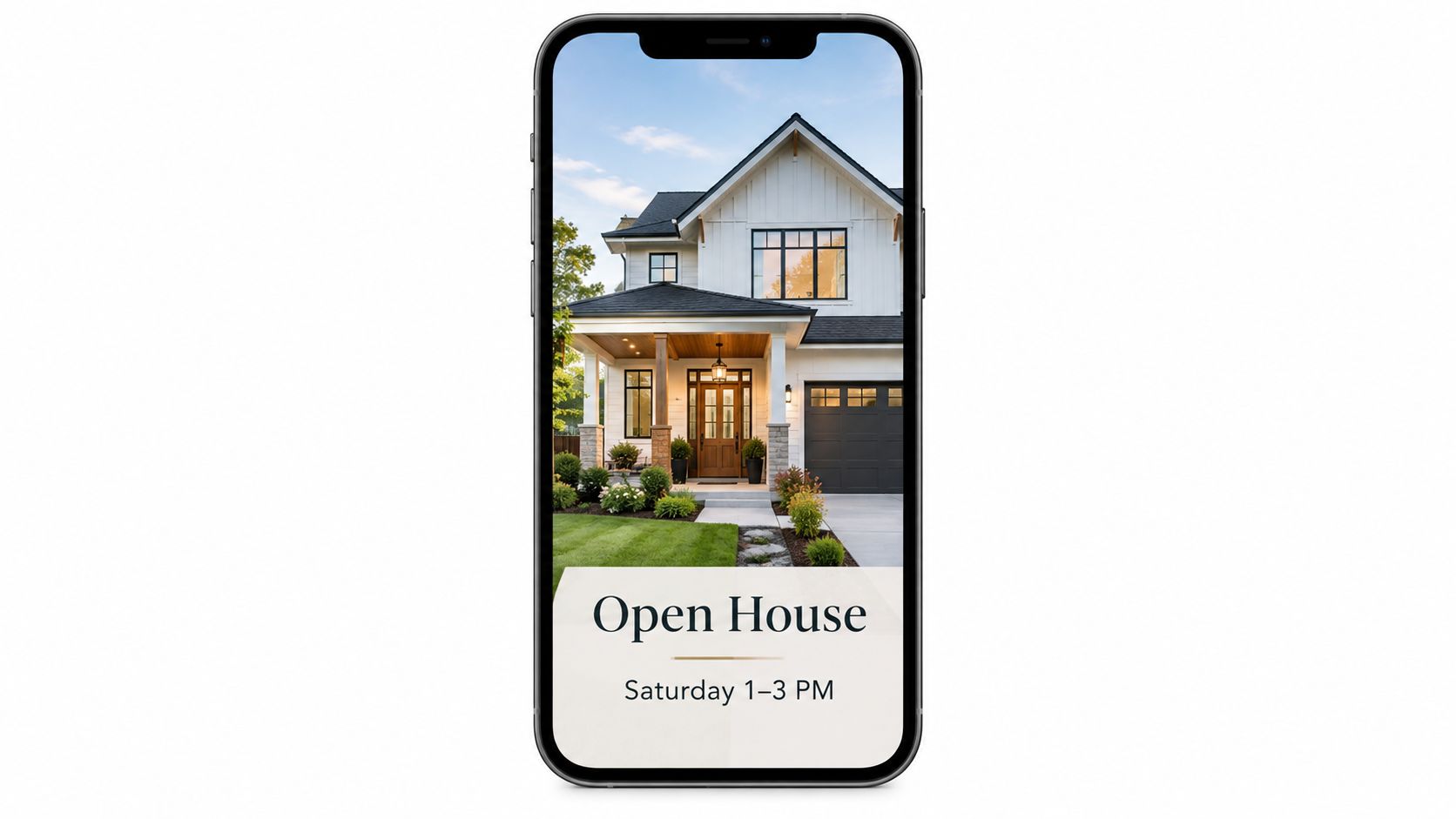 For a listing with a kitchen opening onto a patio, sample copy could read: See how the kitchen connects to the outdoor entertaining space. Open house [date], [hours], at [address]. Preview the property tour before you visit.
2. Portal Open House Listing (Zillow, Realtor.com, and MLS Open House Schedule)
A buyer browsing scheduled open houses is already evaluating where to go. On Zillow, Realtor.com, and your MLS, prioritize complete, consistent information over a clever headline.
Sample opening copy: Open house [date], [hours]. Explore the connected living and dining areas, covered patio, and separate study at [address]. View the property tour and floor plan before attending.
That emphasis on online information reflects buyer behavior: 52% of buyers found their purchased home online, according to the NAR buyer-survey findings summarized in this property-search and visual-content overview. Treat the event as part of the listing experience, not a substitute for it.
Avoid turning the description into an event poster. The property still needs a useful description after the open house ends. Keep event details easy to update, remove expired invitations promptly, and don't let a polished video obscure missing property information.
Sample opening copy: Open house [date], [hours]. Explore the connected living and dining areas, covered patio, and separate study at [address]. View the property tour and floor plan before attending.
That emphasis on online information reflects buyer behavior: 52% of buyers found their purchased home online, according to the NAR buyer-survey findings summarized in this property-search and visual-content overview. Treat the event as part of the listing experience, not a substitute for it.
Check what buyers actually see
Enter the event in the appropriate MLS fields and verify its appearance wherever the listing is distributed. Don't assume that saving an update means every destination immediately displays it correctly.- Event accuracy: Confirm the date, hours, address, and any appointment requirements.
- Visual consistency: Make sure photos, video, and floor plans describe the same current property.
- Tour compliance: Check local MLS rules for branding, contact information, links, and permitted video formats.
- Access details: Explain the entrance, parking arrangements, and any relevant showing instructions.
Avoid turning the description into an event poster. The property still needs a useful description after the open house ends. Keep event details easy to update, remove expired invitations promptly, and don't let a polished video obscure missing property information.
3. Paid Social Event Ad (Facebook and Instagram Events)
Paid social needs a clearer objective than getting more people to notice the listing. Decide whether you're seeking property-page visits or event registrations, then match the creative and destination to that action.
For initial discovery, try: Explore the covered patio, connected living spaces, and separate study at [address]. View the tour and current listing details.
For a permitted follow-up audience, change the invitation: Ready to see the layout in person? Open house [date], [hours]. Confirm your attendance and get showing details.
A developer's paid-social case study reported 571 RSVPs and 288 attendees. Those are separate outcomes, which is precisely why an RSVP shouldn't be reported as a visit.
Use the appropriate housing-ad designation and review current platform restrictions before publishing. Don't assume that a narrow audience or a suggested automated audience is compliant.
This comparison helps distinguish discovery creative from listing detail.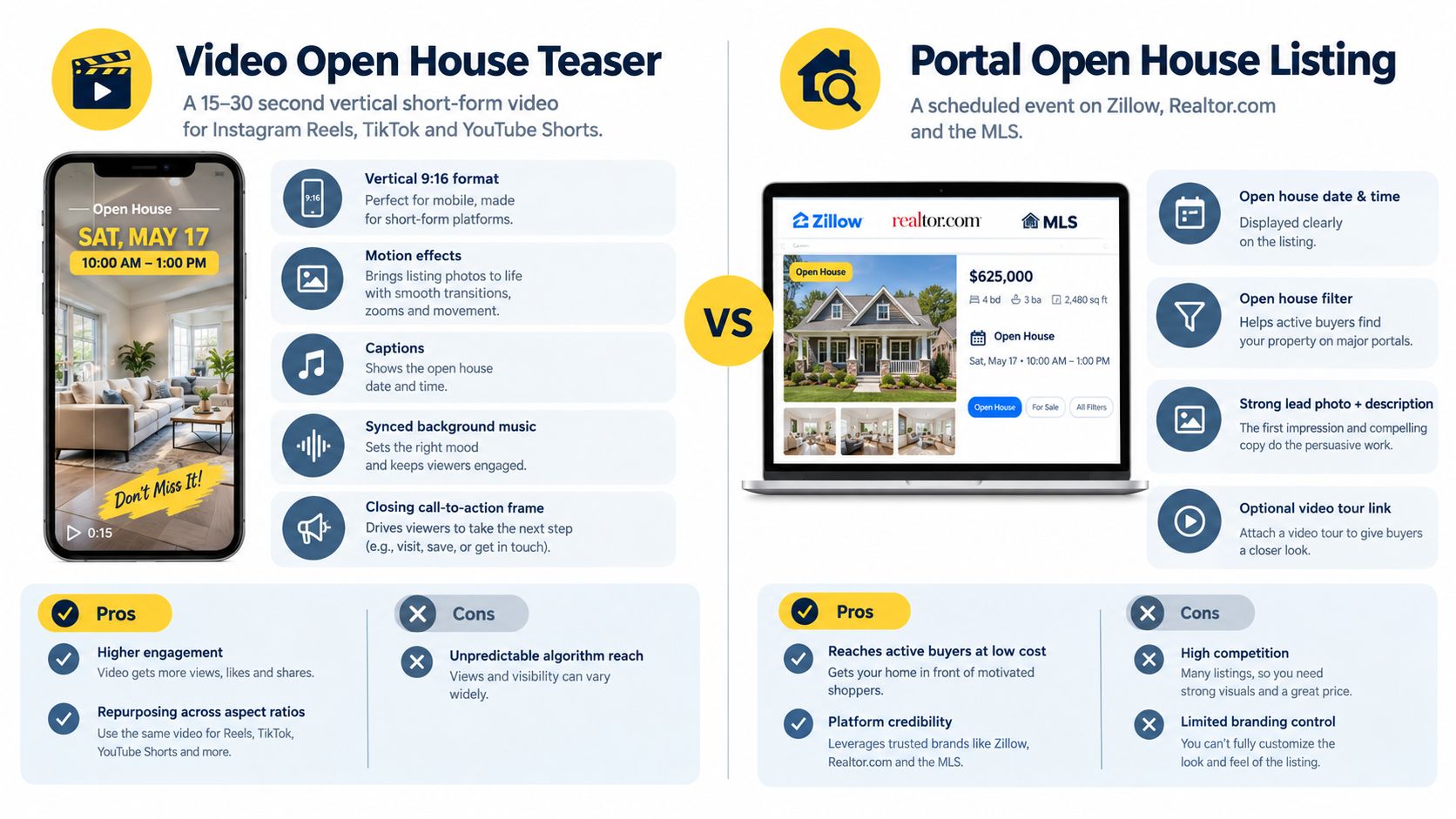 Use this guide to real estate video ads when adapting the creative. More clicks aren't automatically better if visitors can't find the event details or aren't interested in the actual property.
For initial discovery, try: Explore the covered patio, connected living spaces, and separate study at [address]. View the tour and current listing details.
For a permitted follow-up audience, change the invitation: Ready to see the layout in person? Open house [date], [hours]. Confirm your attendance and get showing details.
A developer's paid-social case study reported 571 RSVPs and 288 attendees. Those are separate outcomes, which is precisely why an RSVP shouldn't be reported as a visit.
Use property relevance, not buyer stereotypes
Housing targeting requires particular care. Federal guidance on housing advertising through digital platforms warns about audience segmentation using protected characteristics or proxies, including inferred characteristics.Use the appropriate housing-ad designation and review current platform restrictions before publishing. Don't assume that a narrow audience or a suggested automated audience is compliant.
Practical rule: Describe the property and the opportunity to view it, not the kind of person you think should live there.Use a captioned photo-based video or carousel, include verified pricing and property details, and send visitors to a matching event page. Apply retargeting only where platform rules, consent requirements, and housing obligations permit it.
This comparison helps distinguish discovery creative from listing detail.
Use this guide to real estate video ads when adapting the creative. More clicks aren't automatically better if visitors can't find the event details or aren't interested in the actual property.4. Google Business Profile Event Post
For an agent or brokerage maintaining an eligible Google Business Profile, an event post is a practical place to publish a local invitation. Use it to support discovery, but don't treat publishing as a guarantee of visibility for a particular search.
Lead with the event, not a brokerage slogan. Suggested copy: Open house at [full address], [date], [hours]. Preview the living areas and covered patio in the property tour, then visit during the scheduled showing. Find parking and entry instructions on the property page.
A brokerage handling several listings should give each event a property-specific destination. Sending every visitor to the homepage adds an unnecessary search step.
The limitation is control: you can control the accuracy of the post, not whether every nearby buyer sees it. Track visits from its destination link, and keep portal listings and direct invitations active rather than relying on local search alone.
Lead with the event, not a brokerage slogan. Suggested copy: Open house at [full address], [date], [hours]. Preview the living areas and covered patio in the property tour, then visit during the scheduled showing. Find parking and entry instructions on the property page.
A brokerage handling several listings should give each event a property-specific destination. Sending every visitor to the homepage adds an unnecessary search step.
Match the post to the destination
Use the available event fields and review the published result from a prospective visitor's perspective. If the interface or available features differ from what you expected, adapt the post rather than forcing essential details into an unsuitable field.- Image: Choose an accurate exterior or distinctive interior with a clear subject.
- Description: Include the full address, event hours, and a concrete reason to attend.
- Destination: Link to the relevant property page with the tour and showing logistics.
- Maintenance: Correct changes promptly and remove or update obsolete event information.
The limitation is control: you can control the accuracy of the post, not whether every nearby buyer sees it. Track visits from its destination link, and keep portal listings and direct invitations active rather than relying on local search alone.
5. Email and SMS Open House Invitation with Video Tour Link
Subject: Preview the patio layout before the open house
An email to an existing inquiry can be more specific than a public announcement: You asked about homes with connected indoor and outdoor living areas. This listing has a kitchen opening toward the covered patio. Preview the tour, then join us at [address] on [date], [hours], if the layout fits your search.
That connection should come from an expressed preference, not an assumption about the recipient's identity or household. Segment using relevant inquiry history, such as requested neighborhood, price range, or property features.
Use these real estate marketing email practices to refine the invitation.
An email to an existing inquiry can be more specific than a public announcement: You asked about homes with connected indoor and outdoor living areas. This listing has a kitchen opening toward the covered patio. Preview the tour, then join us at [address] on [date], [hours], if the layout fits your search.
That connection should come from an expressed preference, not an assumption about the recipient's identity or household. Segment using relevant inquiry history, such as requested neighborhood, price range, or property features.
Make replying as easy as watching
Use a clickable thumbnail that opens the property page rather than relying on embedded video playback. Keep the invitation understandable even when images don't load.- Primary action: Invite the recipient to view details and RSVP.
- Useful alternative: Let them reply with a question or request another showing.
- Reminder: Send a concise update to appropriate recipients, avoiding those who've declined or opted out.
- Calendar details: Verify that the event entry matches the current showing schedule.
Use these real estate marketing email practices to refine the invitation.
A familiar sender still needs a relevant reason to contact someone. A database entry isn't permission to send every listing.The trade-off is limited reach for greater relevance. Measure replies, attendance, and subsequent conversations, not just thumbnail clicks. The video should help recipients decide whether to visit, not merely decorate the email.
6. Printed Flyer or Yard Sign with QR Code to Video Tour
A neighbor walking past the property doesn't need your entire listing description. They need to recognize the event, understand when it happens, and find more information without struggling to read a crowded sign.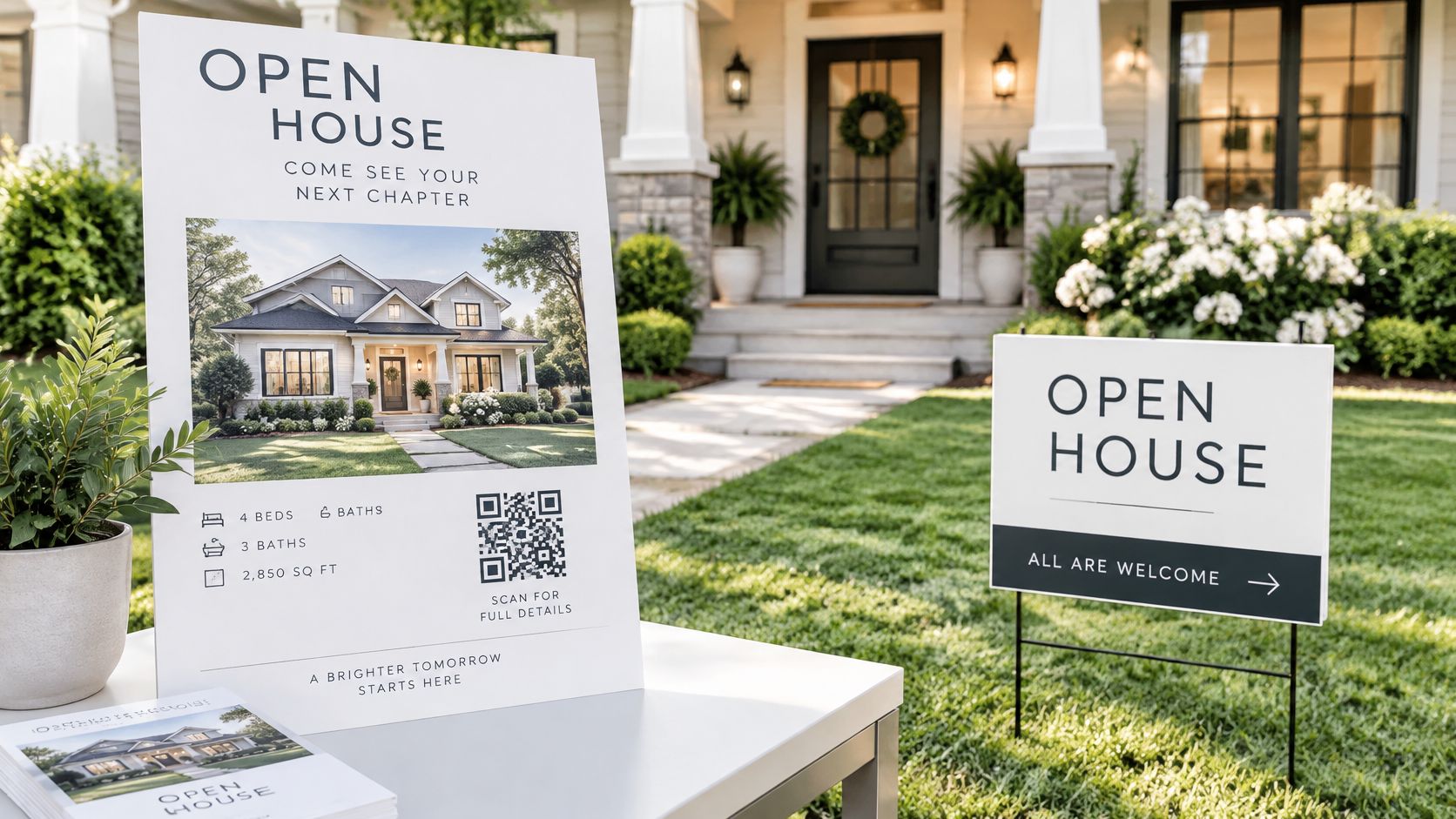 Suggested flyer copy: Open house [date], [hours]. Explore the covered patio and connected living spaces at [address]. Scan to preview the property tour and get entry details.
A historical Mountain View campaign recorded 15 of 135 visitor groups arriving through newspaper advertising or signage, as documented in this open-house marketing case-study summary. It's historical evidence, not a current benchmark, but it supports treating offline promotion as part of a broader campaign.
The QR code is optional assistance, not the invitation itself. Someone who doesn't scan should still know when to attend. Use the linked tour to add context, not to hide basic information.
Suggested flyer copy: Open house [date], [hours]. Explore the covered patio and connected living spaces at [address]. Scan to preview the property tour and get entry details.A historical Mountain View campaign recorded 15 of 135 visitor groups arriving through newspaper advertising or signage, as documented in this open-house marketing case-study summary. It's historical evidence, not a current benchmark, but it supports treating offline promotion as part of a broader campaign.
Design for the setting
A curbside sign and a hand-delivered flyer shouldn't use identical layouts. Make the event wording and hours prominent on the sign, while using the flyer for additional property information.- Scan testing: Test the printed QR code on different phones and under realistic lighting.
- Mobile destination: Open a simple page with event details, the video, and an obvious next step.
- Placement: Follow local sign rules and obtain required permissions.
- Attribution: Use a distinct tracked destination for print rather than combining every channel.
The QR code is optional assistance, not the invitation itself. Someone who doesn't scan should still know when to attend. Use the linked tour to add context, not to hide basic information.
7. Open Tour Event Ad for Commercial Spaces, Coworking, and Short-Term Rentals
Tour the workspace before choosing your next office. Explore the meeting rooms, shared kitchen, and available suites during our scheduled open tour. Preview the layout and book your visit.
That invitation suits someone evaluating a workspace. A hospitality preview needs a different message, perhaps inviting travel advisers to inspect guest accommodation and discuss booking arrangements.
Keep the scheduled-tour format, but change the decision you're helping someone make. Don't reuse residential purchase language for a coworking membership or imply that a short-term rental preview guarantees future availability.
Track the relevant next step: a leasing conversation, membership inquiry, or booking discussion. General tour attendance alone won't tell you whether the ad reached people with a genuine interest in the offering.
That invitation suits someone evaluating a workspace. A hospitality preview needs a different message, perhaps inviting travel advisers to inspect guest accommodation and discuss booking arrangements.
Keep the scheduled-tour format, but change the decision you're helping someone make. Don't reuse residential purchase language for a coworking membership or imply that a short-term rental preview guarantees future availability.
Show how the space functions
For a coworking operator, arrange the photo-based video around an arrival sequence: entrance, shared areas, workspace, meeting rooms, and amenities. For a resort preview, show the accommodation and relevant shared facilities, with captions explaining what's included.- Coworking copy: State the available workspace types, current membership information, and tour-booking process.
- Commercial copy: Clarify which space is available and direct prospects to verified leasing details.
- Hospitality copy: Identify who the preview is for and explain how to request current availability or booking terms.
Production caution: Motion can make still photographs easier to follow, but it can't prove sound levels, current occupancy, or the experience of using the space.The trade-off is operational complexity. Staff need a shared understanding of who's attending, which spaces can be shown, and who handles follow-up.
Track the relevant next step: a leasing conversation, membership inquiry, or booking discussion. General tour attendance alone won't tell you whether the ad reached people with a genuine interest in the offering.
7 Open House Ad Examples: Side-by-Side Comparison
| Marketing Method | 🔄 Implementation Complexity | ⚡ Resource Requirements | 📊 Expected Outcome | 💡 Ideal Use Case | ⭐ Key Advantage |
|---|---|---|---|---|---|
| Video Open House Teaser | Low–moderate; edit photos into a short vertical video | Existing listing photos, editing tool, social accounts | Increased video engagement; attendance is not guaranteed | Building awareness on Instagram, TikTok, or YouTube Shorts | Reuses listing photos and adapts to multiple platforms |
| Portal Open House Listing | Low once the listing is live; requires accurate MLS event details | MLS listing, lead photo, optional video tour | Reaches buyers actively searching for homes | Targeting buyers using portal or MLS open-house filters | High-intent audience with low incremental cost |
| Paid Social Event Ad | Moderate; requires ad setup, policy compliance, and optimization | Ad budget, creative, audience settings, tracking | Local reach, clicks, and RSVPs; attendance may vary | Promoting an event to nearby audiences | Geographic targeting and measurable engagement |
| Google Business Profile Event Post | Low; create and publish an event post | Business profile, photo or video, event details | Local Search and Maps visibility; dependent on profile and competition | Reaching nearby buyers through local searches | Free promotion within Google's local results |
| Email and SMS Invitation with Video Tour | Low–moderate; prepare a targeted message and follow-up | Contact list, CRM or messaging tool, video link | Responses from warm leads; trackable opens and clicks | Inviting past clients, leads, and neighborhood contacts | Direct, personalized outreach to known contacts |
| Printed Flyer or Yard Sign with QR Code | Moderate; design, print, distribute, and test the QR code | Print materials, QR landing page, placement permissions | Local foot-traffic exposure and trackable scans | Reaching neighbors and passersby | Connects physical promotion to an online video tour |
| Open Tour Event Ad for Commercial Spaces, Coworking, and Short-Term Rentals | Moderate; coordinate audience-specific creative and tour scheduling | Space video, booking or RSVP link, staff for tours | Qualified tour interest; commercial decisions may take longer | Promoting walkthroughs for offices, coworking spaces, hotels, or rentals | Shows amenities and atmosphere beyond what photos convey |
Turn One Listing Into a Connected Open House Campaign
The strongest open house ad examples don't require a completely different campaign for every platform. They require a consistent property message adapted to the visitor's immediate question: Is this interesting, does it fit my search, and how can I see it?
Choose a primary discovery channel, a trust-building asset, and a direct-response action. For a visually distinctive listing, that might mean a vertical teaser, a property page with a fuller tour, and an RSVP invitation. For a listing already receiving inquiries, accurate portal information and relevant personal follow-up may deserve attention before another paid campaign.
Use the same approved photographs and event details throughout. Change the sequence and depth: lead with a standout feature on social, explain the layout on the property page, and prioritize practical showing instructions in reminders.
Measure actions separately. Keep property-page visits, registrations, attendance, and follow-up meetings distinct so you can identify where interested prospects stop progressing. Ask attendees how they heard about the event, recognizing that someone may have encountered the listing through several channels.
You don't need to publish everywhere to run a coherent campaign. Start with the channels you can maintain accurately, use a photo-based tour to provide useful visual context, and make the next step unmistakable. Expand only when you can preserve that consistency and follow through on the inquiries you receive.
VideoTour.ai turns existing listing photos into property video tours and social Reels, with captions, music, branding, and MLS-compliant options. Visit VideoTour.ai to create a tour from your approved photos, adapt it for your chosen open house channels, and review the result before sharing.
Choose a primary discovery channel, a trust-building asset, and a direct-response action. For a visually distinctive listing, that might mean a vertical teaser, a property page with a fuller tour, and an RSVP invitation. For a listing already receiving inquiries, accurate portal information and relevant personal follow-up may deserve attention before another paid campaign.
Use the same approved photographs and event details throughout. Change the sequence and depth: lead with a standout feature on social, explain the layout on the property page, and prioritize practical showing instructions in reminders.
Check the handoff before publishing
Review the campaign as a buyer would, starting with the ad and continuing through the destination.- Property accuracy: Confirm current price, availability, features, disclosures, and event hours.
- Visual integrity: Check that motion effects haven't distorted rooms, views, or fixtures.
- Platform requirements: Review housing-ad settings, MLS rules, branding restrictions, and permissions.
- Mobile experience: Test links, playback, registration, and calendar details on a phone.
- Follow-up ownership: Decide who answers questions and records attendance and subsequent conversations.
Measure actions separately. Keep property-page visits, registrations, attendance, and follow-up meetings distinct so you can identify where interested prospects stop progressing. Ask attendees how they heard about the event, recognizing that someone may have encountered the listing through several channels.
You don't need to publish everywhere to run a coherent campaign. Start with the channels you can maintain accurately, use a photo-based tour to provide useful visual context, and make the next step unmistakable. Expand only when you can preserve that consistency and follow through on the inquiries you receive.
VideoTour.ai turns existing listing photos into property video tours and social Reels, with captions, music, branding, and MLS-compliant options. Visit VideoTour.ai to create a tour from your approved photos, adapt it for your chosen open house channels, and review the result before sharing.