
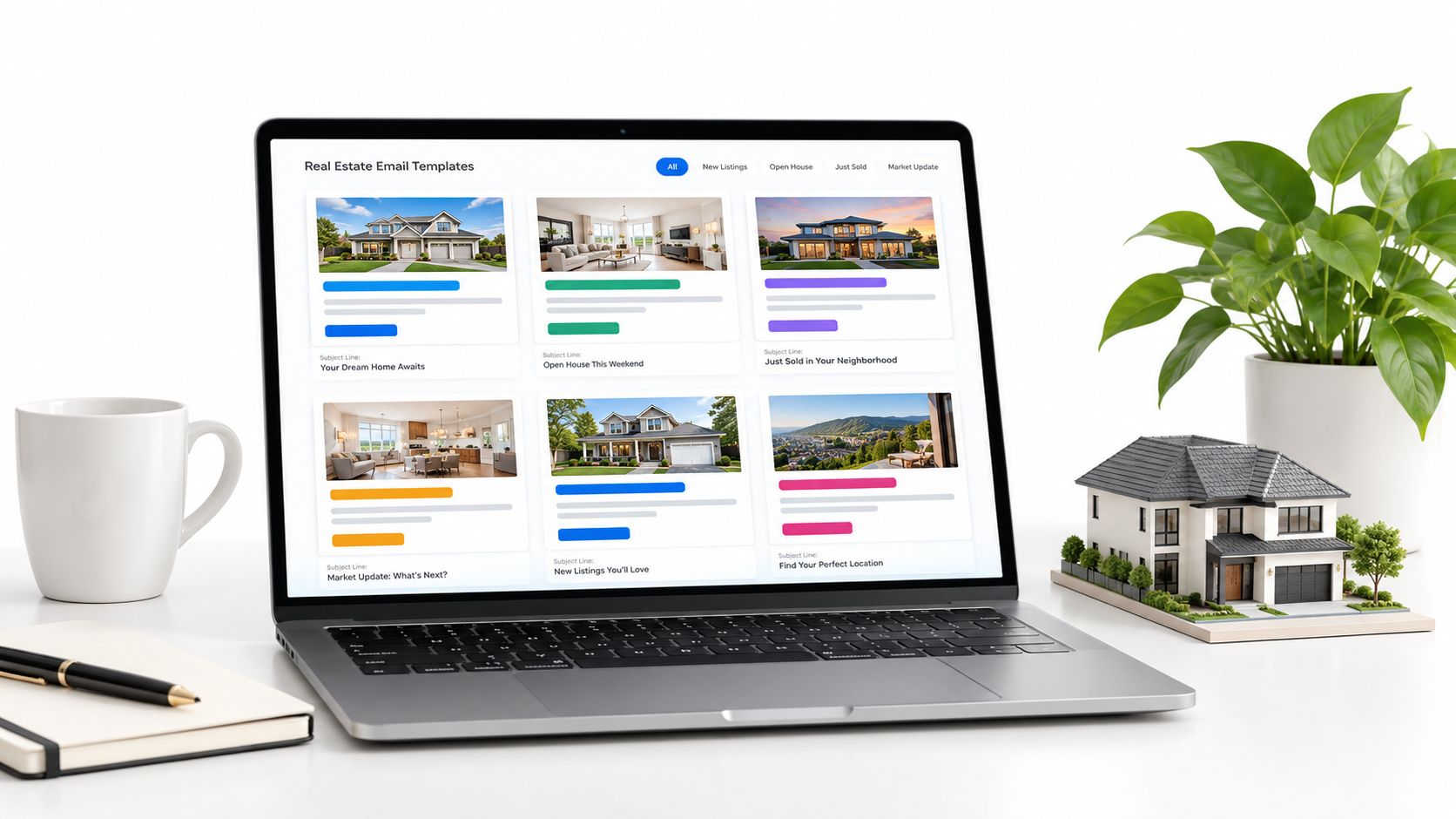
A listing email has only seconds to earn a click before it gets skipped or deleted. The property may be excellent, but a flat row of images and a vague “View Listing” button rarely gives subscribers a strong reason to act. A better real estate marketing email connects the right property or message to the right audience, then makes the next step obvious.
This roundup gives you 10 complete campaign plans for listings, open houses, nurture sequences, personal branding, and investment opportunities. Each plan includes the audience, subject line direction, CTA, timing, and a practical way to use video tours made from existing listing photos with VideoTour.ai. You don't need a camera crew or a new production process. You can turn the photos you've already collected into a branded visual asset, then link that preview to a property page, social channel, or inquiry form.
Email benchmarks vary by provider and measurement method, so don't treat one open-rate target as a universal rule. Benchmark Email's industry data reports a 30.13% average open rate for residential real estate and a 1.29% click rate, compared with 25.54% opens and 1.45% clicks across its all-industry user averages. The gap is a useful reminder: an opened email isn't the same as an interested buyer.
This roundup gives you 10 complete campaign plans for listings, open houses, nurture sequences, personal branding, and investment opportunities. Each plan includes the audience, subject line direction, CTA, timing, and a practical way to use video tours made from existing listing photos with VideoTour.ai. You don't need a camera crew or a new production process. You can turn the photos you've already collected into a branded visual asset, then link that preview to a property page, social channel, or inquiry form.
Email benchmarks vary by provider and measurement method, so don't treat one open-rate target as a universal rule. Benchmark Email's industry data reports a 30.13% average open rate for residential real estate and a 1.29% click rate, compared with 25.54% opens and 1.45% clicks across its all-industry user averages. The gap is a useful reminder: an opened email isn't the same as an interested buyer.
Summary
Create an AI Video Tours from PhotosTry it For Free
1. Video Tour Showcase Campaign
Send this campaign to active buyers, recent property-search contacts, past buyers, and local database members who have opted into listing updates. The message should feel like a curated preview, not a generic blast. Use one property per email when the home has a strong story, or a tightly selected group when the audience has broad preferences.
The subject line should lead with the reason to look now: “A new home with lake views,” “Tour this bright downtown loft,” or “Just listed in [neighborhood].” Avoid promising a full in-email video experience. Most inboxes handle video inconsistently, so use a poster image or animated thumbnail linked to a hosted tour page.
Create the tour from the listing photos with VideoTour.ai. Motion, captions, music, and consistent branding can give a static photo set a more guided sequence. Add a short text summary below the thumbnail for recipients who block images or use screen readers.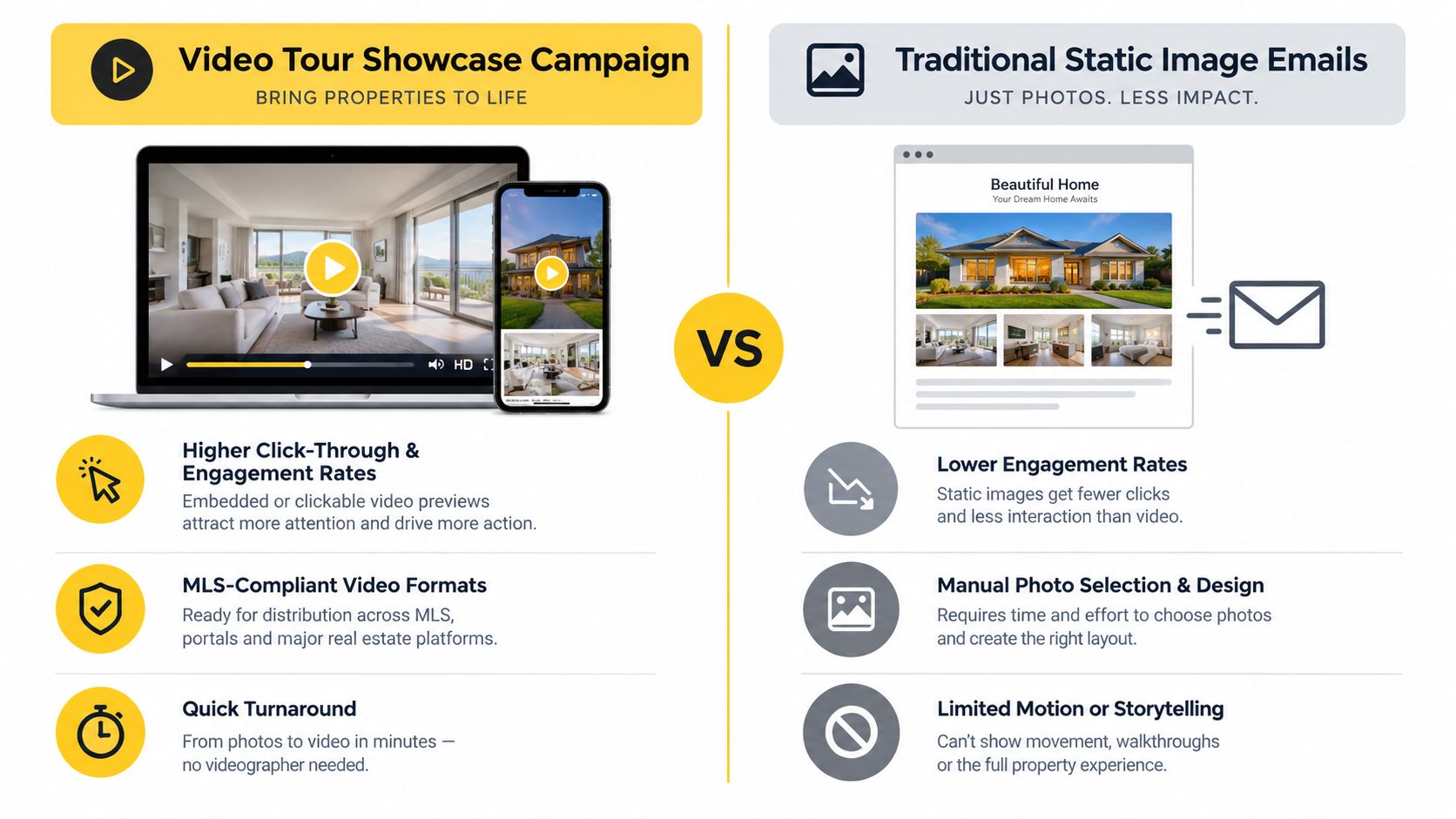
Send shortly after the listing goes live, then create a second version for a meaningful update such as a price change or scheduled open house. Track unique clicks, landing-page visits, showing requests, replies, unsubscribes, and hard bounces. A healthy open rate can't compensate for a thumbnail that earns no property-page visits.
The subject line should lead with the reason to look now: “A new home with lake views,” “Tour this bright downtown loft,” or “Just listed in [neighborhood].” Avoid promising a full in-email video experience. Most inboxes handle video inconsistently, so use a poster image or animated thumbnail linked to a hosted tour page.
Create the tour from the listing photos with VideoTour.ai. Motion, captions, music, and consistent branding can give a static photo set a more guided sequence. Add a short text summary below the thumbnail for recipients who block images or use screen readers.
Build one clear action
Use “Watch the property tour” for early interest, “Book a private showing” for high-intent contacts, or “See full property details” for a broader audience. Keep one primary CTA below the visual. Add the address, price if appropriate, key features, and a plain-text link as a fallback.Send shortly after the listing goes live, then create a second version for a meaningful update such as a price change or scheduled open house. Track unique clicks, landing-page visits, showing requests, replies, unsubscribes, and hard bounces. A healthy open rate can't compensate for a thumbnail that earns no property-page visits.
Practical rule: Treat the video as the invitation, not the destination. The landing page must load quickly, explain the property clearly, and make booking a showing easy.
3. Lifestyle and Market Update Campaign
A useful newsletter doesn't need to promote a listing in every issue. Send this campaign to past clients, homeowners, long-term prospects, local residents, and people who aren't ready to transact yet. The content can combine a neighborhood observation, a market explanation, a seasonal home tip, and one short agent message.
The subject line should promise local usefulness: “What changed in [area] this month,” “Three things homeowners should watch,” or “A quick tour of life in [neighborhood].” Your CTA might be “Reply with your question,” “Get the local report,” or “Talk through your next move.” Use one main action, then keep the rest of the email informational.
VideoTour.ai supports AI real estate lifestyle videos built around neighborhood visuals, lifestyle clips, and talking AI avatar content. The visual doesn't need to imitate a news broadcast. A short sequence of local images with captions and a clear introduction can make the update feel more personal than a dense block of market commentary.
Add a text transcript or summary below the visual. It improves accessibility and gives email clients meaningful text to preview. Keep claims tied to verified local information, and avoid loading the email with unsupported forecasts. The best version gives readers a reason to reply, such as a question about a neighborhood, a renovation decision, or a possible move.
Send monthly or every other week, depending on how much useful material you can produce. A short, reliable update is better than a long newsletter that appears only when a listing needs attention.
The subject line should promise local usefulness: “What changed in [area] this month,” “Three things homeowners should watch,” or “A quick tour of life in [neighborhood].” Your CTA might be “Reply with your question,” “Get the local report,” or “Talk through your next move.” Use one main action, then keep the rest of the email informational.
VideoTour.ai supports AI real estate lifestyle videos built around neighborhood visuals, lifestyle clips, and talking AI avatar content. The visual doesn't need to imitate a news broadcast. A short sequence of local images with captions and a clear introduction can make the update feel more personal than a dense block of market commentary.
Make the series recognizable
Use the same opening treatment, logo placement, type style, and sign-off in every issue. A recurring format helps subscribers understand what they're receiving. If you use voice cloning or an AI avatar, review the script carefully and disclose the format where needed. The message should still sound like an agent who knows the area, not an automated report.Add a text transcript or summary below the visual. It improves accessibility and gives email clients meaningful text to preview. Keep claims tied to verified local information, and avoid loading the email with unsupported forecasts. The best version gives readers a reason to reply, such as a question about a neighborhood, a renovation decision, or a possible move.
Send monthly or every other week, depending on how much useful material you can produce. A short, reliable update is better than a long newsletter that appears only when a listing needs attention.
4. Open House and Event Promotion Campaign
Open-house email has a narrow job: help the right people decide to attend. Send it to active buyers near the property, saved-search contacts, recent showing attendees, local subscribers, and agents who may have interested clients.
Start with a visual preview made from the listing photos. A short tour can show the entry, main living space, outdoor area, and one distinctive feature without forcing readers through a full property presentation. The subject line should make the event easy to understand: “Tour [address] this Saturday,” “New open house in [neighborhood],” or “See the backyard before you visit.”
The CTA is “Register for the open house,” “Get directions,” or “Request a private showing.” Put the date, time, address, parking details, and registration link in text below the thumbnail. Don't bury those details inside the video. People often scan event emails on mobile and may have images disabled.
VideoTour.ai can render a fresh property preview from the same photo collection when the event details are confirmed. Keep the design consistent across the sequence, but change the subject line and opening copy so the follow-up feels useful rather than repetitive.
Measure registrations, direction clicks, showing requests, replies, and unsubscribes. Don't judge the campaign only by opens. A smaller audience that registers or attends is more valuable than a large audience that merely views the message.
Start with a visual preview made from the listing photos. A short tour can show the entry, main living space, outdoor area, and one distinctive feature without forcing readers through a full property presentation. The subject line should make the event easy to understand: “Tour [address] this Saturday,” “New open house in [neighborhood],” or “See the backyard before you visit.”
The CTA is “Register for the open house,” “Get directions,” or “Request a private showing.” Put the date, time, address, parking details, and registration link in text below the thumbnail. Don't bury those details inside the video. People often scan event emails on mobile and may have images disabled.
Use a short sequence
The first send can introduce the property and event. A follow-up should answer practical questions, such as parking, access, or what buyers can expect. The final reminder should be concise and action-led. If the event changes, update the email and landing page immediately.VideoTour.ai can render a fresh property preview from the same photo collection when the event details are confirmed. Keep the design consistent across the sequence, but change the subject line and opening copy so the follow-up feels useful rather than repetitive.
Measure registrations, direction clicks, showing requests, replies, and unsubscribes. Don't judge the campaign only by opens. A smaller audience that registers or attends is more valuable than a large audience that merely views the message.
“The reminder should remove friction, not add more marketing.”
5. Agent Spotlight and Personal Brand Campaign
Brokerages often have strong agents whose databases don't know enough about them. Use an agent spotlight for new team introductions, referral partners, past clients, local prospects, and contacts who need a clearer reason to choose one specialist over another.
The subject line should center on the person and their relevance: “Meet the agent helping buyers in [area],” “A local expert joins our team,” or “Looking for a commercial property specialist?” The CTA can be “Email [agent],” “Book an introduction,” or “Ask a question about [specialty].”
Create a concise introduction using an AI avatar, lifestyle clips, agent photos, or a combination of these assets. The script should answer practical questions: Who does this agent help? Which locations or property types do they know? What kind of conversation can a prospect have with them? Keep credentials factual and avoid inflated claims.
A consistent script framework helps teams maintain brand standards, but don't make every introduction sound identical. Real estate buyers and sellers want competence and approachability, not a corporate voice. This real estate agent marketing guide can support the wider content plan, while Secta Labs' portrait service may help teams maintain a consistent visual identity.
Send the spotlight when an agent joins, changes specialty, hosts an event, or has a useful local insight to share. Track direct replies and inquiries by agent, rather than treating every open as a branding success.
The subject line should center on the person and their relevance: “Meet the agent helping buyers in [area],” “A local expert joins our team,” or “Looking for a commercial property specialist?” The CTA can be “Email [agent],” “Book an introduction,” or “Ask a question about [specialty].”
Create a concise introduction using an AI avatar, lifestyle clips, agent photos, or a combination of these assets. The script should answer practical questions: Who does this agent help? Which locations or property types do they know? What kind of conversation can a prospect have with them? Keep credentials factual and avoid inflated claims.
Keep the human contact visible
Place the agent's direct email, phone number, and preferred response method near the CTA. The video can create familiarity, but the contact details create access. Add a short written bio for people who don't watch the video and a clear explanation of the agent's role within the brokerage.A consistent script framework helps teams maintain brand standards, but don't make every introduction sound identical. Real estate buyers and sellers want competence and approachability, not a corporate voice. This real estate agent marketing guide can support the wider content plan, while Secta Labs' portrait service may help teams maintain a consistent visual identity.
Send the spotlight when an agent joins, changes specialty, hosts an event, or has a useful local insight to share. Track direct replies and inquiries by agent, rather than treating every open as a branding success.
6. Before and After Renovation Campaign
Transformation emails work because they give the reader a clear sequence. Send them to sellers considering improvements, renovation-minded homeowners, investors, staging partners, contractors, and buyers interested in design.
Use a subject line with a visible contrast: “See what changed in this kitchen,” “From empty to market-ready,” or “The renovation story behind this home.” The CTA should depend on the audience. Sellers may see “Discuss your pre-listing plan.” Investors may see “Review the project details.” Homeowners may see “Reply for the improvement guide.”
Build the video from dated photo sets. Place the earlier images first, then use a clear transition into the staged, renovated, or updated result. Add captions identifying the changes, such as kitchen finishes, lighting, flooring, landscaping, or furniture. Don't state renovation costs, sale prices, or returns unless you have verified documentation and can support the claim.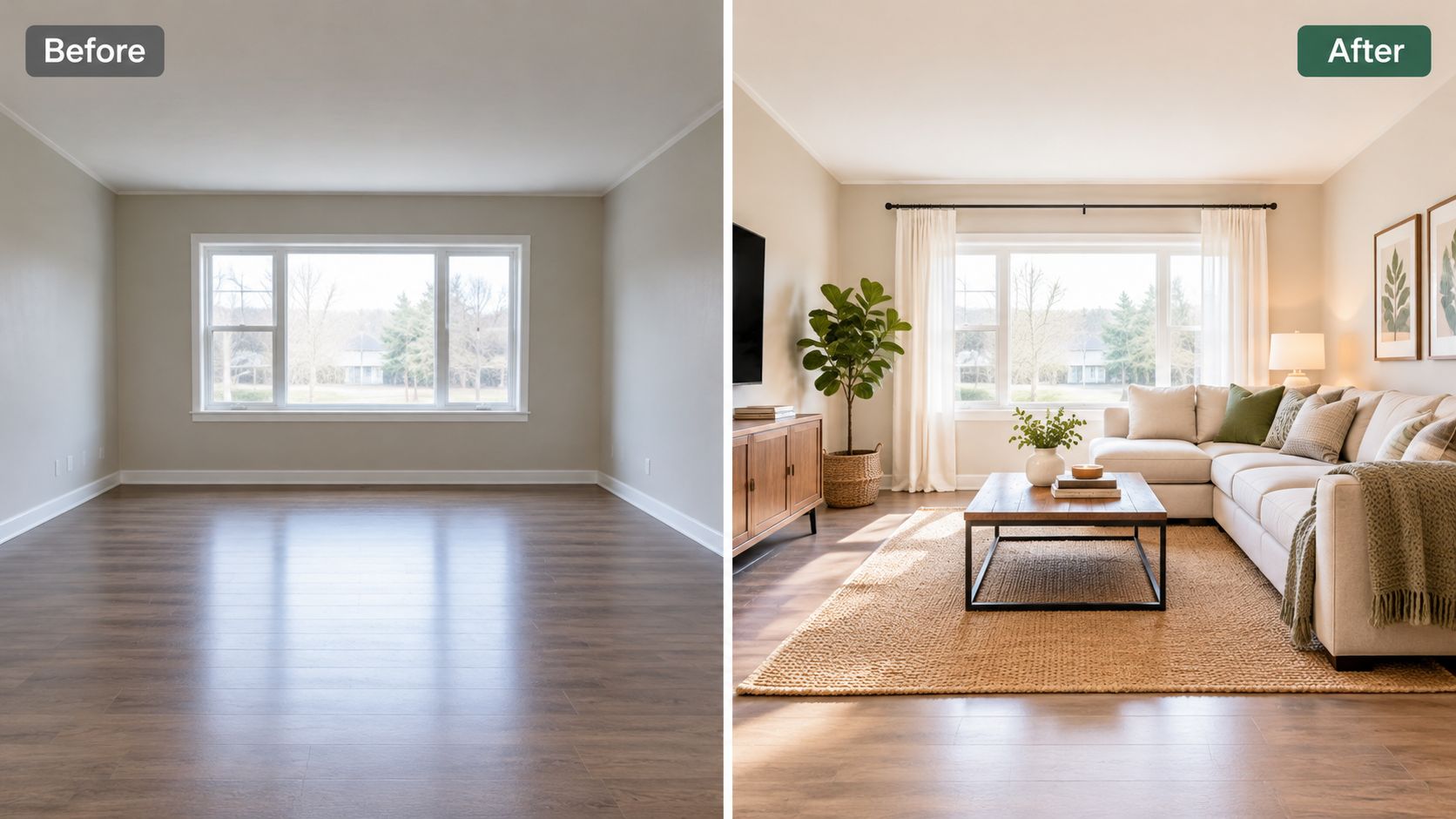
VideoTour.ai's motion, transitions, captions, and music synchronization can make the contrast easy to follow without manual editing. Still, the email should include a written summary. Some recipients won't load the visual, and others need context before they decide whether the changes matter.
Measure clicks to the project page, consultation requests, replies, and unsubscribes. A visually dramatic transition may earn attention but still fail commercially if the CTA doesn't match the reader's situation.
Use a subject line with a visible contrast: “See what changed in this kitchen,” “From empty to market-ready,” or “The renovation story behind this home.” The CTA should depend on the audience. Sellers may see “Discuss your pre-listing plan.” Investors may see “Review the project details.” Homeowners may see “Reply for the improvement guide.”
Build the video from dated photo sets. Place the earlier images first, then use a clear transition into the staged, renovated, or updated result. Add captions identifying the changes, such as kitchen finishes, lighting, flooring, landscaping, or furniture. Don't state renovation costs, sale prices, or returns unless you have verified documentation and can support the claim.
Turn one project into a sequence
The first email can show the transformation. A later message can explain the marketing decisions, staging choices, or buyer questions that followed. A final send can invite a consultation, provided your evidence supports the points you make.VideoTour.ai's motion, transitions, captions, and music synchronization can make the contrast easy to follow without manual editing. Still, the email should include a written summary. Some recipients won't load the visual, and others need context before they decide whether the changes matter.
Measure clicks to the project page, consultation requests, replies, and unsubscribes. A visually dramatic transition may earn attention but still fail commercially if the CTA doesn't match the reader's situation.
7. Expiring Listing Intervention Campaign
An expired listing email requires tact. Send it only where your contact and communication practices allow it, and tailor the message to property owners whose listings have ended, previous inquiry contacts, local agents, and investor prospects. The owner has already experienced disappointment, so a generic “I can sell your home” message is unlikely to build trust.
Use a subject line such as “A fresh marketing plan for [address],” “Would a new presentation help?” or “Ideas for the next listing attempt.” The CTA should be low pressure: “Review the plan,” “Schedule a strategy call,” or “Reply if you'd like a second opinion.”
Create a new tour from current, approved photos. If the staging, price, condition, or presentation has changed, show those changes accurately. Don't reuse an old video with a new logo and call it a new strategy. The owner needs to see what you'll do differently.
Segment previous buyer inquiries separately from agents and investors. A buyer may want a renewed property preview. An owner needs a marketing plan. An investor may want a valuation conversation. One email can't serve all three audiences well.
Use VideoTour.ai to produce a branded preview quickly, but spend more time on the message than on special effects. The strongest CTA is a conversation about strategy, not a demand for an immediate listing agreement.
Use a subject line such as “A fresh marketing plan for [address],” “Would a new presentation help?” or “Ideas for the next listing attempt.” The CTA should be low pressure: “Review the plan,” “Schedule a strategy call,” or “Reply if you'd like a second opinion.”
Create a new tour from current, approved photos. If the staging, price, condition, or presentation has changed, show those changes accurately. Don't reuse an old video with a new logo and call it a new strategy. The owner needs to see what you'll do differently.
Lead with an observation
Write two or three specific points about the previous presentation, such as weak room order, unclear property positioning, missing neighborhood context, or a CTA that made inquiries difficult. Then explain how the new visual and campaign would address those issues. Avoid criticizing the previous agent or implying that video alone will solve the problem.Segment previous buyer inquiries separately from agents and investors. A buyer may want a renewed property preview. An owner needs a marketing plan. An investor may want a valuation conversation. One email can't serve all three audiences well.
Use VideoTour.ai to produce a branded preview quickly, but spend more time on the message than on special effects. The strongest CTA is a conversation about strategy, not a demand for an immediate listing agreement.
8. Luxury and Premium Property Campaign
Luxury email needs restraint. Send it to qualified buyers, past luxury clients, referral partners, relocation contacts, private networks, and subscribers who have shown interest in premium properties. Don't assume a large visual treatment automatically signals quality. In this segment, overproduction can look less credible than a quiet, well-edited presentation.
Subject line directions include “A private preview in [location],” “An architectural home with rare views,” or “Before the public launch.” Use “Request a private presentation,” “Arrange a confidential viewing,” or “Explore the full property brief” as the main CTA.
VideoTour.ai can add cinematic motion, drone-style effects, 3D text, logo intros, and premium transitions. Use those tools selectively. The best premium send often feels bespoke because the copy references the recipient's likely interest, such as design, privacy, entertaining, investment, or access to a particular area.
Include the agent's credentials and direct contact details, but keep the sales pitch measured. Luxury buyers may want a private exchange rather than a high-pressure funnel. Use a hosted landing page for the full tour and property brief, with access controls where appropriate.
Track qualified replies, private-viewing requests, landing-page engagement, and referrals. Don't optimize for the biggest list or the highest raw click volume. Audience quality matters more here than broad distribution.
Subject line directions include “A private preview in [location],” “An architectural home with rare views,” or “Before the public launch.” Use “Request a private presentation,” “Arrange a confidential viewing,” or “Explore the full property brief” as the main CTA.
Edit for confidence
Use the strongest property photographs in a deliberate order. A restrained intro, minimal text overlays, and carefully chosen music can support the property's architecture without competing with it. Add captions for distinctive details, land, outlook, craftsmanship, and location advantages, but don't turn the tour into a list of adjectives.VideoTour.ai can add cinematic motion, drone-style effects, 3D text, logo intros, and premium transitions. Use those tools selectively. The best premium send often feels bespoke because the copy references the recipient's likely interest, such as design, privacy, entertaining, investment, or access to a particular area.
Include the agent's credentials and direct contact details, but keep the sales pitch measured. Luxury buyers may want a private exchange rather than a high-pressure funnel. Use a hosted landing page for the full tour and property brief, with access controls where appropriate.
Track qualified replies, private-viewing requests, landing-page engagement, and referrals. Don't optimize for the biggest list or the highest raw click volume. Audience quality matters more here than broad distribution.
9. Seasonal and Holiday Campaign
Seasonal campaigns keep your database useful between transactions. Send them to past clients, homeowners, local prospects, buyers who paused their search, sellers planning ahead, and vacation-rental or second-home audiences.
Choose one seasonal purpose. A spring campaign might combine new listings with preparation advice. A holiday send might highlight entertaining spaces or a local event. A new-year message might invite a home-value conversation or share a concise market review. Subject lines should make the context clear: “Prepare your home for spring,” “Homes made for holiday hosting,” or “A fresh start for your next move.”
The CTA should follow the content: “Get the preparation guide,” “See homes with outdoor space,” “Request a home-value conversation,” or “Reply with your plans.” Don't combine every seasonal offer in one message.
Segment by likely relevance. A past buyer may appreciate maintenance guidance. An active buyer may want homes with a particular feature. A landlord or investor may need a different message entirely. The same holiday greeting can remain broad, but the CTA should reflect the recipient's relationship with you.
Check every date, offer, property status, and link before sending. Seasonal emails age quickly, especially when they contain event information. Track replies and useful clicks, then keep the strongest themes for the next planning cycle.
Choose one seasonal purpose. A spring campaign might combine new listings with preparation advice. A holiday send might highlight entertaining spaces or a local event. A new-year message might invite a home-value conversation or share a concise market review. Subject lines should make the context clear: “Prepare your home for spring,” “Homes made for holiday hosting,” or “A fresh start for your next move.”
The CTA should follow the content: “Get the preparation guide,” “See homes with outdoor space,” “Request a home-value conversation,” or “Reply with your plans.” Don't combine every seasonal offer in one message.
Produce before the season arrives
Create the photo-based video early, then update captions and links when listings or event details change. VideoTour.ai can apply seasonal music, branded text, lifestyle motion, and reusable formats to the same underlying property images. Keep the treatment tasteful. A seasonal reference should frame the message, not overwhelm it.Segment by likely relevance. A past buyer may appreciate maintenance guidance. An active buyer may want homes with a particular feature. A landlord or investor may need a different message entirely. The same holiday greeting can remain broad, but the CTA should reflect the recipient's relationship with you.
Check every date, offer, property status, and link before sending. Seasonal emails age quickly, especially when they contain event information. Track replies and useful clicks, then keep the strongest themes for the next planning cycle.
10. Investor and Commercial Pitch Campaign
Commercial and investment audiences need more than attractive rooms. Send this campaign to investors, developers, commercial buyers, landlords, brokers, and prospects organized by property type, geography, or investment focus.
The subject line should identify the opportunity without making an unsupported promise: “Review this multifamily opportunity,” “A new commercial space in [market],” or “Property brief for [asset type].” The CTA should be specific: “Download the offering materials,” “Request underwriting,” or “Schedule an investment call.”
Use the video to establish the physical context. Show the building, access points, common areas, unit mix where relevant, surrounding location, and any documented improvement. Add captions for verified financial or operating information supplied by the owner or authorized source. Don't invent projections, returns, occupancy claims, or market figures to make the presentation sound stronger.
VideoTour.ai can turn property photos into a structured tour with captions, motion, branding, and voiceover. For a commercial pitch, the edit should support the analysis rather than imitate a residential lifestyle reel. A measured pace and readable overlays are more useful than excessive effects.
Segment investors by asset class and geography. A multifamily buyer, office tenant, and land developer don't need the same opening, even when they receive information about the same property. Measure document downloads, qualified replies, calls, and meeting requests. Clicks matter, but the commercial outcome is a serious conversation supported by accurate information.
The subject line should identify the opportunity without making an unsupported promise: “Review this multifamily opportunity,” “A new commercial space in [market],” or “Property brief for [asset type].” The CTA should be specific: “Download the offering materials,” “Request underwriting,” or “Schedule an investment call.”
Use the video to establish the physical context. Show the building, access points, common areas, unit mix where relevant, surrounding location, and any documented improvement. Add captions for verified financial or operating information supplied by the owner or authorized source. Don't invent projections, returns, occupancy claims, or market figures to make the presentation sound stronger.
Put the analysis beside the tour
The email should summarize the investment thesis in plain language. Explain what the recipient is viewing, why it may be relevant to their criteria, and where they can inspect the full documents. Link to underwriting, comparable sales, offering materials, or a data room below the visual.VideoTour.ai can turn property photos into a structured tour with captions, motion, branding, and voiceover. For a commercial pitch, the edit should support the analysis rather than imitate a residential lifestyle reel. A measured pace and readable overlays are more useful than excessive effects.
Segment investors by asset class and geography. A multifamily buyer, office tenant, and land developer don't need the same opening, even when they receive information about the same property. Measure document downloads, qualified replies, calls, and meeting requests. Clicks matter, but the commercial outcome is a serious conversation supported by accurate information.
10 Real Estate Email Campaigns Comparison
| Campaign | Implementation Complexity 🔄 | Resource Requirements ⚡ | Expected Outcomes ⭐📊 | Ideal Use Cases 💡 | Key Advantages ⭐ |
|---|---|---|---|---|---|
| Video Tour Showcase Campaign | Medium, automated photo-to-video; email playback caveats 🔄 | Photos (up to 60), branding, hosting fallback; moderate bandwidth ⚡ | Higher CTR and engagement; increased time-on-content ⭐📊 | New listing announcements; weekly new-listing emails | Fast photo→video turnaround; MLS-compliant formats; professional captions/music ⭐ |
| Social Media Teaser Campaign | Low–Medium, preset reels, cross-channel coordination 🔄 | Social presets, trending music, frequent content cadence ⚡ | Strong social engagement and follower growth; more shares ⭐📊 | Driving viewers to Instagram/TikTok reels; teaser promos before full email send | Rapid reel creation; platform-native formats; consistent style templates ⭐ |
| Lifestyle & Market Update Campaign | Medium, content planning + avatar setup; recurring schedule 🔄 | AI avatars, voice cloning, lifestyle clips, scripts ⚡ | Improved subscriber retention and trust; expert positioning ⭐📊 | Market updates, neighborhood spotlights, nurture sequences | Personalizes agent voice without filming; builds local authority ⭐ |
| Open House & Event Promotion Campaign | Low, time-sensitive, quick renders enable rapid sends 🔄 | Photos/video previews, event details, templates; fast render times ⚡ | Higher open/RSVP rates; reduced no-shows when previews set expectations ⭐📊 | Open house promos, broker tours, last-minute event pushes | Same-day production; countdown messaging; multi-channel reuse ⭐ |
| Agent Spotlight & Personal Brand Campaign | Low–Medium, requires agent buy-in and templates 🔄 | Agent assets or avatar, branding toolkit, simple scripting ⚡ | Increased direct inquiries and referral opportunities; stronger personal brands ⭐📊 | Agent bios, personal newsletters, recruitment/retention efforts | Enables agent branding at scale; low production barrier; voice cloning ⭐ |
| Before & After Renovation Campaign | Medium, needs staged sequencing and timing 🔄 | High-quality before/after photos, captions, sequencing tools ⚡ | High shareability and emotional engagement; demonstrates ROI ⭐📊 | Renovation reveals, staging showcases, investor flip highlights | Compelling transformation storytelling; longer view times ⭐ |
| Expiring Listing Intervention Campaign | Low–Medium, quick re-render and targeted segmentation 🔄 | Updated photos (recommended), targeted lists, revised messaging ⚡ | Re-engages past viewers; potential relist/sale momentum ⭐📊 | Expiring listings, price-reduction alerts, relist outreach | Fast, cost-effective refresh of listing marketing; targeted sends ⭐ |
| Luxury & Premium Property Campaign | Medium–High, careful curation, cinematic polish required 🔄 | Drone effects, premium music, advanced transitions, designer curation ⚡ | Fewer but higher-quality inquiries; strong brand alignment ⭐📊 | High-net-worth listings, exclusive previews, international marketing | Cinematic presentation and aerials that justify luxury positioning ⭐ |
| Seasonal & Holiday Campaign | Low, template-driven but needs advance planning 🔄 | Seasonal branding, lifestyle clips, scheduling and cadence ⚡ | Keeps contact during off-peak; themed engagement spikes ⭐📊 | Holiday greetings, seasonal tips, spring/summer market activations | Predictable touchpoints; low-cost alternative to print mailers ⭐ |
| Investor & Commercial Pitch Campaign | High, integrates data overlays and longer narratives 🔄 | Detailed financials, market analysis, voiceover, data visualizations ⚡ | Persuasive investor interest; qualified leads and deeper diligence ⭐📊 | Multifamily/commercial listings, syndication pitches, investor outreach | Combines video storytelling with hard data to position investment value ⭐ |
Pick One Campaign and Send It This Week
Don't wait for a complete content library. Choose the campaign that matches an asset already in your pipeline: a new listing, an upcoming open house, a useful neighborhood update, a renovation project, or a database segment that has gone quiet. The fastest first test is usually the one that uses photos you've already collected and a CTA your team can fulfill immediately.
Start with the audience, not the video style. Write down who should receive the message, what they already know, and what action makes sense for them. An active buyer may need a showing link. A past client may respond better to a local update. An investor may need an offering document. Relevance does more work than decoration.
Build a short send plan:
Apple Mail Privacy Protection can preload tracking pixels, which makes opens a directional signal rather than a definitive engagement measure. Use tagged links, unique landing pages, and downstream actions as your stronger evidence. For a video test, keep the audience, property, offer, and timing consistent while comparing a static hero image with a tour thumbnail. Review unique clicks, click-to-open rate, landing-page conversion, showing requests, replies, unsubscribes, and spam complaints.
VideoTour.ai can turn existing photo sets into branded tours in minutes, but the tool doesn't replace campaign judgment. Choose the right segment, write a clear message, verify every property detail, and make the next step easy on mobile. If your team uses AI for drafting, review the output before it reaches clients. The National Association of REALTORS® 2025 Technology Survey reports that 52% of REALTORS® use AI to draft emails and follow-up communications, which points to assisted workflow adoption, not fully autonomous marketing.
Send one campaign this week. After the results arrive, change one variable at a time, such as the subject line, thumbnail, CTA, or audience segment. Use an email spam checker before sending, verify authentication and unsubscribe details, and review the email on a phone. A disciplined first test gives you more useful insight than another month of collecting ideas.
VideoTour.ai turns listing photo sets into ready-to-share real estate video tours with motion, captions, music, branding, and multiple formats for email and social campaigns. Use it to create a lightweight tour preview, link subscribers to a mobile-friendly hosted page, and test clicks and inquiries instead of relying on opens alone. Visit VideoTour.ai to create your first property video from the photos you already have.
Start with the audience, not the video style. Write down who should receive the message, what they already know, and what action makes sense for them. An active buyer may need a showing link. A past client may respond better to a local update. An investor may need an offering document. Relevance does more work than decoration.
Build a short send plan:
- Audience: Define the segment and exclude contacts who aren't relevant.
- Subject line: Write a direct reason to open, without promising something the email can't deliver.
- Preview asset: Use a lightweight thumbnail linked to a hosted tour page.
- Primary CTA: Ask for one action, such as watching, booking, replying, or downloading.
- Supporting text: Include property facts, event details, accessibility text, and a plain-text fallback.
- Measurement: Tag every link and track clicks, replies, downstream inquiries, unsubscribes, and hard bounces.
Apple Mail Privacy Protection can preload tracking pixels, which makes opens a directional signal rather than a definitive engagement measure. Use tagged links, unique landing pages, and downstream actions as your stronger evidence. For a video test, keep the audience, property, offer, and timing consistent while comparing a static hero image with a tour thumbnail. Review unique clicks, click-to-open rate, landing-page conversion, showing requests, replies, unsubscribes, and spam complaints.
VideoTour.ai can turn existing photo sets into branded tours in minutes, but the tool doesn't replace campaign judgment. Choose the right segment, write a clear message, verify every property detail, and make the next step easy on mobile. If your team uses AI for drafting, review the output before it reaches clients. The National Association of REALTORS® 2025 Technology Survey reports that 52% of REALTORS® use AI to draft emails and follow-up communications, which points to assisted workflow adoption, not fully autonomous marketing.
Send one campaign this week. After the results arrive, change one variable at a time, such as the subject line, thumbnail, CTA, or audience segment. Use an email spam checker before sending, verify authentication and unsubscribe details, and review the email on a phone. A disciplined first test gives you more useful insight than another month of collecting ideas.
VideoTour.ai turns listing photo sets into ready-to-share real estate video tours with motion, captions, music, branding, and multiple formats for email and social campaigns. Use it to create a lightweight tour preview, link subscribers to a mobile-friendly hosted page, and test clicks and inquiries instead of relying on opens alone. Visit VideoTour.ai to create your first property video from the photos you already have.