
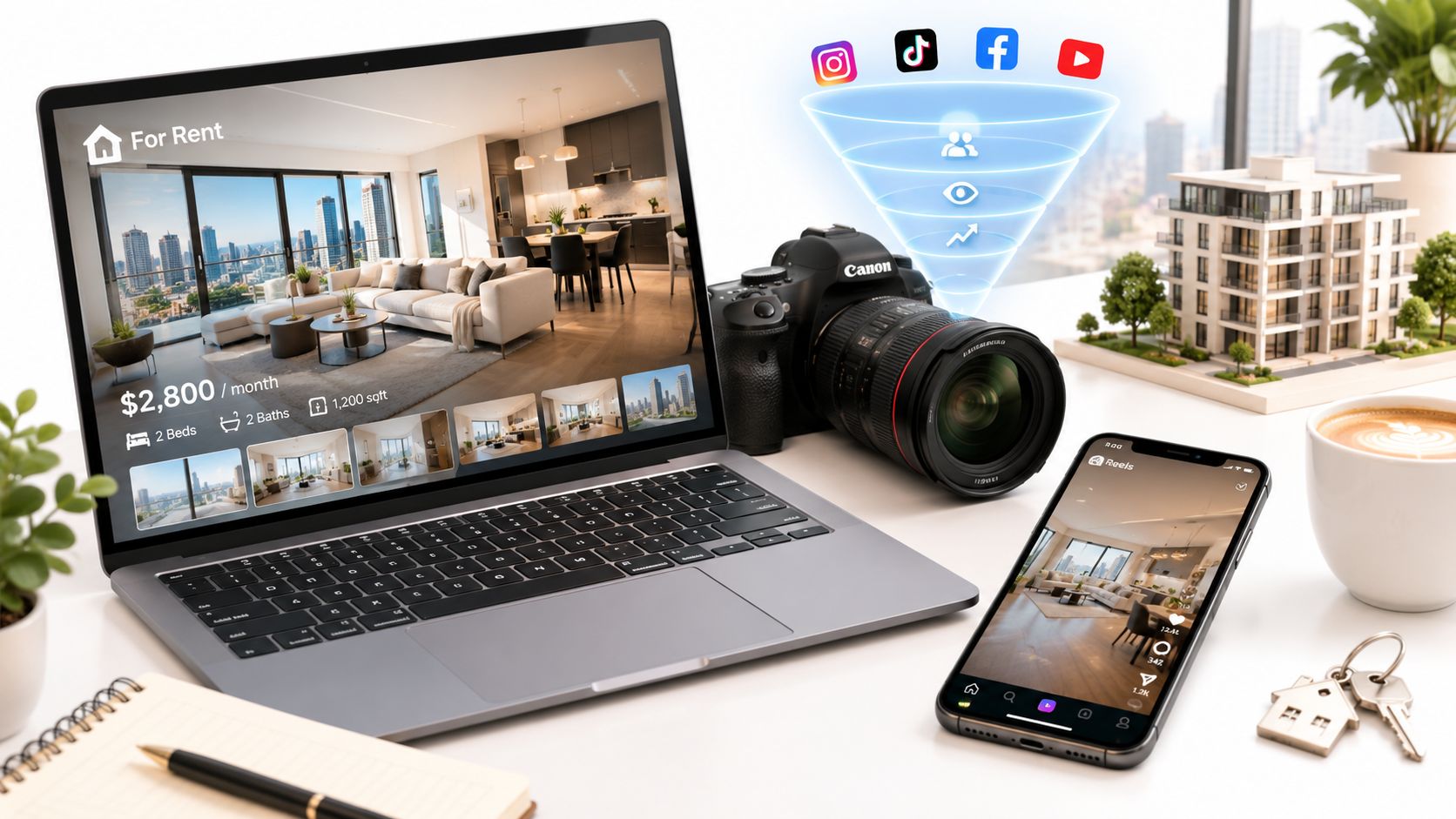
Most rental operators still treat video as a nice extra. The data says that's backwards. Listings with video reportedly receive 403% more inquiries than listings without it, while only 26% of agents consistently use video for every listing (Reel-e.ai). The opportunity isn't to publish another walkthrough. It's to make one well-planned shoot power every place a renter discovers, evaluates, and books your property.
Rental property marketing now works as a connected system. A single asset should support portal listings, social clips, Google Maps updates, follow-up messages, landing pages, and the structured information that helps AI answer engines understand your property. Pretty photos still matter, but they no longer carry the whole campaign.
Rental property marketing now works as a connected system. A single asset should support portal listings, social clips, Google Maps updates, follow-up messages, landing pages, and the structured information that helps AI answer engines understand your property. Pretty photos still matter, but they no longer carry the whole campaign.
Summary
Create an AI Video Tours from PhotosTry it For Free
Why Rental Property Marketing in 2026 Is a System, Not a Listing
A portal listing is a storefront, not a marketing strategy. Renters and travelers move between Airbnb, Vrbo, Google Maps, TikTok, Instagram, property websites, and AI-powered answer engines before they decide which property deserves their attention. If each channel has different facts, stale media, or no clear next step, you're paying to create confusion.
Video is the connective tissue because it can show the same property consistently across every channel. A walkthrough becomes the lead asset on a portal, a vertical reel on Instagram, a short answer to a common question, a Google Business post, and a visual landing-page element. The message changes by channel, but the underlying evidence stays recognizable.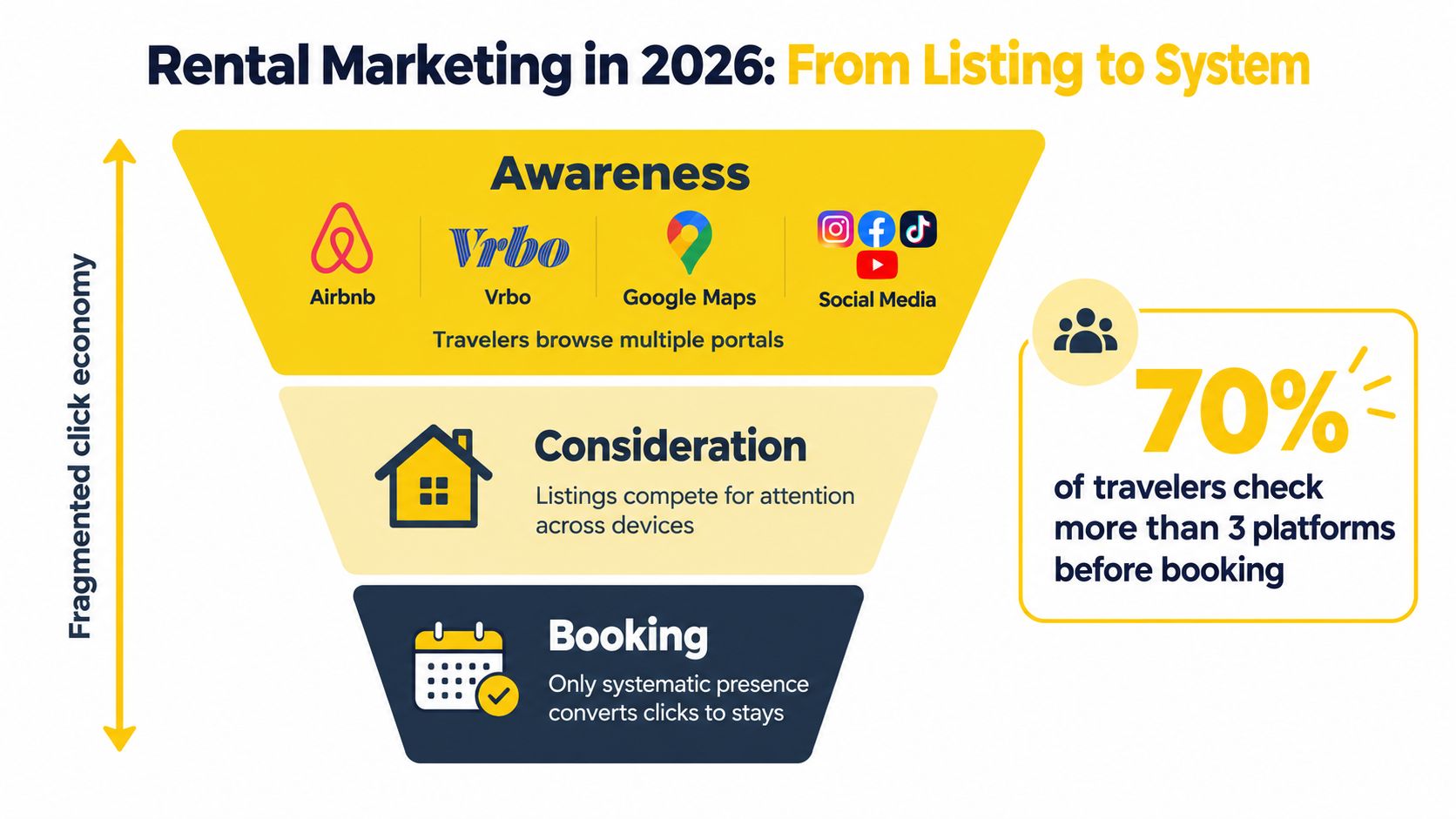 The system starts with a shared source of truth:
Video is the connective tissue because it can show the same property consistently across every channel. A walkthrough becomes the lead asset on a portal, a vertical reel on Instagram, a short answer to a common question, a Google Business post, and a visual landing-page element. The message changes by channel, but the underlying evidence stays recognizable.
The system starts with a shared source of truth:- Property facts: Keep beds, baths, amenities, policies, availability, location, and fees consistent.
- Media library: Store the original photos, walkthrough, vertical cuts, captions, thumbnails, and brand files together.
- Channel mapping: Decide which version belongs on each portal, social network, map profile, email, or SMS sequence.
- Conversion path: Give every asset one obvious action, such as requesting a showing, checking availability, or booking directly.
Practical rule: Don't produce content until you know which question it answers and which booking action it supports.The payoff compounds because each new shoot improves more than one channel. A stronger listing earns attention, the social cuts create repeated exposure, the map profile supports local discovery, and the follow-up sequence gives hesitant renters another reason to act. That's how rental property marketing becomes an operating system instead of a series of disconnected posts.
The Four Pillars Every Rental Marketing Plan Needs
Rental property marketing rests on four linked pillars: listings, media, distribution, and conversion. Operators get into trouble when they optimize one pillar while ignoring the others.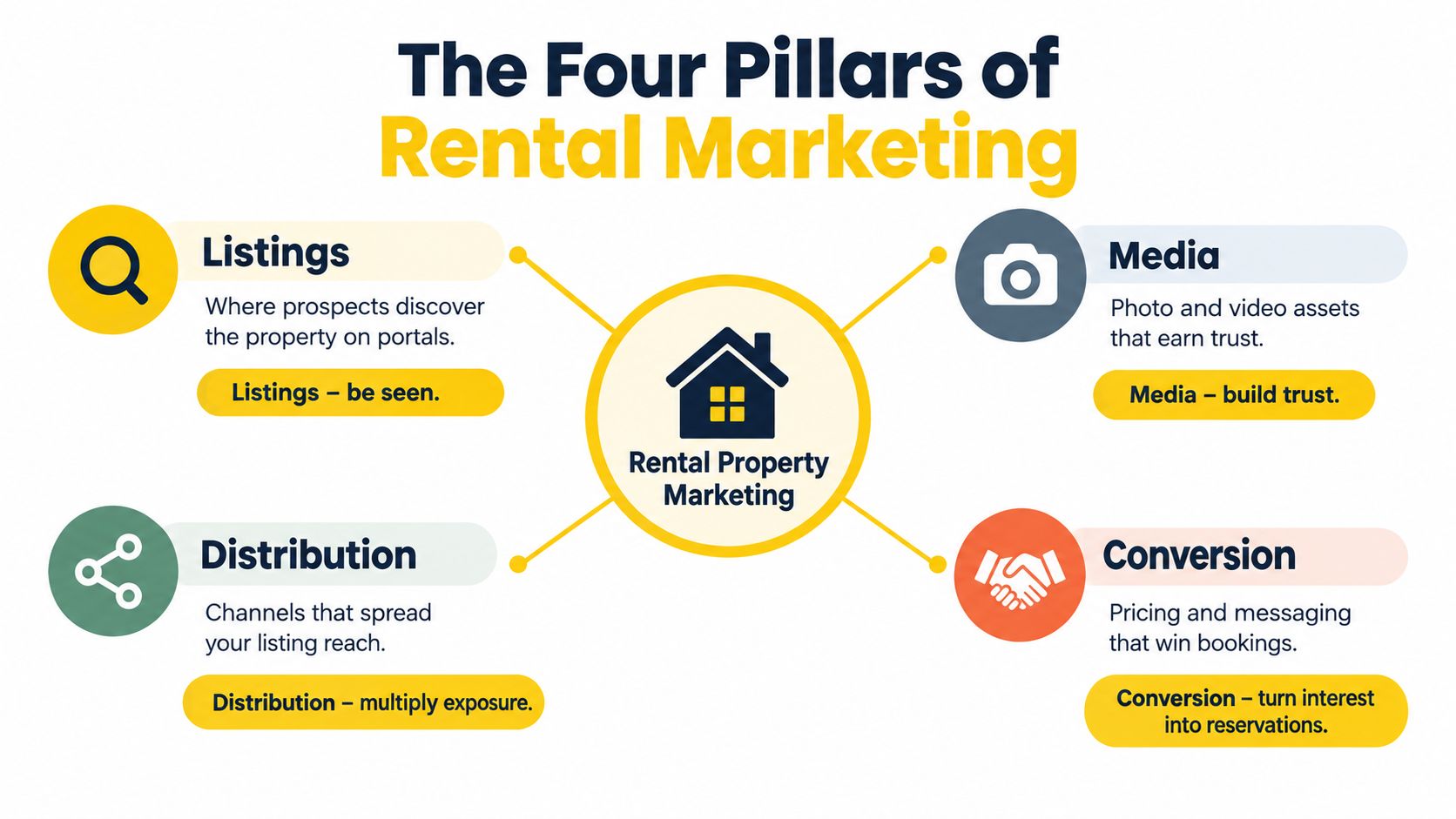 Listings determine whether a prospect can find and understand the property. That includes the headline, description, amenities, policies, availability, location signals, and price presentation. A listing can have beautiful creative and still fail if the first screen doesn't answer who the property suits, what it costs, or why the location matters.
Media earns trust before the first inquiry. Photos establish layout and condition. Video gives renters a better sense of movement, scale, light, access, and the relationship between rooms. Professional photography can increase listing views by 61% and help homes sell 32% faster than listings without it, according to PhotoUp's real-estate marketing statistics. The rental application is different, but the visual decision happens in much the same way.
Distribution places the listing in front of people with different levels of intent. Portals capture active searches. Social platforms create discovery. Google Maps supports local research. Email and SMS reach known prospects. AI answer engines depend on clear, consistent information that can be interpreted and summarized.
Conversion turns attention into a tour, application, lease, or reservation. It includes transparent fees, useful calls to action, response speed, qualification, scheduling, and follow-up. Strong distribution can't rescue unclear costs, and a fast reply can't repair a misleading listing.
Think of the pillars as a chain rather than a menu. Improve the weakest link first. If inquiries are scarce, repair discovery and media. If traffic is healthy but tours are thin, fix the offer, price framing, or response process. If bookings happen only through portals, build an owned follow-up channel.
Listings determine whether a prospect can find and understand the property. That includes the headline, description, amenities, policies, availability, location signals, and price presentation. A listing can have beautiful creative and still fail if the first screen doesn't answer who the property suits, what it costs, or why the location matters.Media earns trust before the first inquiry. Photos establish layout and condition. Video gives renters a better sense of movement, scale, light, access, and the relationship between rooms. Professional photography can increase listing views by 61% and help homes sell 32% faster than listings without it, according to PhotoUp's real-estate marketing statistics. The rental application is different, but the visual decision happens in much the same way.
Distribution places the listing in front of people with different levels of intent. Portals capture active searches. Social platforms create discovery. Google Maps supports local research. Email and SMS reach known prospects. AI answer engines depend on clear, consistent information that can be interpreted and summarized.
Conversion turns attention into a tour, application, lease, or reservation. It includes transparent fees, useful calls to action, response speed, qualification, scheduling, and follow-up. Strong distribution can't rescue unclear costs, and a fast reply can't repair a misleading listing.
Think of the pillars as a chain rather than a menu. Improve the weakest link first. If inquiries are scarce, repair discovery and media. If traffic is healthy but tours are thin, fix the offer, price framing, or response process. If bookings happen only through portals, build an owned follow-up channel.
Listing Fundamentals That Win the Click
The first screen has one job: earn the next action. Lead with the property's strongest concrete benefit, then make the practical details easy to scan. A headline should identify the property type, bed and bath count, neighborhood, standout feature, and rate where the platform allows it.
Photos should tell a physical story. Start with the exterior or strongest room, then show how a renter moves through the home. Prioritize the kitchen, primary bedroom, bathroom, living area, workspace, storage, outdoor space, parking, and any feature that justifies the rate. Use wide-angle lenses carefully. Distorted rooms create disappointment during the tour.
A floor plan is especially valuable for long-term and mid-term rentals because renters need to assess furniture placement, privacy, and circulation. Add a 3D or 360-degree tour when the layout is difficult to understand from still images, but don't use it as a substitute for a clear photo sequence.
For examples of how different creative structures frame benefits and calls to action, study this breakdown of high-converting property ads from Sight AI. For social execution, use this guide to create a Reel for Instagram, then adapt the finished asset to the listing's booking objective.
Photos should tell a physical story. Start with the exterior or strongest room, then show how a renter moves through the home. Prioritize the kitchen, primary bedroom, bathroom, living area, workspace, storage, outdoor space, parking, and any feature that justifies the rate. Use wide-angle lenses carefully. Distorted rooms create disappointment during the tour.
A floor plan is especially valuable for long-term and mid-term rentals because renters need to assess furniture placement, privacy, and circulation. Add a 3D or 360-degree tour when the layout is difficult to understand from still images, but don't use it as a substitute for a clear photo sequence.
Build the listing pack around decisions
Descriptions should answer questions in the order renters ask them:- Who is it for: Families, remote workers, relocating professionals, students, or weekend travelers.
- Why this property: The strongest combination of location, layout, amenity, and convenience.
- What is included: Utilities, furnishings, parking, laundry, internet, pets, and outdoor features.
- What it costs: Nightly or monthly rate, mandatory fees, deposit, taxes, and other required charges.
- What happens next: Request a tour, check dates, apply, or book.
| Asset | Short-Term Rental | Mid-Term Rental | Long-Term Lease |
|---|---|---|---|
| Hero photo | Living area, view, or signature amenity | Comfortable living space and workspace | Brightest room or strongest exterior |
| Floor plan | Helpful for complex layouts | High priority for extended stays | Essential for evaluating fit |
| Video | Fast walkthrough with booking prompt | Tour focused on livability and storage | Tour focused on layout, condition, and access |
| Description | Dates, rules, amenities, nearby experiences | Furnishings, utilities, work setup, flexibility | Lease terms, policies, inclusions, and application path |
| Pricing signal | Nightly rate and full required cost | Monthly rate and included services | Monthly rent, deposit, and mandatory fees |
Video as the Engine of Modern Rental Marketing
Video earns its place because it holds attention and carries context that photos can't. One benchmark reports average session time of 3 minutes 41 seconds for video-enabled listing views, compared with 48 seconds for photo-only pages (Real Estate Agent Leads). More time on page gives the renter more opportunity to understand the property, encounter a call to action, and decide whether the listing fits.
The same source reports that listings above $500,000 with video receive 6.1 times more inquiries than comparable listings without video. That benchmark concerns sales listings, so don't copy the figure into a rental forecast. The useful lesson is that video matters most when the decision requires confidence, and a rental with unusual layout, premium amenities, or a higher consideration level benefits from the same clarity.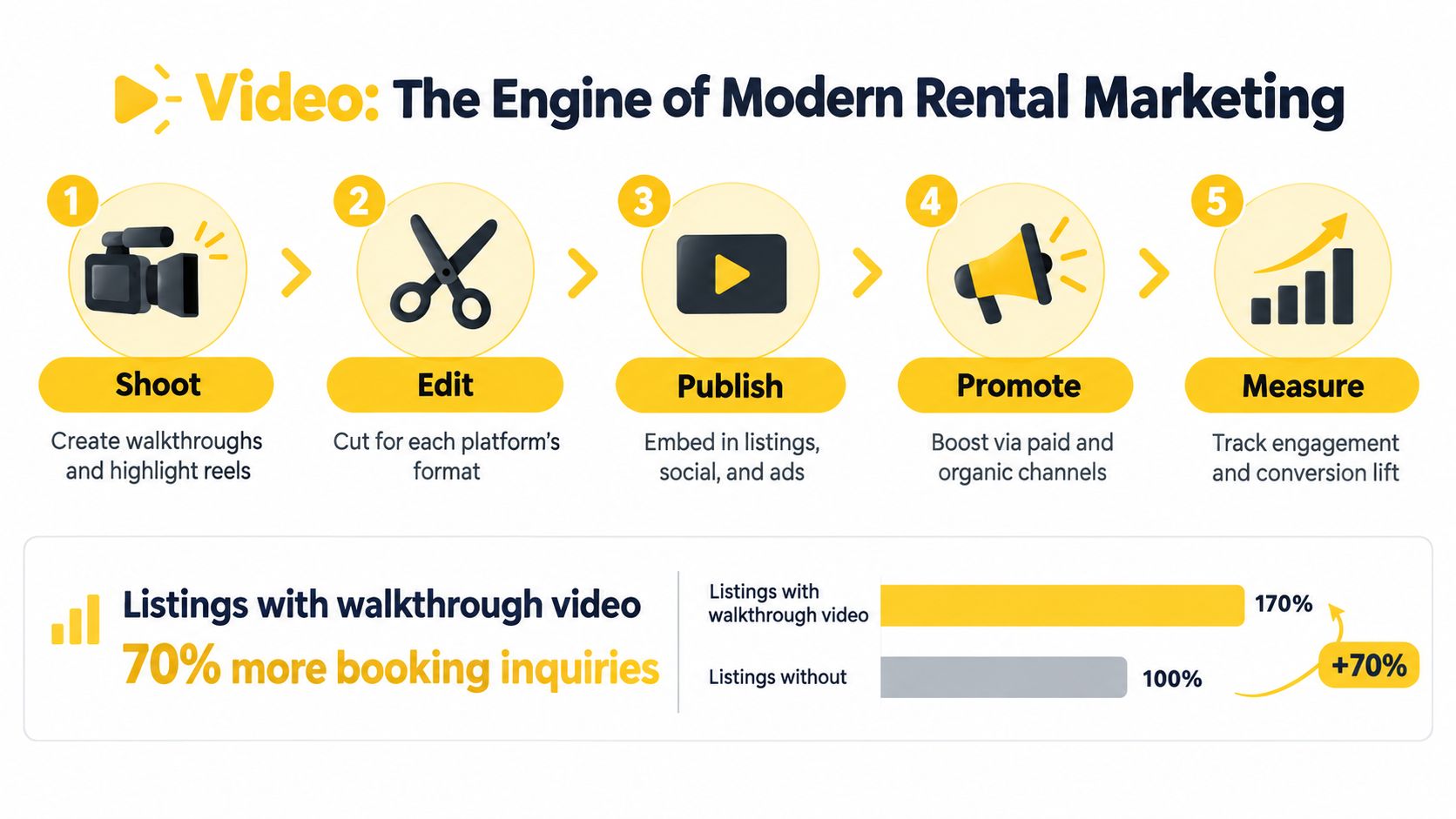
The two waste patterns are predictable. Operators create a cinematic horizontal tour with no vertical cuts, or they publish attractive reels that never point to a page where a renter can act. Map each edit to one platform, one audience intent, and one next step. For production and software options, see this guide to real-estate video marketing tools for 2026.
The same source reports that listings above $500,000 with video receive 6.1 times more inquiries than comparable listings without video. That benchmark concerns sales listings, so don't copy the figure into a rental forecast. The useful lesson is that video matters most when the decision requires confidence, and a rental with unusual layout, premium amenities, or a higher consideration level benefits from the same clarity.
Shoot once, ship many versions
A disciplined shoot should produce a complete asset family:- One horizontal tour: A concise property overview for the website, YouTube, and portal embedding.
- Three vertical reels: One for the hook, one for the layout, and one for the signature amenity or location.
- Short clips: Kitchen, bedroom, workspace, outdoor area, parking, storage, and FAQ answers.
- Thumbnail sequence: Clear room labels and a readable value proposition.
- Still-image frames: Useful for stories, map posts, email, and retargeting.
The two waste patterns are predictable. Operators create a cinematic horizontal tour with no vertical cuts, or they publish attractive reels that never point to a page where a renter can act. Map each edit to one platform, one audience intent, and one next step. For production and software options, see this guide to real-estate video marketing tools for 2026.
Choosing the Right Distribution Channels
Don't distribute equally. Match the channel to the renter's intent and the content format it can support.
Long-term rental managers should anchor on the major portals and a maintained Google Business Profile. Short-term operators should add Instagram, TikTok, YouTube Shorts, and direct-booking content because discovery often begins before a traveler searches for a specific address.
The 2026 multifamily marketing conversation is moving beyond website SEO alone. One roundup describes search behavior across social, maps, and AI answer engines, while another reports that 56% of property teams plan larger budgets and 35% plan to test SMS (Conversion Logix). Treat those figures as planning signals, not proof that every channel will work for your portfolio.
AI answer engines need readable facts. Publish neighborhood pages, property FAQs, fee explanations, accessibility details, pet policies, and structured listing data. Keep the same name, address, amenities, and pricing logic everywhere. For a broader playbook on rental advertising, review how to master rental advertising with VerticalRent, then adapt the channel mix to your inventory. This real-estate social media marketing guide can help turn the video library into a repeatable publishing routine.
| Channel | Best For | Cost Per Inquiry | Content Fit | 2026 Priority |
|---|---|---|---|---|
| Rental portals | Active searchers comparing available properties | Paid, listing, or platform-dependent | Complete listing pack, floor plan, tour | High for long-term and mid-term |
| Instagram and TikTok | Discovery, lifestyle context, local awareness | Organic effort or paid promotion | Vertical reels, room clips, neighborhood content | High for short-term |
| YouTube Shorts | Searchable video discovery and reuse | Organic effort or paid promotion | Vertical tours, FAQs, location clips | Useful when video volume is consistent |
| Google Business Profile and Maps | Local intent and branded discovery | Usually operational effort, with optional promotion | Updates, photos, short videos, reviews, directions | High for managers and direct-booking operators |
| AI answer engines | Travelers asking comparative or location-specific questions | Requires owned-content effort and monitoring | Clear pages, structured facts, FAQs, consistent listings | Emerging and worth testing |
| Email and SMS | Known prospects, past guests, and waitlists | Platform and message costs | Availability alerts, follow-up, offers, tour reminders | High once you have permission-based contacts |
The 2026 multifamily marketing conversation is moving beyond website SEO alone. One roundup describes search behavior across social, maps, and AI answer engines, while another reports that 56% of property teams plan larger budgets and 35% plan to test SMS (Conversion Logix). Treat those figures as planning signals, not proof that every channel will work for your portfolio.
AI answer engines need readable facts. Publish neighborhood pages, property FAQs, fee explanations, accessibility details, pet policies, and structured listing data. Keep the same name, address, amenities, and pricing logic everywhere. For a broader playbook on rental advertising, review how to master rental advertising with VerticalRent, then adapt the channel mix to your inventory. This real-estate social media marketing guide can help turn the video library into a repeatable publishing routine.
Pricing, Fees, and Transparent Messaging That Converts
Lifestyle sells the first click. Transparent pricing protects the second click. Renters now expect the full cost picture before they invest time in an inquiry, tour, or application. A polished video that hides mandatory charges creates the exact distrust that good creative is supposed to prevent.
Publish the nightly or monthly rate early, then disclose every mandatory add-on in plain language. For short-term rentals, show cleaning, service, occupancy, and tax treatment as the platform permits. For long-term leases, state rent, deposit, utilities, pet charges, parking, application requirements, and any recurring fee.
Your video should address price without sounding defensive. Use a beat such as: “The advertised rate is listed below, and the required fees are itemized before you request a tour or booking.” Then show the amenity, convenience, or operating savings that gives the price meaning.
Dynamic pricing tools can adjust rates, but they shouldn't make the offer impossible to understand. Set a clear base-rate logic, define minimum-stay rules, and describe length-of-stay discounts as a value exchange rather than a permanent markdown. Test transparent versus lifestyle-only creative while holding availability and pricing logic steady. Judge the result through qualified inquiries, completed tours, applications, cancellations, and signed leases, not clicks alone.
The 2026 planning guidance from Zumper highlights the growing importance of upfront fee disclosure and transparent pricing, while its referenced marketing context notes that three-quarters of rental searches happen on mobile (Zumper). That makes short, readable, mobile-first cost communication a conversion requirement.
Publish the nightly or monthly rate early, then disclose every mandatory add-on in plain language. For short-term rentals, show cleaning, service, occupancy, and tax treatment as the platform permits. For long-term leases, state rent, deposit, utilities, pet charges, parking, application requirements, and any recurring fee.
Use one message across every format
A practical listing opener might read:For remote professionals and relocating households: a furnished two-bedroom home with dedicated workspace, reliable internet, parking, and utilities clearly itemized below.Follow it with a compact fee table:
| Cost item | Amount or treatment |
|---|---|
| Base rent or nightly rate | Publish the current applicable rate |
| Mandatory recurring fees | Name each fee and its frequency |
| One-time charges | State when each charge applies |
| Utilities and services | Identify what's included and excluded |
| Deposit or authorization | Explain the timing and refund conditions |
| Estimated total | Show the renter's realistic required cost |
Dynamic pricing tools can adjust rates, but they shouldn't make the offer impossible to understand. Set a clear base-rate logic, define minimum-stay rules, and describe length-of-stay discounts as a value exchange rather than a permanent markdown. Test transparent versus lifestyle-only creative while holding availability and pricing logic steady. Judge the result through qualified inquiries, completed tours, applications, cancellations, and signed leases, not clicks alone.
The 2026 planning guidance from Zumper highlights the growing importance of upfront fee disclosure and transparent pricing, while its referenced marketing context notes that three-quarters of rental searches happen on mobile (Zumper). That makes short, readable, mobile-first cost communication a conversion requirement.
A Real Listing Campaign From Shoot to Signed Lease
Consider a representative campaign for a three-bedroom single-family rental in a mid-tier mountain market. The operator doesn't begin by buying ads. The team first creates enough material to make every later channel credible.
On the first day, a focused shoot captures the exterior, entry, shared rooms, bedrooms, bathrooms, storage, parking, workspace, and mountain-facing outdoor area. The team records a complete walkthrough, room-specific vertical clips, and an exterior aerial sequence where local rules and conditions allow it. They also note every detail that affects qualification, including utilities, pet rules, lease terms, and access.
The same source material goes to Zillow, Furnished Finder, Airbnb where appropriate, and the direct website. The direct page carries the clearest FAQ and inquiry form. An email goes to the existing waitlist, but the message uses a property-specific video rather than a generic availability announcement.
The operator checks every portal manually after publishing. Image order, captions, pet policies, fees, calendar status, and calls to action must match. Syndication saves time, but it doesn't remove the need for quality control.
The manager claims and updates the Google Business Profile, publishes a concise property post, and links to the direct inquiry page. The team also checks how the property appears in AI answer engines by asking location and amenity questions, then strengthens the website's factual pages where answers are incomplete or inconsistent.
The campaign is judged by source, inquiry quality, tour completion, application progress, and lease outcome. If portal inquiries are plentiful but unqualified, the listing needs better pricing and eligibility language. If social gets attention but no visits, the links and calls to action are broken. The system tells you where the leak is.
On the first day, a focused shoot captures the exterior, entry, shared rooms, bedrooms, bathrooms, storage, parking, workspace, and mountain-facing outdoor area. The team records a complete walkthrough, room-specific vertical clips, and an exterior aerial sequence where local rules and conditions allow it. They also note every detail that affects qualification, including utilities, pet rules, lease terms, and access.
Days two through four
The team builds one listing pack instead of four disconnected listings. The description opens with the intended resident profile, presents the layout in bullets, names nearby landmarks, and explains the full cost structure before inviting an application.The same source material goes to Zillow, Furnished Finder, Airbnb where appropriate, and the direct website. The direct page carries the clearest FAQ and inquiry form. An email goes to the existing waitlist, but the message uses a property-specific video rather than a generic availability announcement.
The operator checks every portal manually after publishing. Image order, captions, pet policies, fees, calendar status, and calls to action must match. Syndication saves time, but it doesn't remove the need for quality control.
Days five through twelve
The team releases the vertical cuts across Instagram, TikTok, and YouTube Shorts. Each post has a different job. One introduces the property, another explains the layout, and another answers whether the home suits a remote worker, family, or relocating tenant.The manager claims and updates the Google Business Profile, publishes a concise property post, and links to the direct inquiry page. The team also checks how the property appears in AI answer engines by asking location and amenity questions, then strengthens the website's factual pages where answers are incomplete or inconsistent.
Days thirteen through twenty-one
Conversion work starts before the first inquiry. The team sets a 15-minute response target, prepares recorded answers for parking, pets, utilities, and move-in timing, and offers scheduled tours with clear confirmation messages. A soft-hold process can create urgency without misrepresenting availability, provided the rules are explained.The campaign is judged by source, inquiry quality, tour completion, application progress, and lease outcome. If portal inquiries are plentiful but unqualified, the listing needs better pricing and eligibility language. If social gets attention but no visits, the links and calls to action are broken. The system tells you where the leak is.
Your 30-Day Rental Marketing Rollout
A month is enough to replace scattered promotion with a functioning campaign. Don't wait for a perfect brand system. Ship the useful version, measure the response, and improve the weakest stage.
VideoTour.ai turns a set of property photos into share-ready video tours, social reels, captions, motion, music, branding, and multiple aspect ratios without requiring a camera or manual editing. Use it to expand one listing shoot into the portal, social, map, and direct-booking assets your rental funnel needs, then visit VideoTour.ai to create your first tour.
Week one builds the evidence
Audit every active listing on its main portal, social profile, map presence, and direct page. Record outdated photos, inconsistent fees, missing floor plans, weak headlines, and unanswered questions. Order or create the photo and video pack, claim the Google Business Profile, and compare nearby competing properties by their first-screen presentation.Week two packages the offer
Rewrite titles and descriptions around the strongest benefit, clear location signals, practical policies, and transparent costs. Publish the floor plan, organize the media library, and create a simple inquiry or email-capture form. Schedule three useful posts across two selected channels, not a dozen low-effort updates.Week three tests distribution
Push the tour and its short edits to the relevant portals, social channels, Google profile, and at least one AI answer-engine discovery path. Run a paid boost only after the organic creative has a clear destination. The brief's suggested $150 test budget is an operational starting point from the rollout plan, not a universal benchmark. Spend it to compare hooks and audiences, then stop weak variations quickly.Week four fixes conversion
Set a 15-minute inquiry service level, load automated video answers for recurring questions, and review the four metrics that matter:- Inquiry-to-tour rate: Shows whether the offer attracts qualified prospects.
- Time-to-lease or booking: Reveals friction between interest and commitment.
- Cost per signed lease or confirmed reservation: Connects spend to revenue-producing outcomes.
- Direct versus portal share: Shows whether owned demand is growing alongside marketplace demand.
VideoTour.ai turns a set of property photos into share-ready video tours, social reels, captions, motion, music, branding, and multiple aspect ratios without requiring a camera or manual editing. Use it to expand one listing shoot into the portal, social, map, and direct-booking assets your rental funnel needs, then visit VideoTour.ai to create your first tour.