

You're at the kitchen table with a seller who has two other agents coming tonight, and your deck still opens on your bio. They want a number they can defend, a plan that reaches buyers, and a date they can move. A realtor listing presentation that spends the first ten minutes on awards usually loses that room. Treat the meeting as a decision with dated checkpoints. Show the price band and the comps behind it, show who will see the home, and name the day you will review both. Promises don't get the signature. Evidence and a fallback number do.
Summary
Create an AI Video Tours from PhotosTry it For Free

Slide Order That Wins the Listing
Sellers arrive with three jobs for you. The National Association of REALTORS® 2024 Profile highlights rank marketing the home to potential buyers at 22%, pricing it competitively at 20%, and selling inside a set timeframe at 18%. A career slideshow answers none of those questions in the order they decide. Build the deck around their decision instead: what they need, what the home is worth, who will see it, and when they hear from you next.
Use this seller-priority sequence as the default for a 35-minute meeting. Discovery comes first because the target price, the move-by date, and the worry they name change every later slide. If school starts in six weeks, the fallback price matters more than a stretch number, and the pricing slide has to say so.
Keep credentials to one early slide. Trust has to show up, but a long bio crowds out the pricing and plan they came for. Pricing and marketing take the largest share of the clock, together 18 of the 35 minutes. Service cadence stays short and concrete: the day they hear from you, and what the note contains. A weekly report that names showings held, inquiries received, and feedback collected is a promise they can check.
Most listings go to the MLS first, so the marketing slide should open there, then tie portals, social, open houses, and direct outreach to one measurable objective each. Give every channel a date on the 30-day calendar and a number the weekly report will carry back to them. A short branded tour belongs on that slide as proof of the launch, not as a credentials flex. Cut the undifferentiated checklist, the price with no stated assumptions, and any promise of exposure that has no dates, deliverables, or feedback loop.
Adjust the order to the room. On a 30-minute walk-through, cut the bio to one spoken line and fold the weekly report into the marketing slide. On a 60-minute kitchen-table meeting, keep all six slides and give the extra time to comps and questions, not more slides about you. Either way, the last slide names the agreement terms and a date for their answer, so the meeting ends on a checkpoint rather than a handshake.
Test the deck you use now. Every slide title should be a question the seller would ask, and every slide should end with a choice or a next step. If a title only says "About me," it isn't earning its minutes.
Use this seller-priority sequence as the default for a 35-minute meeting. Discovery comes first because the target price, the move-by date, and the worry they name change every later slide. If school starts in six weeks, the fallback price matters more than a stretch number, and the pricing slide has to say so.
| Slide | Seller Question It Answers | Proof to Include | Minutes |
|---|---|---|---|
| 1. Seller goals | What do you need on price, timing and concerns? | Two or three priorities in the seller's own words | 5 |
| 2. Agent credibility | Why should I trust you? | Recent sales, reviews, referral source, one-line bio | 3 |
| 3. Pricing strategy | What will my home sell for, and why? | CMA with 4-8 comps, price band, stated assumptions | 10 |
| 4. Marketing plan | How will buyers find my home? | Channel plan, video tour, launch dates | 8 |
| 5. Service cadence | How will you keep me informed? | Weekly report schedule and feedback loop | 4 |
| 6. Next steps | What happens if I sign today? | Agreement terms, 30-day calendar, decision date | 5 |
Most listings go to the MLS first, so the marketing slide should open there, then tie portals, social, open houses, and direct outreach to one measurable objective each. Give every channel a date on the 30-day calendar and a number the weekly report will carry back to them. A short branded tour belongs on that slide as proof of the launch, not as a credentials flex. Cut the undifferentiated checklist, the price with no stated assumptions, and any promise of exposure that has no dates, deliverables, or feedback loop.
Adjust the order to the room. On a 30-minute walk-through, cut the bio to one spoken line and fold the weekly report into the marketing slide. On a 60-minute kitchen-table meeting, keep all six slides and give the extra time to comps and questions, not more slides about you. Either way, the last slide names the agreement terms and a date for their answer, so the meeting ends on a checkpoint rather than a handshake.
Test the deck you use now. Every slide title should be a question the seller would ask, and every slide should end with a choice or a next step. If a title only says "About me," it isn't earning its minutes.
Meeting Scripts for Opening and Closing
A couple calls after a neighbor's referral. They already plan to hire someone. In the 2024 Profile of Home Buyers and Sellers, 90% of sellers used an agent and only 6% sold FSBO, an all-time low in that report. Your job is to show a marketing plan, a pricing method, and a realistic timeline, then ask for a decision on a date you both write down.
Open by naming their goal, stating the half hour, and asking permission.
Ask these three questions before any price appears on screen. The answers tell you which close to use later.
Keep the voice steady. Short sentences. Repeat their words back. Don't claim a result you can't document with a comp, a channel, or a date. If they won't sign tonight, never leave on "I'll follow up." End on a confirmed slot: "I'll call Thursday at 6, and I'll send the one-page summary before then." Write that date on the last slide while they watch.
Open by naming their goal, stating the half hour, and asking permission.
"You told me you want to move by March and get the best price you can. I'd like to show you how I'd get you there, and I'll leave time for your questions."That line works because it uses their words and sets a clock. Sellers most often choose agents through referrals and past relationships, so your reputation usually won the meeting before your slides did. If they came from a past client, say that client's name in the first minute. One proof of competence beats a résumé.
Ask these three questions before any price appears on screen. The answers tell you which close to use later.
- "What number would make you say yes today?" You learn the floor they won't cross, so the band you recommend isn't a surprise.
- "What date does the move need to happen?" A hard date changes which price you lead with.
- "What worries you most about selling this home?" Repair fears, showings with kids at home, or a stale listing each need a different emphasis.
"If we agree on this price band and this launch plan, can we sign today and start photos on Monday?"If they hesitate, give a fallback instead of pressure. Offer the same plan with a checkpoint: sign today, and if showings in the first stretch miss the traffic you projected, you revisit the price band on a set date. Sellers hear that as a process with controls, not a guess they have to live with.
Keep the voice steady. Short sentences. Repeat their words back. Don't claim a result you can't document with a comp, a channel, or a date. If they won't sign tonight, never leave on "I'll follow up." End on a confirmed slot: "I'll call Thursday at 6, and I'll send the one-page summary before then." Write that date on the last slide while they watch.
Build the Pricing Slide and Answer Price Pushback
Pricing is the objection you will hear most. In the 2026 Art of the CMA survey, 63.7% of agents named it their number-one seller objection. A price persuades only when the seller can see the assumptions behind it, so build a number they can audit: every comp, every adjustment, and the date each price gets tested. Rehearse the replies below out loud twice before you walk in.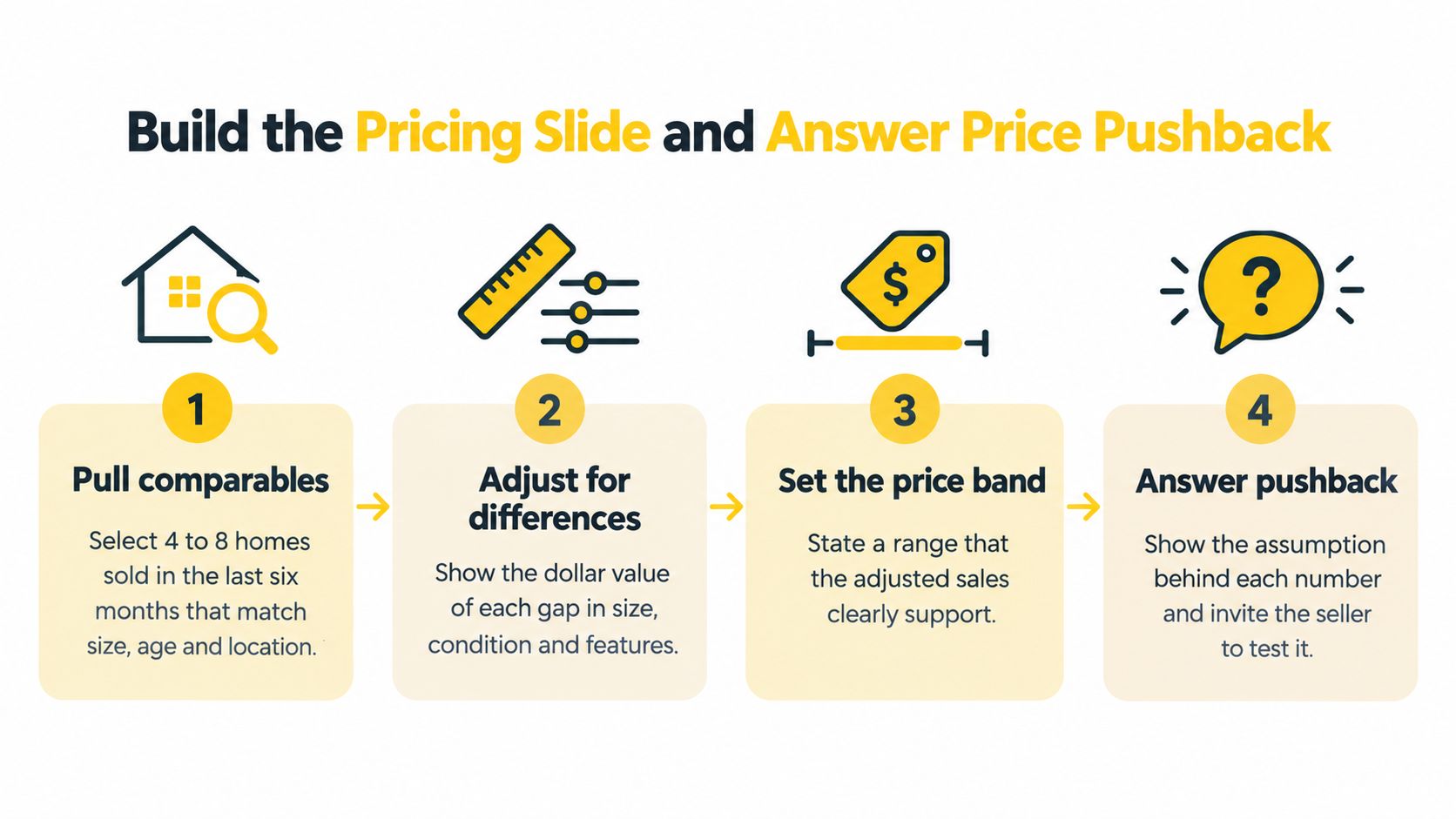
Build the band before the meeting
The same survey put agents' comparable sets at roughly 3.7 to 8.7 properties. I would aim for four to eight sold homes from the last six months that match size, age, and style, which sits in the middle of that range. It also found 75% of agents still hand over the CMA at the appointment rather than beforehand. Sending yours a day early puts you in the prepared minority before you say a word.- Pull the comps the day before. Four to eight closed sales, not every sale in the zip code. You can explain a tight set. You can't defend a dump of listings.
- Write every adjustment. Condition, square footage, lot, and sale date each get a dollar figure the seller can see. Hidden math reads as a guess.
- Set three numbers, each with one assumption. A stretch price for a seller who will wait for a specific buyer. A recommended price that balances price against timing. A fallback price tied to a firm move-by date.
- Put it on one page. Recommended band first, then the two alternatives, then the trigger that moves you from one to the next. Leave the full spreadsheet in the folder.
Answer the pushback in one structure
Acknowledge the concern, ask one question that exposes their assumption, then put the proof on screen. Don't stack five comps and hope they pick yours. When a seller wants to list high and drop later, the exchange should sound like this: "We can try your number. What should we do if the first two weeks are quiet?" Then open the days-on-market history for the comp set and let it carry the point.| Seller Objection | Question to Ask First | Proof to Show |
|---|---|---|
| A neighbor sold for more | What was different about that home? | Side-by-side comp adjustments |
| Let's list high and drop later | What would you do if the first two weeks were quiet? | Days-on-market history for the comp set |
| Another agent promised a higher price | What comps and plan did they show you? | Your plan with dated checkpoints |
| I can sell it myself | How much time can you give to showings and paperwork? | Service schedule and cost of a stale listing |
Practical rule: If you can't answer in the room, name the hour you'll send the missing comp, and deliver it within 24 hours.
Keep the same sequence on a video call
Virtual listing meetings are still uneven. The same survey found many agents have run a remote listing appointment, but far fewer expect to repeat one soon. Run it as the full meeting anyway: same discovery, same one-page summary, same three numbers. Share the screen on the decision page, not on a 40-row export, and email the band sheet before the call so the seller can follow along on paper. The dated checkpoints matter more on video because you can't read the room, so put days 10, 21, and 30 on screen and say each one out loud. The seller should leave knowing which number you recommend, why, and the date that number gets tested.Marketing Plan Slide That Proves Buyer Reach
A list of tactics proves nothing about who will see the home. Zillow's research on choosing an agent found that 52% of sellers treat reaching the largest pool of interested buyers as a top selection factor, 45% prioritize the promise of the highest sale price, and 37% prioritize a fast closing. "We'll do social and an open house" answers none of those. Exposure counts as a plan only when you name the metric and the day you'll read it.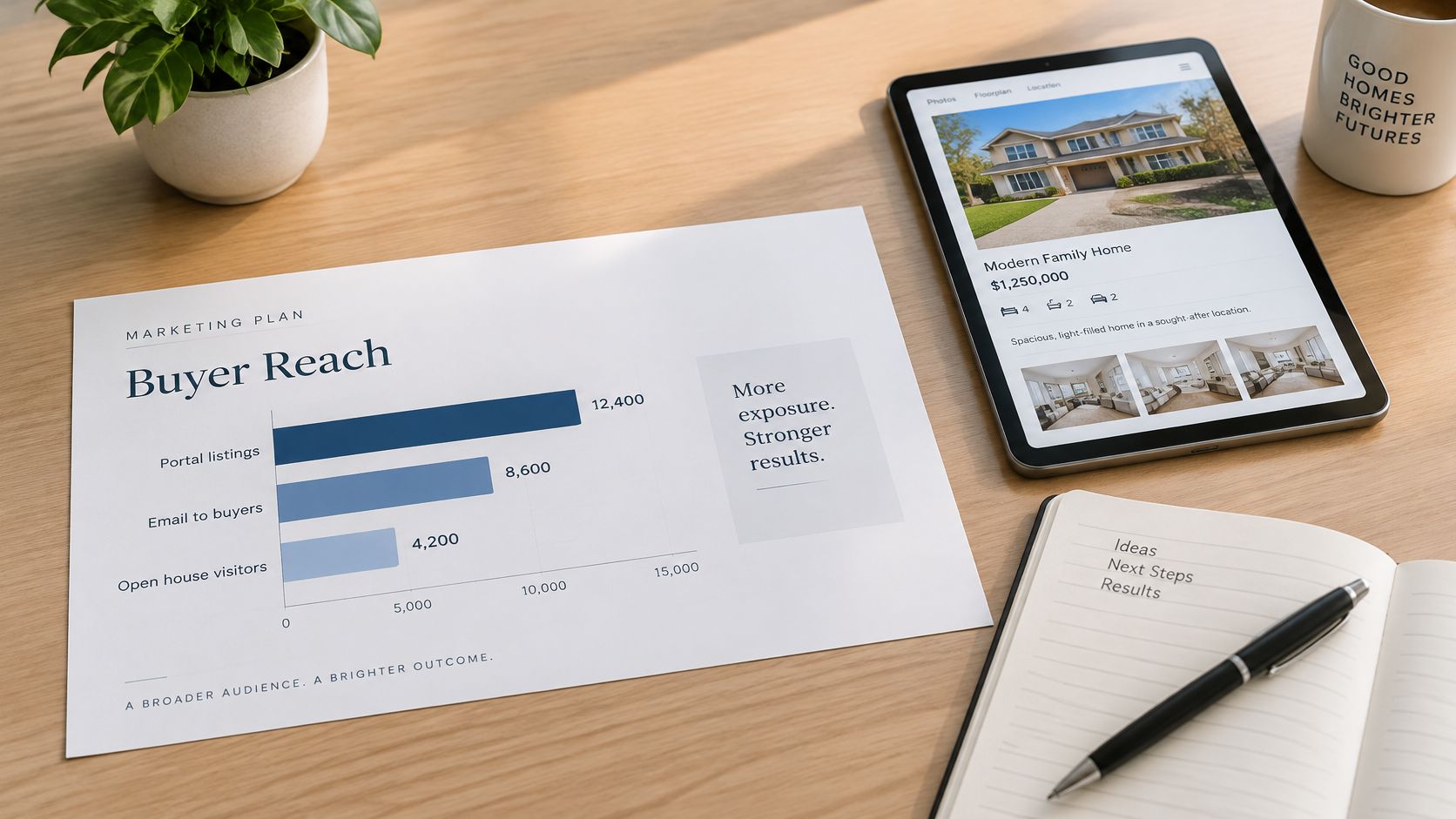 Give each channel one line on a single slide: MLS syndication, then portals, targeted social, your database, the open house, and calls to other agents. Next to each line, the seller sees the number you will report and the price-adjustment trigger attached to it. A quiet week then produces a pre-agreed response instead of a debate in the kitchen.
Before launch, write down days on market and showings from the same comp set you priced against. That baseline defines "working." Put the checkpoints on the slide as dates: launch day, the first weekly report comparing listing views and showing requests to the comp baseline, the twice-weekly read on reach and video completion, and the visitor count from the first open house. If showings trail the comps at that first weekly report, the channel and the price get reviewed together on a date the seller already knows.
The same assets belong in the seller update, not only in launch week. A short walkthrough of listing marketing materials you can reuse shows how a narrated tour sits inside the report, so the weekly numbers arrive next to something visual instead of a paragraph of adjectives.
Give each channel one line on a single slide: MLS syndication, then portals, targeted social, your database, the open house, and calls to other agents. Next to each line, the seller sees the number you will report and the price-adjustment trigger attached to it. A quiet week then produces a pre-agreed response instead of a debate in the kitchen.| Channel | Objective | Metric to Report | Review Cadence |
|---|---|---|---|
| MLS syndication | Reach every agent's active buyer pool | Listing views, saves, days to first showing | Weekly |
| Portal listings | Capture buyers searching the area | Portal views and inquiries | Weekly |
| Targeted social | Reach local buyers beyond the MLS | Reach, video completion rate, shares | Twice weekly |
| Email and database | Reach past clients and referral partners | Opens, clicks, forwarded replies | Per campaign |
| Open house | Convert nearby traffic into leads | Visitors and follow-up leads | Per event |
| Direct agent outreach | Bring buyers represented by other agents | Calls logged and showing requests | Weekly |
Don't lead with a private list
Lead with broad, transparent exposure, and mention a private buyer network only as a supplement after the seller has seen the public plan. Sellers respond to reach they can verify. A channel that expands qualified reach, plus a metric that says when to change course, makes a stronger case than a contact list nobody can check.The same assets belong in the seller update, not only in launch week. A short walkthrough of listing marketing materials you can reuse shows how a narrated tour sits inside the report, so the weekly numbers arrive next to something visual instead of a paragraph of adjectives.
Video Tours and Visual Assets That Pass Review
Video is still the gap in most listing plans. NAR's 2025 generational trends report found that 88% of sellers used the MLS, while only 12% said their agent marketed the home with video, and social media showed up for 22%. Cost explains part of the hesitation. The larger part is that agents can't answer whether the file is useful, MLS-compatible, disclosed, and safe to post in three shapes. Answer it on the slide: give each version a job and a publish date, so the seller sees a schedule instead of a promise.
Ship three versions.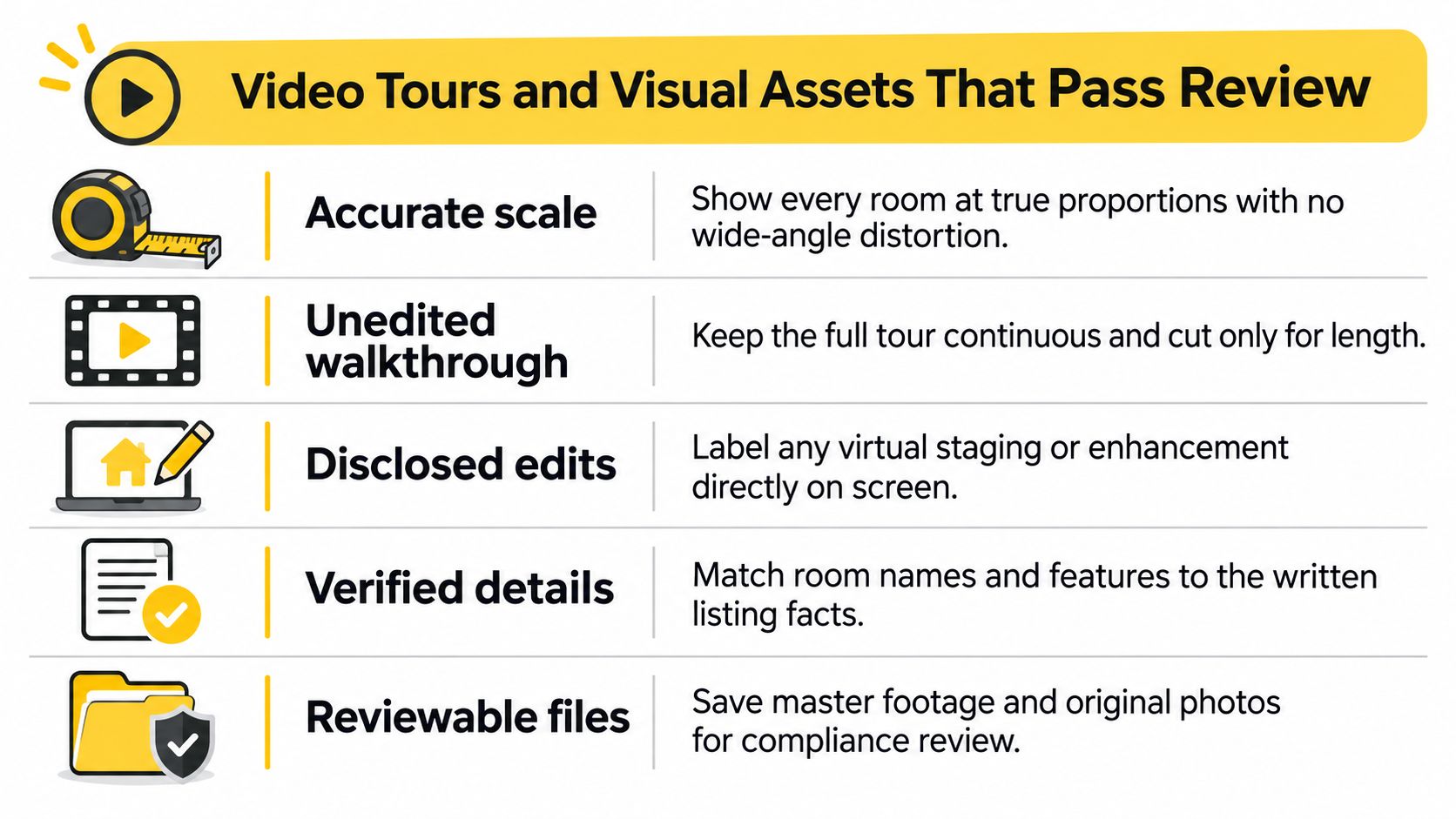
Curb appeal belongs in that approval, not only in the edit. Stains, debris, and dark streaks read larger on a moving shot than in a still. The pre-listing advice from Ventura County Roof Cleaners is a useful pass for sellers who haven't looked up in years, before you lock the photo set.
Ship three versions.
- Horizontal HD at 16:9 runs on the MLS, YouTube, and the property page. Leave the MLS photos unaltered. This is the day-one cut.
- Vertical at 9:16 runs on Instagram, TikTok, and YouTube Shorts. Keep captions clear of the platform's own buttons. It goes live once the horizontal cut is approved.
- Square at 1:1 runs on Facebook, the Instagram feed, and email. Headline text has to be readable on a phone without a zoom. It carries the listing's second week, when the launch spike fades.
Rules before anything publishes
Virtual tours, AI-generated edits, and electronically signed paperwork all sit under the same advertising, disclosure, and record-retention rules as the rest of your marketing. Confirm your state's requirements before anything publishes, and run each render through the pass below. Put this checklist on the slide itself. A seller who watches you work through it stops asking whether the tour is risky.- Label generated changes. Skies, virtual staging, and virtual renovations get an on-screen note.
- Protect the listing photos. Anything that will sit in the MLS stays true to the property.
- Clear the rights. Music and any cloned voice need a license you can show.
- Make it accessible. Captions and an audio description are required, full stop.
- Read the copy for fair housing. Drop wording that describes who should live there.
- Log the version. Name the person who approved each render, and keep the file.
Curb appeal belongs in that approval, not only in the edit. Stains, debris, and dark streaks read larger on a moving shot than in a still. The pre-listing advice from Ventura County Roof Cleaners is a useful pass for sellers who haven't looked up in years, before you lock the photo set.
Commission and Agreement Terms Sellers Ask About
The next-steps slide can't carry the money conversation by itself. Sellers ask what the agreement costs and what it locks them into. Say the commission once, in one line on the agreement slide, as a percentage or a flat fee, and name what that fee covers. Then stop talking and invite the question before anyone reaches the signature line.
- State the listing term and how cancellation works, in plain language, not in the form's smallest type.
- Split the costs out loud. Photo or video production the seller pays directly stays separate from costs you cover. No line item should appear for the first time on an invoice.
- Write the review date and the price-change process so they match the one-page decision summary from the pricing conversation.
- Walk through the electronic signature and where the record lives. A signed file you can't find later is not a closed loop, and generated marketing still has to meet disclosure and retention rules.
- Ask them to repeat the price band and the start date. If they can't say it back, you don't have agreement yet.
Turn the Presentation Into a Signed Listing
The seller signs when the price, the plan, and the dates sit in one place they can reread without you in the room. Before the photo shoot, confirm four items in writing: the agreed price band, the listing term, the review date, and the person who approves each marketing asset. If any of those is still verbal, you're not ready to book the photographer.
Production comes before MLS activation so the tour and the photos go live together. A listing that hits the market with an empty media tab wastes the first weekend of buyer traffic. A week with no showings is a signal to reopen the presentation, not an automatic price cut. Check the channels and the band in the same conversation.
The seller should expect a feedback note around day 14 and a price-review meeting by day 30, with the choice written down as hold, adjust, or reduce. Once the agreement is signed, build the tour from the listing photo set, use the free first video to test the look, and drop those same clips into the update you send. A simple structure for that note is in this guide to a real estate marketing email. If you're still choosing where to hang your license, it helps to compare brokerage support for agents against the calendar you just promised, because a desk that can't back the reporting cadence will show up in week two.
VideoTour.ai turns a listing's photo set into narrated, branded tours in horizontal, vertical, and square formats you can put on the marketing slide and in the seller's weekly update. You can adjust the script, photo order, captions, and music, then approve the cut before it goes near the MLS. When you're ready to show a seller the launch instead of describing it, start at VideoTour.ai.
| Days | Activity | Owner | Checkpoint |
|---|---|---|---|
| 1-3 | Sign agreement, confirm price band, book photo shoot | Agent | Price approved in writing |
| 4-7 | Produce tour, reels and square post; run compliance checklist | Agent and editor | Approval log complete |
| 8-10 | Activate MLS and portal syndication | Agent | Listing checked on desktop and mobile |
| 14-21 | Follow up on showings and feedback | Agent | Feedback summary sent to seller |
| 22-30 | Hold price-review checkpoint | Agent and seller | Hold, adjust or reduce price in writing |
The seller should expect a feedback note around day 14 and a price-review meeting by day 30, with the choice written down as hold, adjust, or reduce. Once the agreement is signed, build the tour from the listing photo set, use the free first video to test the look, and drop those same clips into the update you send. A simple structure for that note is in this guide to a real estate marketing email. If you're still choosing where to hang your license, it helps to compare brokerage support for agents against the calendar you just promised, because a desk that can't back the reporting cadence will show up in week two.
VideoTour.ai turns a listing's photo set into narrated, branded tours in horizontal, vertical, and square formats you can put on the marketing slide and in the seller's weekly update. You can adjust the script, photo order, captions, and music, then approve the cut before it goes near the MLS. When you're ready to show a seller the launch instead of describing it, start at VideoTour.ai.