

The most popular advice for a real estate description is to make the property sound irresistible. Add a lifestyle hook, pile on the adjectives, and tell buyers to book a tour. That approach can make copy feel polished, but it doesn't answer the questions that determine whether someone trusts the listing enough to inquire.
A strong description is a structured disclosure first and a sales pitch second. It gives buyers verifiable facts they can compare, makes material limitations easier to spot, and uses persuasive language only where the evidence supports it. That's how a listing can attract attention without promising more than the property delivers.
A strong description is a structured disclosure first and a sales pitch second. It gives buyers verifiable facts they can compare, makes material limitations easier to spot, and uses persuasive language only where the evidence supports it. That's how a listing can attract attention without promising more than the property delivers.
Summary
Create an AI Video Tours from PhotosTry it For Free

Why Most Real Estate Descriptions Underperform
“Charming,” “stunning,” and “must-see” are easy to write. They're also poor substitutes for information. A buyer can't tell from “charming” whether the kitchen faces east, whether parking is included, or whether the pictured shed is part of the sale.
Detailed property information can make a real difference to how useful a listing feels: 79% of buyers consider it very useful during an online home search, behind photos at 83%, according to the real estate video marketing statistics summary. That puts a practical limit on lifestyle-first copy. Photos may catch the eye, but buyers still need facts to decide whether the property suits them.
Promotional language still has a place. “A quiet place to unwind” can help convey the feel of a covered patio, but it shouldn't stand in for information about its size, orientation, condition, or access. The distinction is simple: facts help buyers evaluate; interpretation helps them imagine.
Vague copy often creates more questions than it answers. If the description calls a home “fully updated,” buyers may wonder which rooms were renovated and when. If it says “easy access,” they may still need to ask about stairs, parking, or the route to the entrance.
Detailed property information can make a real difference to how useful a listing feels: 79% of buyers consider it very useful during an online home search, behind photos at 83%, according to the real estate video marketing statistics summary. That puts a practical limit on lifestyle-first copy. Photos may catch the eye, but buyers still need facts to decide whether the property suits them.
Replace atmosphere with useful detail
A buyer-friendly description makes it easier to screen in or out before scheduling a visit. State what's verified, clarify what's included, and identify relevant limitations or unknowns. A phrase like “generous outdoor space” might sound attractive, but it leaves the buyer guessing. If the actual area or lot dimensions are available, include them and label estimates clearly.Promotional language still has a place. “A quiet place to unwind” can help convey the feel of a covered patio, but it shouldn't stand in for information about its size, orientation, condition, or access. The distinction is simple: facts help buyers evaluate; interpretation helps them imagine.
Vague copy often creates more questions than it answers. If the description calls a home “fully updated,” buyers may wonder which rooms were renovated and when. If it says “easy access,” they may still need to ask about stairs, parking, or the route to the entrance.
The shift that improves a listing: Write to help buyers make a decision, not to make every property sound perfect.
What a Real Estate Description Actually Is
A modern real estate description has two layers. The factual layer records what the property is and what's being offered. The marketing layer helps a reader understand why those facts may matter to them.
The factual layer should be built from verified listing information, property records, and appropriate disclosures. The marketing layer can translate those details into a readable narrative, but it shouldn't alter or exaggerate them. For example, “east-facing kitchen” is a checkable feature; “a sun-drenched kitchen” is an interpretation that may not hold throughout the day or year.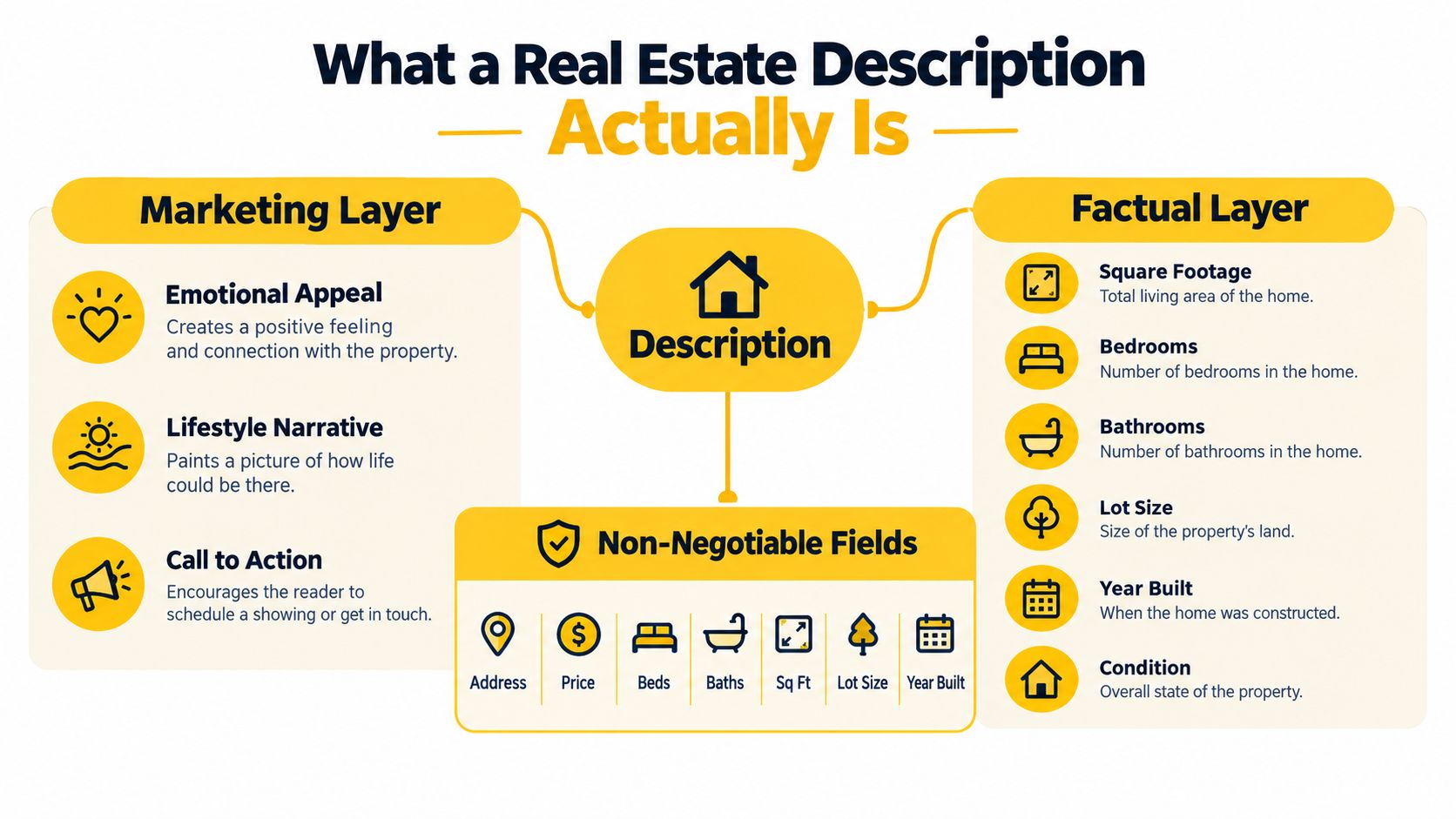
That depth explains why a description connects marketing to valuation and recordkeeping. The Appraisal Institute's overview of appraisal reports describes physical and legal property details, measurements, comparable properties, market-area conditions, and trends as components of appraisal reporting. Keep the same discipline in listing copy: distinguish facts from opinion, and check that the details match the listing media.
A quick audit can reveal gaps before they turn into questions:
The factual layer should be built from verified listing information, property records, and appropriate disclosures. The marketing layer can translate those details into a readable narrative, but it shouldn't alter or exaggerate them. For example, “east-facing kitchen” is a checkable feature; “a sun-drenched kitchen” is an interpretation that may not hold throughout the day or year.
Audit the factual layer first
Appraisal practice treats property description as more than an address and room count. The North Carolina Department of Transportation appraisal guide identifies information such as location, size, shape, road frontage, access, topography, dimensions, utilities, drainage, present use, easements, and encroachments. Its standards also call for a documented property history covering transactions and certain changes over time.That depth explains why a description connects marketing to valuation and recordkeeping. The Appraisal Institute's overview of appraisal reports describes physical and legal property details, measurements, comparable properties, market-area conditions, and trends as components of appraisal reporting. Keep the same discipline in listing copy: distinguish facts from opinion, and check that the details match the listing media.
A quick audit can reveal gaps before they turn into questions:
- Property identity: Confirm address, property type, location context, and permitted use.
- Measurements and layout: Verify building area, lot size, bedrooms, bathrooms, and any relevant floor-plan limitations.
- Condition and features: Check condition, known upgrades, utilities, parking, accessibility, and amenities.
- Transaction details: State inclusions, exclusions, availability, and material restrictions where applicable.
The Core Building Blocks of Every Strong Listing
A strong listing is easy to scan because its information follows a sensible order. Buyers should be able to find the property type, location, size, condition, and practical terms without hunting through a paragraph of superlatives.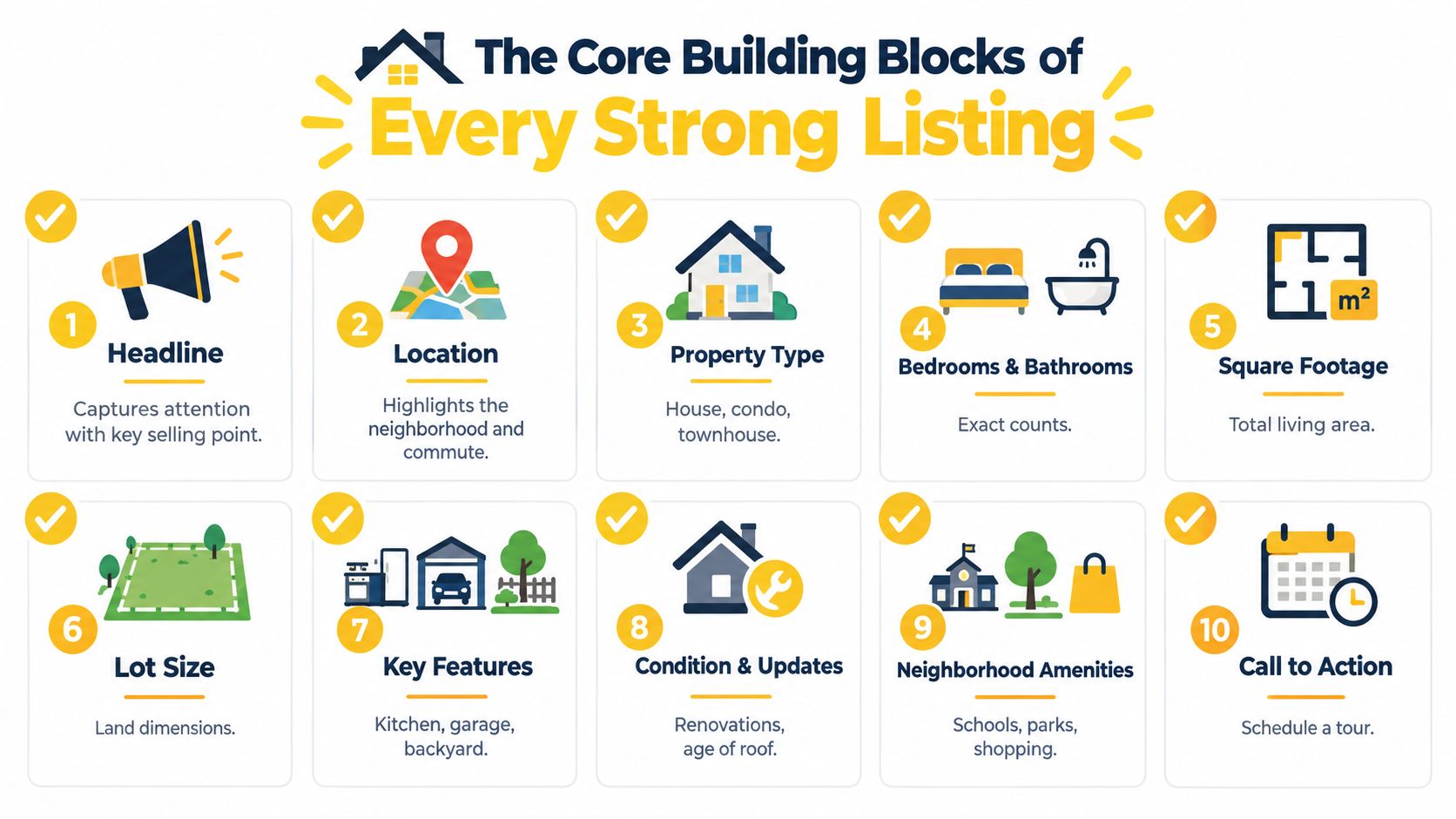
For a sense of how property facts and positioning can appear across real listings, browse the Christie's International Real Estate Puerto Rico sale listings. Use examples for inspiration, not as a substitute for verifying the details of your own property.
When preparing the source information, add property details in a consistent format. That makes it easier to reuse the same verified facts in listing copy, floor plans, and video captions without introducing contradictions.
Build a reusable scaffold
Use these building blocks as a starting point, then adjust them to the property and local disclosure requirements:- Headline: Lead with a verified point of interest, such as a corner position, renovated kitchen, or included parking.
- Location: Give useful context, not vague promises. Name the neighborhood or nearby amenities only when the details are current and supportable.
- Property type and permitted use: Identify whether it's a house, condominium, townhouse, or another property type, and avoid implying a use that hasn't been confirmed.
- Bedrooms and bathrooms: State exact counts and clarify unusual configurations when needed.
- Building area and lot size: Use the applicable measurement source and label approximations.
- Layout and orientation: Describe how rooms connect, where entrances sit, and what buyers should know about access or floor-plan limitations.
- Features and inclusions: Call out meaningful equipment, outdoor areas, appliances, fixtures, and parking. Say what is excluded if a buyer might reasonably assume it stays.
- Condition and upgrades: Name verified work and any relevant context. “New roof” is more useful when its date or documentation is known.
- Costs and restrictions: Include available information about utilities, maintenance, service charges, tenancy terms, association rules, or other material conditions.
- Next steps: Give a clear way to arrange a viewing and point readers to applicable disclosures or application information.
For a sense of how property facts and positioning can appear across real listings, browse the Christie's International Real Estate Puerto Rico sale listings. Use examples for inspiration, not as a substitute for verifying the details of your own property.
When preparing the source information, add property details in a consistent format. That makes it easier to reuse the same verified facts in listing copy, floor plans, and video captions without introducing contradictions.
Writing Techniques That Move Inquiries
Buyers often read listing copy on a phone, between other tasks. A dense paragraph with several claims and long sentences makes it harder to locate useful details. Use a short opening, direct language, and sentence lengths that give the eye room to move.
Sensory verbs can help when they describe something real. "Step from the dining area onto the covered terrace" gives the reader a clear picture. "Experience indoor-outdoor living" makes a bigger promise without supplying more information.
The stronger version isn't necessarily longer. It replaces an adjective with a detail the reader can assess. If the facts support a subjective phrase, use it sparingly and keep the verifiable detail close by.
Use the opening to orient the reader
A practical opening can be five short lines in sequence: the property type and strongest verified feature; the location context; a concrete benefit; a key detail buyers will want to compare; and a transition into the full description. Don't force all five into one sentence. A crisp opening earns attention by telling readers what the home is, where it sits, and why they might keep reading.Sensory verbs can help when they describe something real. "Step from the dining area onto the covered terrace" gives the reader a clear picture. "Experience indoor-outdoor living" makes a bigger promise without supplying more information.
| Generic copy | More useful copy |
|---|---|
| “Bright and airy kitchen” | “East-facing kitchen with a window overlooking the side garden.” |
| “Huge backyard” | “Fenced rear yard with a paved seating area.” |
| “Fully updated home” | “Kitchen cabinetry and bathroom fixtures replaced; confirm dates and permits before publication.” |
A good edit removes claims that the seller can't support and adds the detail a buyer would otherwise have to ask for.For more ideas on translating property features into buyer-facing language, see this guide to features that sell a house in 2023. Then review each sentence with one question: does it tell the reader a fact, explain a benefit, or just take up space? A real estate marketing email can extend the same clear language to follow-up, but it should preserve the listing's verified details rather than introducing new claims.
Adapting One Description for MLS, Social, and Video
A listing shouldn't have one copy block pasted everywhere. MLS fields, a short vertical video, and a property landing page serve different reading situations, but the underlying facts must remain aligned.
Online video is an opportunity that many listings still leave unused: a 2025 industry summary citing NAR data reports that 37% of buyers used online video in their home search, while 12% of sellers' agents marketed the property with video (industry summary). The useful response isn't to cram the entire listing into a video. Build each version from the same verified source and tailor the presentation.
Keep price, dimensions, availability, attribution, and disclosure language consistent wherever they appear. Change the wording, pacing, aspect ratio, and call to action for the platform. A short-form hook can be lively; it still can't imply that a feature exists when it doesn't.
Agents adapting copy for a local social audience may find useful ideas in these real estate marketing tips for Mandurah. For Instagram-specific production, creating a Reel for Instagram can help with format choices. VideoTour.ai is one option for turning listing photos into shareable property videos with captions, music, branding, and different aspect ratios. Whatever tool you use, treat captions and overlays as published listing claims: verify them against the source facts before sharing.
Online video is an opportunity that many listings still leave unused: a 2025 industry summary citing NAR data reports that 37% of buyers used online video in their home search, while 12% of sellers' agents marketed the property with video (industry summary). The useful response isn't to cram the entire listing into a video. Build each version from the same verified source and tailor the presentation.
| Element | MLS Listing | Vertical Reel | Landing Page |
|---|---|---|---|
| Length and order | Complete, restrained detail in fields buyers can scan. | Brief opening hook, then a few salient facts. | Organized sections with fuller context and clear navigation. |
| Information emphasis | Measurements, condition, inclusions, exclusions, and applicable disclosures. | Visual sequence supported by concise captions. | Layout, features, terms, and next steps in one place. |
| Call to action | Contact the listing representative or follow the portal's process. | Ask viewers to visit the listing or arrange a tour. | Make the inquiry or application process explicit. |
| Review needs | Field accuracy and local rules. | Caption readability, accessibility, music rights, and fair-housing review. | Current facts, working contact details, and clear disclosures. |
Agents adapting copy for a local social audience may find useful ideas in these real estate marketing tips for Mandurah. For Instagram-specific production, creating a Reel for Instagram can help with format choices. VideoTour.ai is one option for turning listing photos into shareable property videos with captions, music, branding, and different aspect ratios. Whatever tool you use, treat captions and overlays as published listing claims: verify them against the source facts before sharing.
Common Description Mistakes That Cost Trust
Some listing habits sound energetic but make buyers work harder. Emoji-heavy headlines compete with the property details. “Large backyard” tells a buyer little if dimensions or useful context are available. “Best in town” is an unsupported superlative unless there's a clear, defensible basis for the comparison.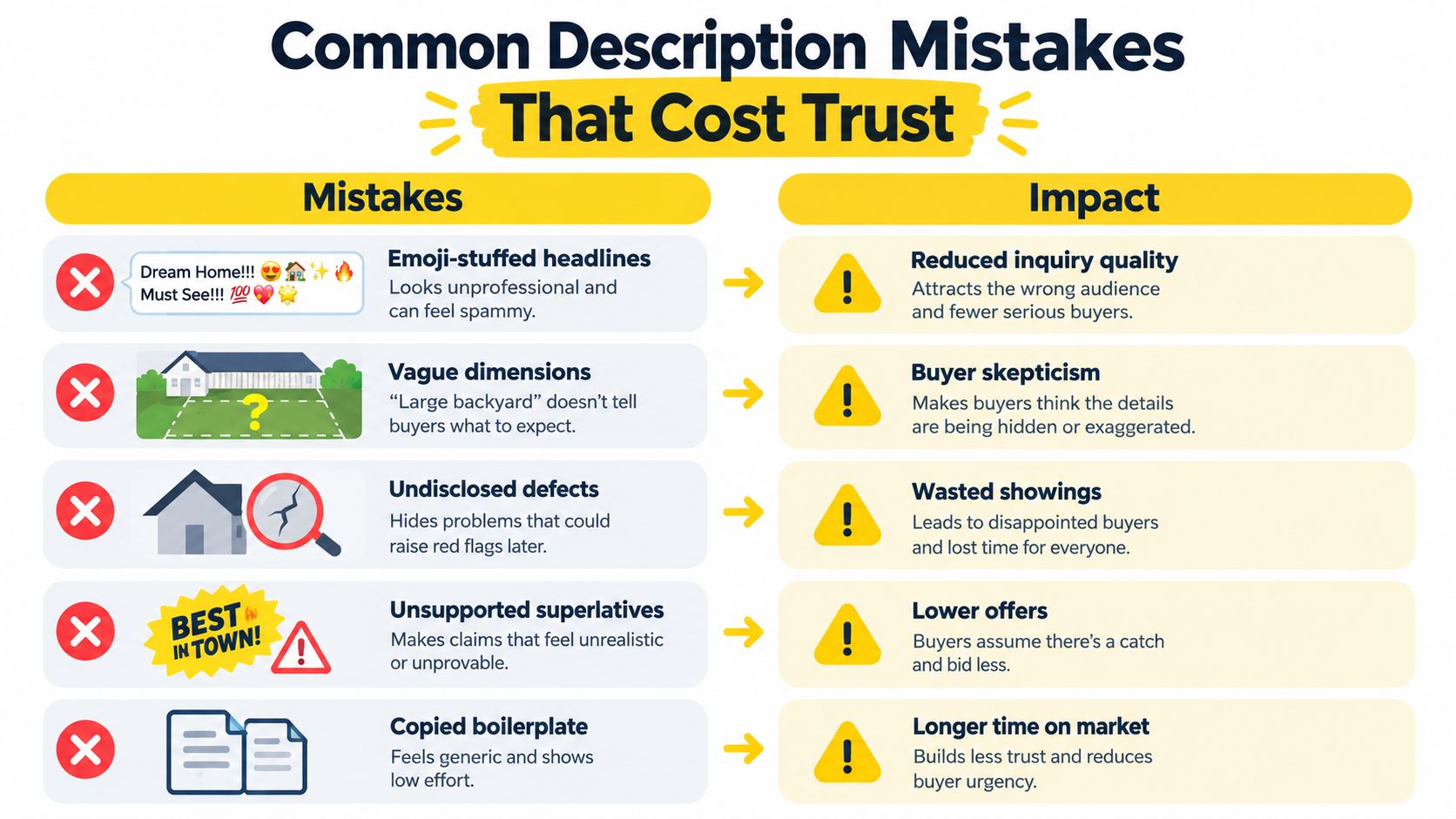
Copied boilerplate causes a quieter problem. A line about a fireplace, garden, or nearby transit that belonged to an old listing can mislead buyers and damage confidence in everything else. Check each feature against the current property rather than assuming last season's copy still applies.
Use this pre-publish check:
Fix the trust leaks before publishing
A description should set realistic expectations for a viewing, not create a surprise at the door. Known material defects and exclusions need careful handling in line with local disclosure rules. Avoid claiming that a property is “perfect,” “fully renovated,” or “move-in ready” unless the wording is accurate and the evidence supports it.Copied boilerplate causes a quieter problem. A line about a fireplace, garden, or nearby transit that belonged to an old listing can mislead buyers and damage confidence in everything else. Check each feature against the current property rather than assuming last season's copy still applies.
Use this pre-publish check:
- Emoji-stuffed headline: Replace decorative clutter with a clear property type or verified feature.
- Vague dimensions: Use the available measurement and name what it refers to, such as building area or lot size.
- Missing defect or exclusion information: Review the appropriate documents and local obligations, then state material details accurately.
- Unsupported superlative: Remove “best,” “perfect,” or “unmatched,” or replace it with a concrete, supportable feature.
- Stale or copied claims: Confirm every detail, including school, transit, amenity, and availability information.
- Fair-housing risk: Use neutral, property-focused language and review wording against applicable rules.
- Media rights: Confirm that the photos, video clips, and music are cleared for the channels where they'll appear.
A Repeatable Workflow from Intake to Publish
A clear workflow prevents a good description from drifting as it moves from a seller's notes to a portal, caption, and video overlay. Keep the verified facts in one source document, then treat every published version as an adaptation of that record.
Generate video captions and overlays from the approved property facts, not from an unreviewed visual impression. If a photo makes a room look larger than the recorded dimensions suggest, the description should follow the verified measurement. The video can add motion; it shouldn't change the facts.
- Collect verified details. Request information from the seller and check appropriate property documents and records. Separate confirmed details from estimates and unresolved questions.
- Draft from the scaffold. Organize the material around identity, location, measurements, layout, features, condition, terms, and next steps.
- Edit for evidence. Mark factual statements and subjective interpretation separately. Remove any claim that can't be supported, or qualify it clearly.
- Create platform versions. Adapt length, order, captions, and calls to action while keeping core facts and disclosures consistent.
- Review and refresh. Check local compliance, accessibility, media rights, availability, and current price language before publication. Set a reminder to revisit details when circumstances change.
Generate video captions and overlays from the approved property facts, not from an unreviewed visual impression. If a photo makes a room look larger than the recorded dimensions suggest, the description should follow the verified measurement. The video can add motion; it shouldn't change the facts.
Putting It Together and Next Actions
A reliable real estate description does two jobs at once. It markets the property and acts as a structured decision aid that buyers, renters, agents, and valuers can interpret against the same underlying facts.
This week, take three practical steps. Audit one active listing for missing measurements, inclusions, condition details, and unclear terms. Rewrite its opening using a verified feature instead of a string of adjectives. Then compare its MLS copy, captions, and landing-page text to confirm that price, dimensions, availability, and disclosures agree.
Apply the same check to older listings before reusing their copy. The more consistently you maintain a single source of truth, the easier it becomes to publish accurate descriptions across records, pages, and media.
VideoTour.ai turns property photo sets into ready-to-share video tours with editable captions, music, and branding, giving you another format for communicating verified listing details. Build the description first, then use VideoTour.ai to adapt those facts into a video buyers can review before arranging a tour.
This week, take three practical steps. Audit one active listing for missing measurements, inclusions, condition details, and unclear terms. Rewrite its opening using a verified feature instead of a string of adjectives. Then compare its MLS copy, captions, and landing-page text to confirm that price, dimensions, availability, and disclosures agree.
Apply the same check to older listings before reusing their copy. The more consistently you maintain a single source of truth, the easier it becomes to publish accurate descriptions across records, pages, and media.
VideoTour.ai turns property photo sets into ready-to-share video tours with editable captions, music, and branding, giving you another format for communicating verified listing details. Build the description first, then use VideoTour.ai to adapt those facts into a video buyers can review before arranging a tour.