

46% of respondents used AI-generated content, explicitly including listing descriptions, according to the National Association of REALTORS® 2025 Technology Survey. That makes the useful question less about whether AI can write listing copy and more about who checks it before buyers read it. Fast drafting helps, but speed without a review trail is the expensive version.
Summary
Create an AI Video Tours from PhotosTry it For Free

What an AI Listing Description Is Now
An AI listing description is a probabilistic draft that a model writes from facts the agent supplies. It isn't a verified property record or a signed disclosure. Treat it like a fast junior writer who knows the conventions of real estate advertising but has never walked through this house.
Say an agent supplies a ranch property's room counts, kitchen finishes, and fenced yard. The model arranges those details into readable paragraphs, then adds a finished basement because that feature fits the pattern of similar listings. The sentence sounds ordinary, which is exactly why someone must catch it.
The distinction should be visible wherever your team drafts copy.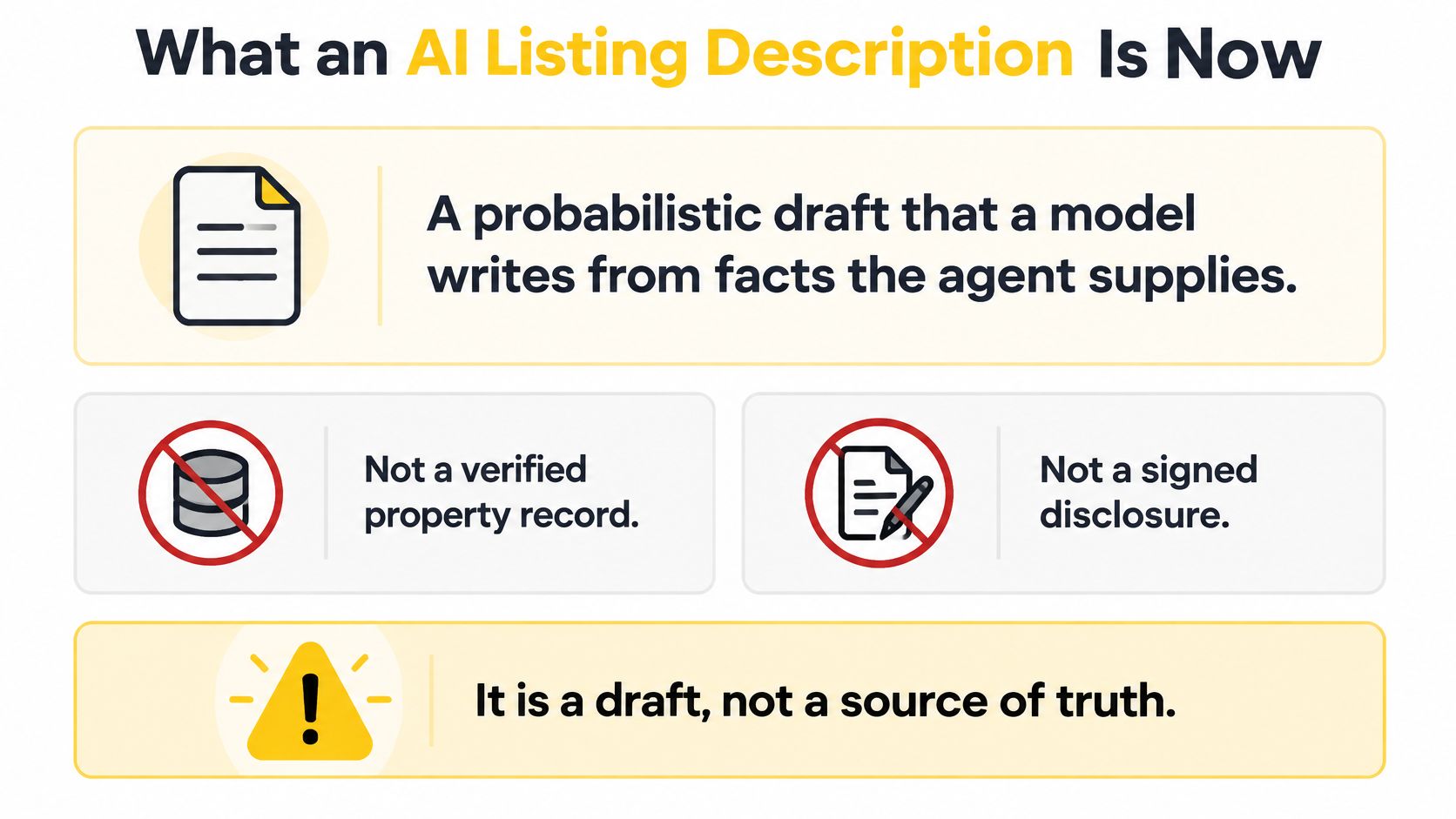
A workable handoff contains:
Say an agent supplies a ranch property's room counts, kitchen finishes, and fenced yard. The model arranges those details into readable paragraphs, then adds a finished basement because that feature fits the pattern of similar listings. The sentence sounds ordinary, which is exactly why someone must catch it.
The distinction should be visible wherever your team drafts copy.
Define the handoff before choosing the tool
The agent's job is to supply evidence, resolve contradictions, and approve the final representation of the property. The model's job is narrower: organize those approved facts into useful language. Don't combine those responsibilities just because the drafting interface looks confident.A workable handoff contains:
- Source facts: Property fields tied to identifiable documents or confirmed observations.
- Writing constraints: Channel, tone, required statements, and prohibited assumptions.
- Named approval: A person who accepts the edited description for publication.
Measure the finished workflow
Don't judge a description generator solely by how quickly it fills an empty box. Count the work required to reconcile room counts, remove unsupported condition claims, restore omitted information, and correct every published version.Desk rule: A draft is ready for editing when it sounds readable. It's ready for publication only when a named reviewer can support its claims.That changes the buying criteria for any drafting tool. Useful controls include editable inputs, clear handling of missing fields, and a way to retain the approved version. A more elaborate paragraph isn't an improvement if the agent has to investigate every adjective.
Facts Every Listing Description Must Carry
Complete this worksheet before writing a prompt. The source column matters as much as the copy column.
Blocks of an AI listing description
Next, reconcile the structural fields. Check the MLS input sheet against the underlying listing file before calling it authoritative. A room labeled as an office in the paperwork shouldn't become an additional bedroom because the photograph contains a bed.
For size, retain the source's units and distinctions. Don't combine living area with unfinished space or choose the larger of conflicting measurements. Record the discrepancy for resolution before drafting.
Updates need scope as well as timing. An invoice for cabinet painting doesn't support a claim that the kitchen was completely renovated. An installed appliance isn't evidence of a broader electrical upgrade.
For the listing desk, the implication is straightforward: don't force sparse facts into a long description. Expand only when another verified detail helps a buyer understand the property. Repeating appealing adjectives adds length without adding information.
The setting block deserves particular restraint. Separate a documented view from a promise that nothing will ever obstruct it. Don't infer flood status from appearance, or turn a nearby school into an unsupported ranking or travel-time claim.
When entering the approved information into the publishing workflow, use the property-details instructions to organize the fields. Finish the worksheet before opening the drafting tool, so an absent pool, permit, or school detail stays absent.
Blocks of an AI listing description
| Block | Put in the draft | Prove it with | Do not let AI add |
|---|---|---|---|
| Opening | One verified standout | Photos or seller disclosure | Lifestyle or buyer guesses |
| Structure | Type, beds, baths, garage | MLS input sheet | Extra rooms or half-baths |
| Size | Living area and lot, with units | Tax record or appraisal | Rounded-up square footage |
| Updates | Year and scope of work | Permits or invoices | Brand names not supplied |
| Setting | Documented view, flood, or HOA | Public record or disclosure | School ranks or walk times |
| Close | Showing or offer instruction | Brokerage policy | Unsupported urgency |
Build the sheet in publication order
Start with a documented distinction, not a generic welcome. A fenced yard, a covered terrace, or a kitchen renovation gives the writer something concrete to lead with. Photos can support visible features, but they don't establish permits, ownership boundaries, or the working condition of equipment.Next, reconcile the structural fields. Check the MLS input sheet against the underlying listing file before calling it authoritative. A room labeled as an office in the paperwork shouldn't become an additional bedroom because the photograph contains a bed.
For size, retain the source's units and distinctions. Don't combine living area with unfinished space or choose the larger of conflicting measurements. Record the discrepancy for resolution before drafting.
Updates need scope as well as timing. An invoice for cabinet painting doesn't support a claim that the kitchen was completely renovated. An installed appliance isn't evidence of a broader electrical upgrade.
Let evidence determine length
Listing copy isn't a uniform information container. Zillow's analysis of real estate descriptions describes the text as a source of distinctive property attributes while examining the complications of extracting information from it.For the listing desk, the implication is straightforward: don't force sparse facts into a long description. Expand only when another verified detail helps a buyer understand the property. Repeating appealing adjectives adds length without adding information.
The setting block deserves particular restraint. Separate a documented view from a promise that nothing will ever obstruct it. Don't infer flood status from appearance, or turn a nearby school into an unsupported ranking or travel-time claim.
- Keep uncertainty visible: Mark unresolved fields as excluded from publication, not as blanks for the model to fill.
- Separate internal notes: Seller circumstances and negotiation instructions don't belong in public-facing source material.
- Use an authorized close: Confirm showing instructions rather than inventing scarcity or an offer deadline.
When entering the approved information into the publishing workflow, use the property-details instructions to organize the fields. Finish the worksheet before opening the drafting tool, so an absent pool, permit, or school detail stays absent.
Where AI Copy Helps and Where It Fails
Delegate writing operations, not property judgment. A request to shorten verified copy gives the model a bounded task. A request to make a home sound exceptional invites unsupported interpretation.
In a Delta Media Group survey described by Florida Realtors, 82% of real estate agents surveyed used AI to craft property descriptions in 2024, and the survey included more than 130 brokerage leaders. Access to drafting tools isn't a distinctive workflow by itself.
The practical comparison is the writing job and its failure mode.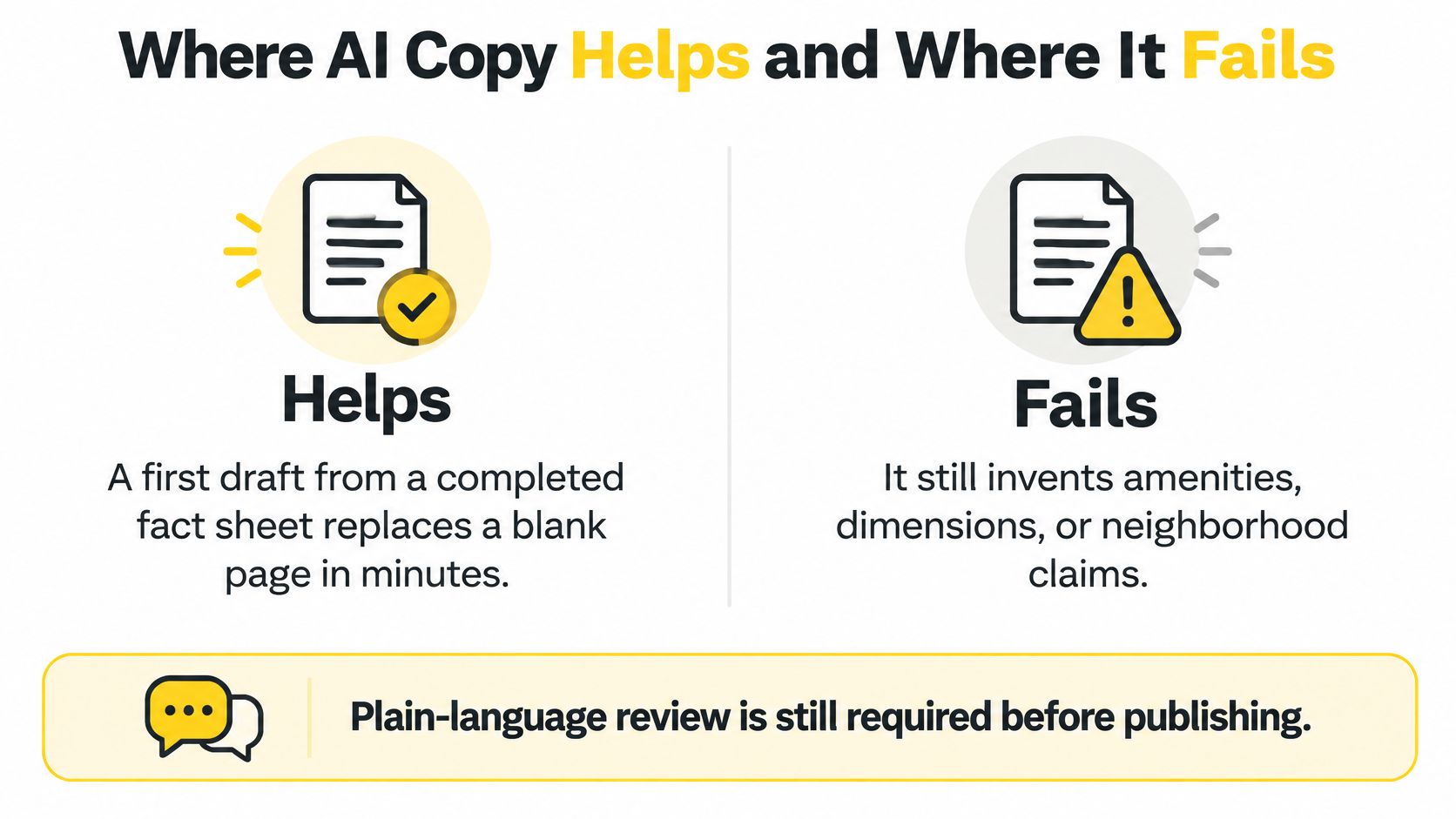
A first draft helps most when the agent already knows what belongs in it. Asking the tool to arrange a completed worksheet removes blank-page friction. Asking it to discover the selling points from an incomplete address record creates a different and riskier assignment.
Plain-language rewriting is useful for dense abbreviations and awkward room-by-room lists. However, a smoother sentence can change meaning: a kitchen with selected updates isn't necessarily a renovated kitchen. Preserve qualifications even when they make the prose less elegant.
Tone changes deserve the same discipline. A higher asking price doesn't establish bespoke cabinetry, architectural significance, or premium construction. Ask for restrained, specific language rather than a luxury transformation.
Lumi Humanizer's AI copywriter guide is a useful companion when thinking about the human editing role. On a listing desk, that role includes checking whether improved phrasing has changed the claim.
In a Delta Media Group survey described by Florida Realtors, 82% of real estate agents surveyed used AI to craft property descriptions in 2024, and the survey included more than 130 brokerage leaders. Access to drafting tools isn't a distinctive workflow by itself.
The practical comparison is the writing job and its failure mode.
Match the assignment to the evidence
| Copy job | Useful contribution | What the editor must catch |
|---|---|---|
| First draft | Organizes completed fact blocks | Added amenities or invented connections |
| Plain-language rewrite | Removes stiff MLS shorthand | Lost qualifications or required statements |
| Shorter portal version | Removes repetition | Omitted material information |
| Tone adjustment | Changes rhythm and vocabulary | Unsupported luxury or condition claims |
| Alt text and metadata | Produces concise supporting text | False features repeated outside the main copy |
Plain-language rewriting is useful for dense abbreviations and awkward room-by-room lists. However, a smoother sentence can change meaning: a kitchen with selected updates isn't necessarily a renovated kitchen. Preserve qualifications even when they make the prose less elegant.
Style changes aren't fact changes
A shorter version should discard redundancy before discarding substance. If the original explains that an advertised space is unfinished, the shortened version can't retain the space while dropping that qualification.Tone changes deserve the same discipline. A higher asking price doesn't establish bespoke cabinetry, architectural significance, or premium construction. Ask for restrained, specific language rather than a luxury transformation.
Lumi Humanizer's AI copywriter guide is a useful companion when thinking about the human editing role. On a listing desk, that role includes checking whether improved phrasing has changed the claim.
Good delegation leaves the editor choosing better sentences, not investigating newly invented property features.Evaluate the time saving after review, not at generation. A quick draft that requires extensive correction may still help, but only if the final editing burden is lower than writing from the worksheet directly.
How to Check Every Claim Before Publishing
The agent, broker, or MLS user remains responsible for the published representation; the software doesn't assume that professional responsibility. A fluent sentence isn't evidence, and an automated compliance label isn't a substitute for brokerage review.
Use this routine on the actual version headed for publication, not an earlier draft.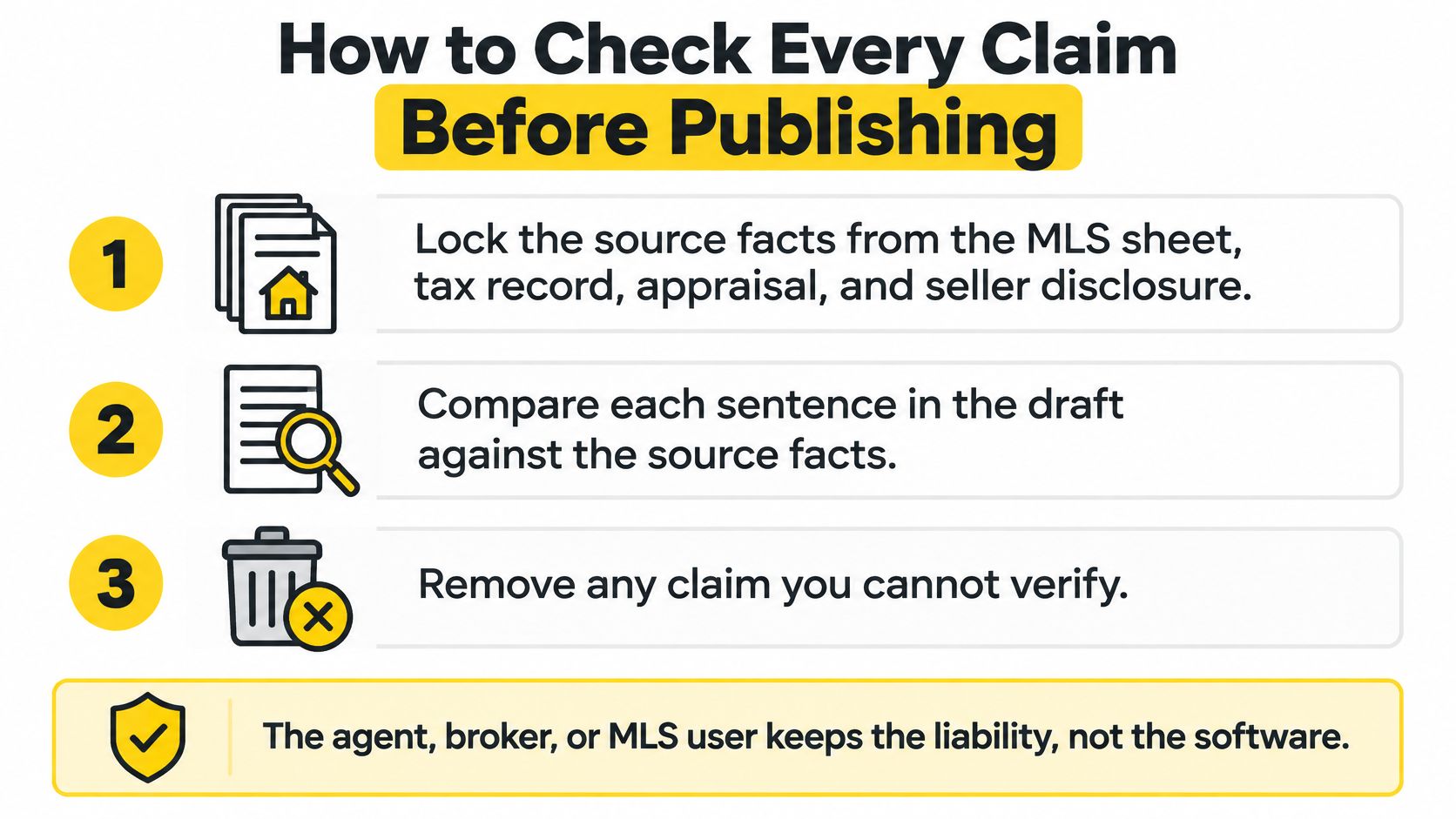
Spell-check doesn't sign the contract. Likewise, AI wording doesn't remove the obligation to avoid exaggeration, concealment of pertinent facts, or misrepresentation.
Use this routine on the actual version headed for publication, not an earlier draft.
Run the approval pass
- Lock the source facts. Assemble the MLS input sheet, tax record, appraisal, seller disclosure, and supporting documents. Resolve conflicting values before drafting, and leave remembered but unconfirmed details out.
- Constrain the prompt. Instruct the model to use only the approved fields, preserve qualifications, and omit missing information. Make clear that the result needs review so nobody mistakes a generated response for cleared copy.
- Generate a single working description. Edit that document rather than creating a pile of competing keyword versions. Keep the source sheet attached to the working file so the reviewer can compare claims without searching through messages.
- Check each property field. Compare beds, baths, living area, lot size, and year built against their designated sources. Then check permits, flood history, school references, distances, renovation scope, and accessibility statements. A visible ramp doesn't establish that an entire property is accessible, and a nearby destination doesn't establish a walking time.
- Remove unsupported evaluations. Inspect terms such as fully renovated, maintenance-free, pristine, and safest. If a statement implies condition, safety, or completeness beyond the evidence, replace it with the specific supported feature or delete it.
- Describe the property rather than a preferred resident. A fenced yard describes a feature; declaring a preferred household describes who should live there. Review demographic assumptions, exclusionary phrasing, and neighborhood language that could steer a reader. The practical distinction between feature descriptions and presumed buyers is central to this real estate AI workflow guidance; route uncertain language to the broker rather than improvising a legal judgment.
- Inspect the supporting fields. Titles, meta descriptions, structured data, and image alt text need their own factual pass. Google's guidance on generative AI content recommends checking accuracy, including metadata, before publication. Don't clear the main paragraph while leaving the rejected amenity in a page title.
- Record the approval. Retain the input facts, generated draft, edits, reviewer's name, and approval time. If a substantive fact changes afterward, reopen approval rather than editing the published master unnoticed.
Approve the destination as well as the words
Commercial permission and MLS suitability are separate checks. Use the commercial-use and MLS guidance when preparing assets, then confirm the receiving board's requirements and your brokerage's instructions.Spell-check doesn't sign the contract. Likewise, AI wording doesn't remove the obligation to avoid exaggeration, concealment of pertinent facts, or misrepresentation.
Publication gate: Any measurement or neighborhood claim without an identifiable source stays out, even when deleting it makes the copy less impressive.
Sample Listing Descriptions You Can Adapt
A listing description should be a constrained draft: use verified property facts, obtain approval from a named human, then reuse that approved copy as the source for channel versions and video. Speed helps only when the final wording can be traced to supported details and an accountable reviewer.
The examples below use hypothetical property details to show how specific claims change the copy. Treat each fact as an illustration, not as information about a property for sale.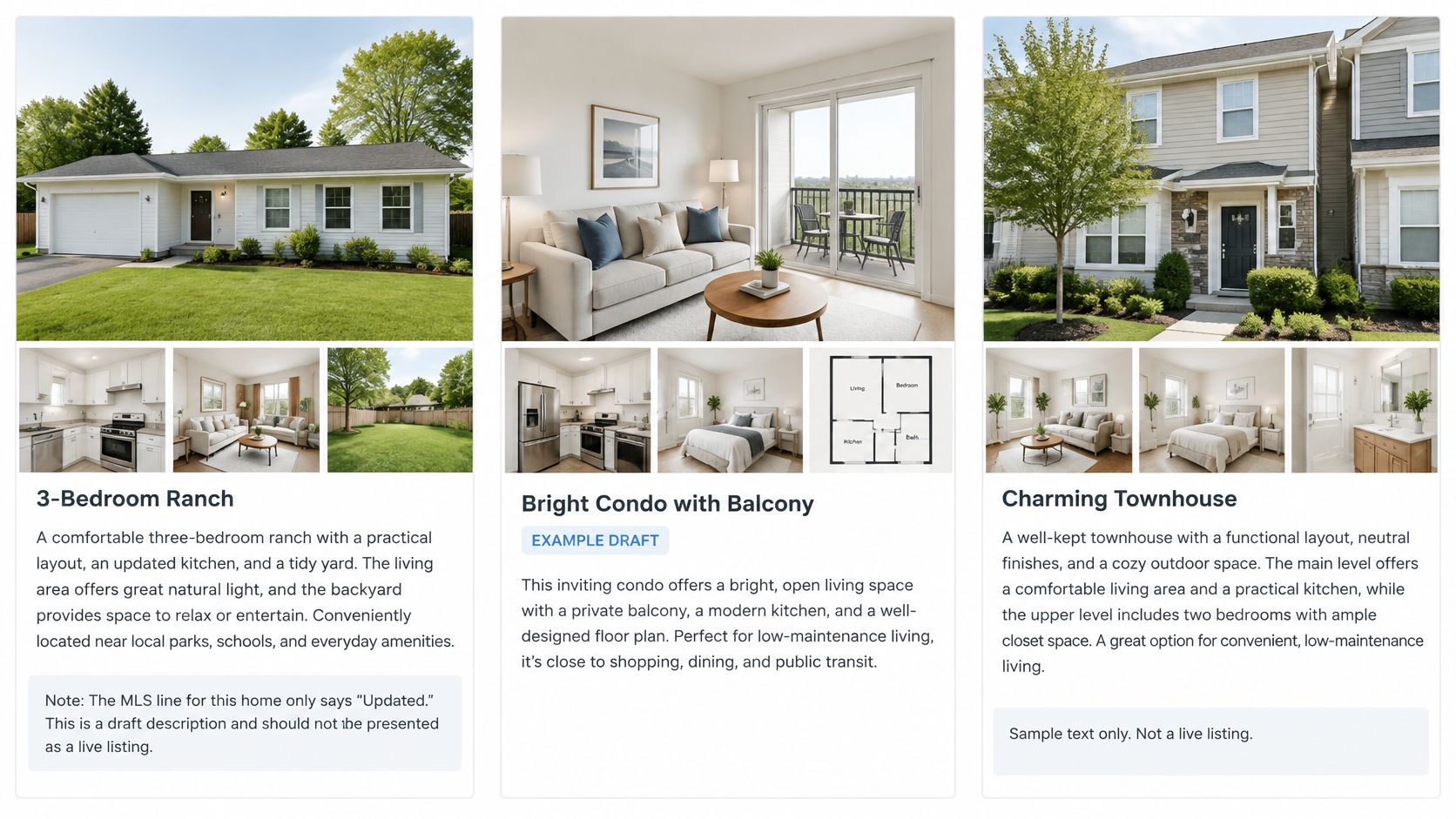
The examples below use hypothetical property details to show how specific claims change the copy. Treat each fact as an illustration, not as information about a property for sale.
Ranch with vague update language
Suppose the available property facts include three bedrooms, a kitchen renovated in 2022, quartz counters, a fenced rear yard, and a covered patio. A generic claim that the home is updated and move-in ready adds little. “Move-in ready” also makes a broad statement about condition without telling readers what supports it.A kitchen renovated in 2022 and a fenced rear yard distinguish this three-bedroom ranch. Quartz counters add a specific kitchen detail, while the covered patio offers a sheltered outdoor area. Contact the listing agent for showing arrangements.The copy uses concrete features instead of a general condition claim. Each sentence should be traceable to a listing fact, and a named human should approve the draft before it becomes the master description. If the confirmed details do not support another useful sentence, keep the copy concise rather than filling space with assumptions.
Condo with an invented school claim
Suppose the confirmed condo details are a balcony, in-unit laundry, and an assigned parking space. A generated sentence calling nearby schools award-winning adds a school-quality claim, while “steps away” adds a distance claim. Neither belongs in the description unless the listing facts support it.This condo includes a balcony, in-unit laundry, and an assigned parking space. Contact the listing agent for showing arrangements.A shorter description is preferable to an appealing sentence with no support. Do not retain an unsupported claim just because it makes the paragraph read more smoothly.
Townhouse with inflated luxury language
Suppose the townhouse facts include quartz counters and a primary bedroom measuring twelve by fourteen feet. Words such as “stunning” and “breathtaking” do not tell a reader what the kitchen contains or how large the room is.Quartz counters highlight the kitchen, and the primary bedroom measures twelve by fourteen feet.Materials and dimensions give readers details they can assess. Keep the units and qualifications supplied with each fact, and do not use adjectives as substitutes for evidence.
Reuse the prompt structure, not the property sentences
Give an AI tool a completed fact block and clear limits. The prompt should direct it to use only supplied facts, retain units and qualifications, omit missing fields, and avoid inferring amenities, condition, distances, neighborhood qualities, or superlatives. It should also specify the approved showing instruction and request concise copy.Act as a listing assistant. Write a concise property description using only the completed fact blocks below. Preserve units and qualifications, omit missing fields, and don't infer amenities, condition, distances, or neighborhood qualities. Avoid protected-class preferences and unsupported superlatives. Use only the supplied showing instruction. The named reviewer is responsible for approving the finished copy. Approved fact blocks follow.Replace the entire fact block for each new address. Reusing sentences from another property can carry over an incorrect garage, renovation, or view. Once the named reviewer approves the draft, use that version as the source for channel edits and video rather than generating a new set of property claims.
Channel Cuts and Putting the Approved Draft on Video
Keep one approved master description, then make controlled cuts for each destination. Regenerating every channel version independently creates unnecessary opportunities for the versions to disagree.
A channel adaptation should change emphasis, format, or length, not the underlying property representation. Preserve any qualification that a retained claim needs.
Channel cuts from one approved draft
Disclosure and ownership need their own decisions. NAR's response on AI regulatory reform addresses industry concerns involving AI, copyright, consumer data, and clearer rules. Don't assume that wording assistance and altered property imagery raise identical questions, or that permission to use photographs settles rights in every subsequent asset.
A prudent file records AI assistance, the human-edited master, source permissions, and the applicable brokerage, MLS, platform, and jurisdictional checks. Where disclosure is needed, make it accurate and proportionate rather than adding a generic disclaimer that explains nothing.
Check each exported version in its final layout. A truncated caption can lose a qualification, and a title card can make a broader promise than the voiceover. Keep amenity and eligibility language understandable and welcoming, without demographic assumptions.
Supply only approved highlights for narration and on-screen text. Match each sentence to the relevant photograph, and confirm that the image itself doesn't imply something the listing file can't support. When an MLS requires an unbranded version, we can prepare one, but the wording still needs the same destination-specific review.
Before release, confirm that the fact sheet is complete, the approval is recorded, and the rendered assets match the cleared master. A buyer, a broker, and the MLS file should all encounter the same house.
Bring your approved listing highlights and existing photos to VideoTour.ai to create a property video without another shoot. New users can create their first listing video for free, with no credit card required. Review the captions and voiceover against your approved description before sharing it.
A channel adaptation should change emphasis, format, or length, not the underlying property representation. Preserve any qualification that a retained claim needs.
Channel cuts from one approved draft
| Channel | Lead with | Length or limit | Do not add |
|---|---|---|---|
| MLS or portal | Type, counts, and size | Concise; follow the receiving board's field limits and media rules | New neighborhood or condition claims |
| Brokerage page | Full reviewed master draft | Full approved length | Neighborhood color that failed the source check |
| Social caption | One verified hook and a showing ask | Short | Any new claim because the post is brief |
| Alt text | Room name and visible features | Short descriptive line | Marketing adjectives |
| Video voiceover and on-screen text | Only highlights that survived review | Matches the master's claims | Rooms or features the copy removed |
Keep governance with the listing file
Keep confidential seller financial details and unlicensed source material out of prompts. Before uploading property information, review the vendor's terms for storage, reuse, retention, and access. Public listing facts and private negotiation notes shouldn't travel together merely because they occupy the same internal document.Disclosure and ownership need their own decisions. NAR's response on AI regulatory reform addresses industry concerns involving AI, copyright, consumer data, and clearer rules. Don't assume that wording assistance and altered property imagery raise identical questions, or that permission to use photographs settles rights in every subsequent asset.
A prudent file records AI assistance, the human-edited master, source permissions, and the applicable brokerage, MLS, platform, and jurisdictional checks. Where disclosure is needed, make it accurate and proportionate rather than adding a generic disclaimer that explains nothing.
Adapt for usefulness, not keyword volume
Google's helpful-content guidance favors useful, reliable material created for people and recommends explaining automation when readers would reasonably expect that context. Don't turn a property into multiple near-identical pages merely to target keyword variations.Check each exported version in its final layout. A truncated caption can lose a qualification, and a title card can make a broader promise than the voiceover. Keep amenity and eligibility language understandable and welcoming, without demographic assumptions.
- Read the social caption aloud: Confirm that the hook still describes the property accurately.
- Inspect accessibility text separately: Describe the image rather than pasting the sales paragraph.
- Check rendered video text: Review what viewers see, including captions and closing cards.
Put the approved highlights on video
With VideoTour.ai, we turn existing listing photos into consistent, ready-to-post videos in minutes, without another shoot or editing timeline. The workflow is to import a link or photos, make it yours, then share your listing; our guide to turning listing photos into video tours explains that handoff.Supply only approved highlights for narration and on-screen text. Match each sentence to the relevant photograph, and confirm that the image itself doesn't imply something the listing file can't support. When an MLS requires an unbranded version, we can prepare one, but the wording still needs the same destination-specific review.
Before release, confirm that the fact sheet is complete, the approval is recorded, and the rendered assets match the cleared master. A buyer, a broker, and the MLS file should all encounter the same house.
Bring your approved listing highlights and existing photos to VideoTour.ai to create a property video without another shoot. New users can create their first listing video for free, with no credit card required. Review the captions and voiceover against your approved description before sharing it.