
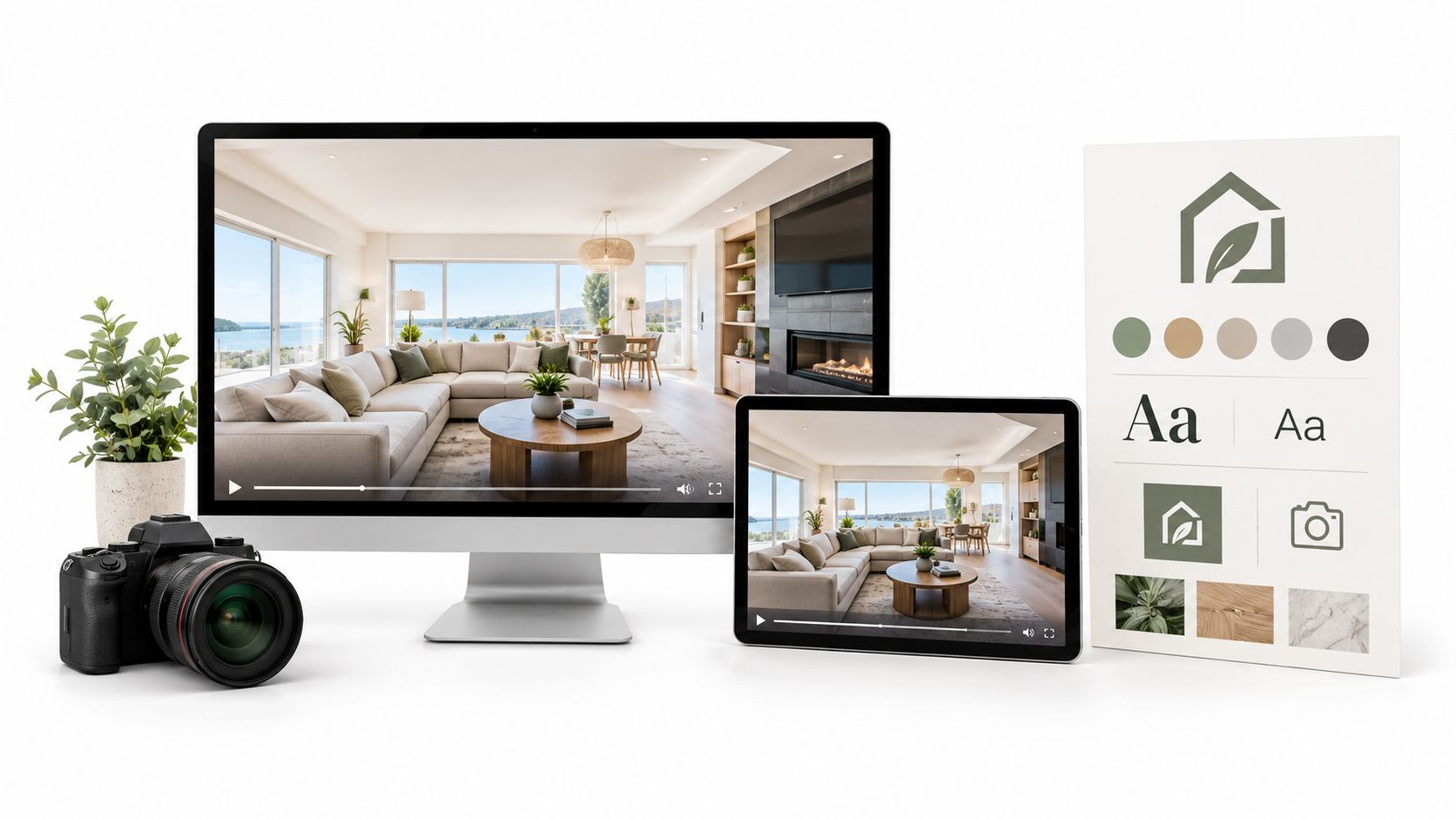
Branding guidelines are a formal operating system that documents how a brand should look, sound, and appear across its touchpoints, not just a logo sheet. Consistent brand presentation has been associated with 10% to 20% higher revenue and brand visibility 3.5 times higher than inconsistent presentation, according to industry research summarized by WiserNotify.
Think about a familiar brokerage week. One agent posts a polished property tour with a small logo, clean captions, and gentle music. Another uses a different font, oversized branding, and a loud soundtrack. A third has no clear end card or call to action. Each video may suit its listing, but viewers may not recognize that all three came from the same brokerage.
A useful guideline helps settle those everyday choices before the next listing goes live. It gives agents and marketers a shared reference for what stays consistent, what can change, and how to make a video feel unmistakably part of the brand without making every property look identical.
Summary
Create an AI Video Tours from PhotosTry it For Free

What Branding Guidelines Actually Do
 A branding guideline is the house style a newsroom uses so that stories feel recognizable even before readers see a byline. For a brokerage, it plays a similar role across listing tours, social posts, property pages, and materials created by agents or outside vendors. It describes how to use the logo and its clear space, approved colors and color codes, typography, imagery, iconography, tone of voice, layouts, templates, and examples of correct and incorrect use.
That breadth matters because a brand is experienced through more than its mark. Viewers may see a brokerage's identity in a video thumbnail, the font used for a property address, the wording of a caption, or the final call to action. If those choices change without a reason, each new asset asks viewers to recognize the brand from scratch.
Guidelines became more important as businesses needed the same identity to appear across print, packaging, offices, advertising, websites, and social channels. Property video brings the same challenge into a faster-moving format. A single listing might appear in a full tour, a vertical social edit, a thumbnail, captions, and a landing page, all produced by different people or tools.
A reference, not a taste test
The point isn't to make every video look alike. It's to replace repeated guesswork with decisions a producer can apply: which logo version belongs on dark footage, how captions should sound and look, and what a closing card needs to include.This is also why guidelines are more than an optional design reference. They help preserve recognition as teams make new assets, and they connect consistent presentation with business outcomes rather than individual taste. In the WiserNotify summary, consistent brand presentation is associated with 10% to 20% higher revenue, while consistent visibility is reported as 3.5 times higher than for inconsistently presented brands. These figures help explain the value of a shared standard, though they don't guarantee a particular result for any individual brokerage.
A real guideline lets an agent answer, “What should I do with this video?” without hunting for a designer or relying on memory. It makes the brand easier to reproduce and easier to recognize, whether the next asset is a luxury home tour or a quick neighborhood clip.
From Brand Strategy to Repeatable Decisions
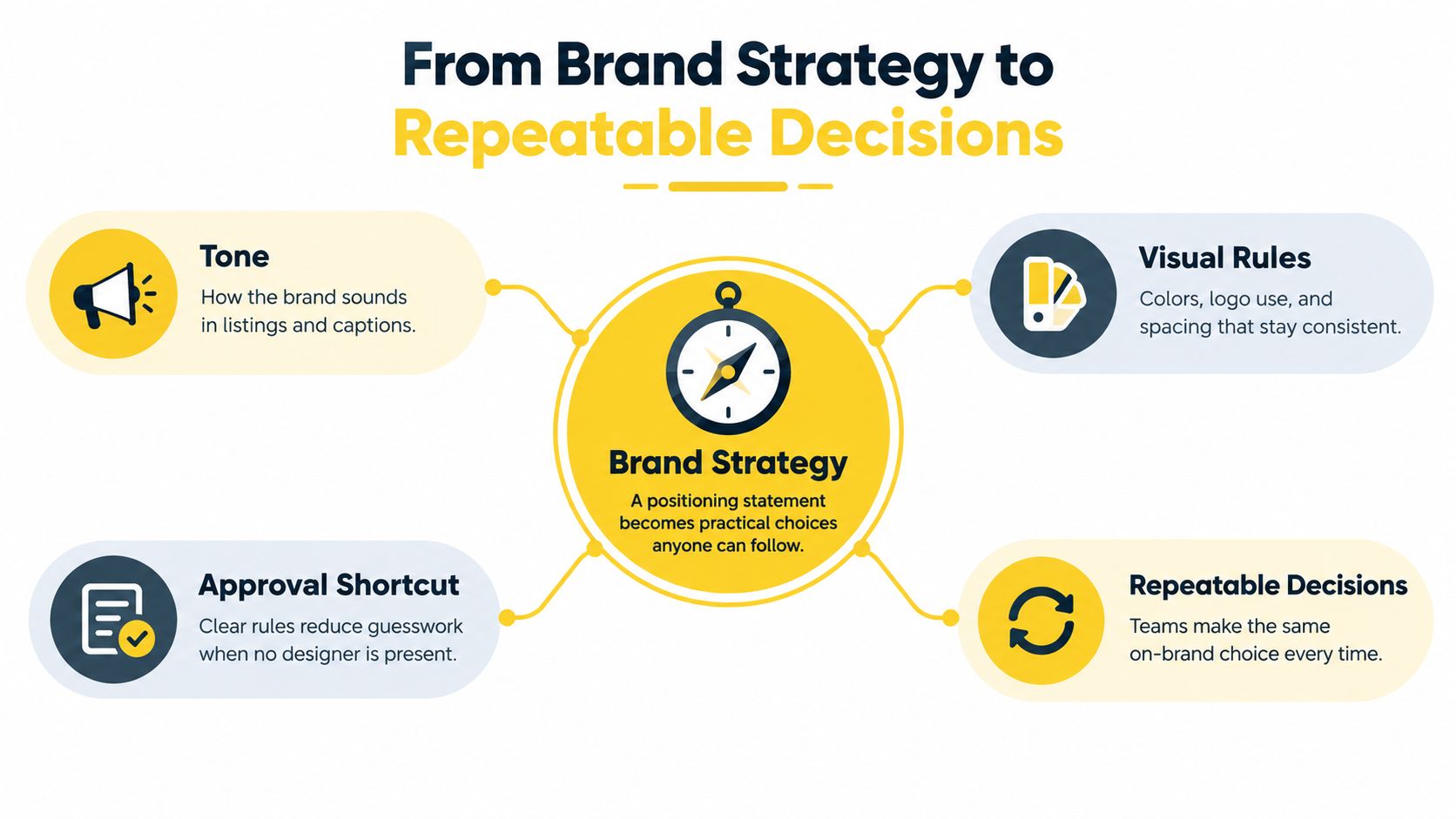 A brand strategy becomes useful to a video producer when it answers practical questions. If a brokerage wants to feel knowledgeable and welcoming, what does that mean for a listing intro? Should the opening sound like a personal invitation, a sales pitch, or a quiet presentation of the home? A guideline turns those broad intentions into choices that an agent or marketer can repeat without a designer in the room.
The first useful distinction is between mandatory rules and flexible choices. The property, neighborhood, agent, and script naturally change from listing to listing. The logo treatment, type hierarchy, and overall tone can stay recognizable while making room for those differences.
Write rules someone can apply
A producer needs to know which logo to use on light backgrounds and which reversed version to use over dark footage. They also need instructions not to stretch or distort the mark, how much clear space to leave around it, and how large it must appear onscreen. Captions and identity elements should sit inside safe areas, so platform interface controls don't cover them when a video is viewed on a phone.Those details turn an abstract instruction like “keep it on brand” into a decision someone can act on. When every agent uses the same type scale, palette, logo treatment, and opening or closing sequence, viewers have clearer cues for recognizing the brokerage. Producers also have fewer subjective choices to revisit during review.
A PDF manual can establish the standard, but a file that's hard to find, outdated, or too vague won't shape everyday work. The need to reproduce a shared identity across many channels has pushed brand practice beyond creating a manual toward managing how people use it. For a guideline to work, it needs to be accessible, current, specific, and part of the production workflow.
That may mean saving approved layouts as templates and building checks into the rendering process. A production team can validate font choices, aspect-ratio layouts, contrast, caption safe zones, and approved audio categories before a video is ready to share.
See how real estate branding services apply brand direction across marketing materials.
The distinction is simple: guidelines set the standard; templates, reviews, and checks help teams follow it. Use this video as a visual companion to the idea of turning strategy into repeatable production choices.
Logo Color Type Voice and Motion Rules
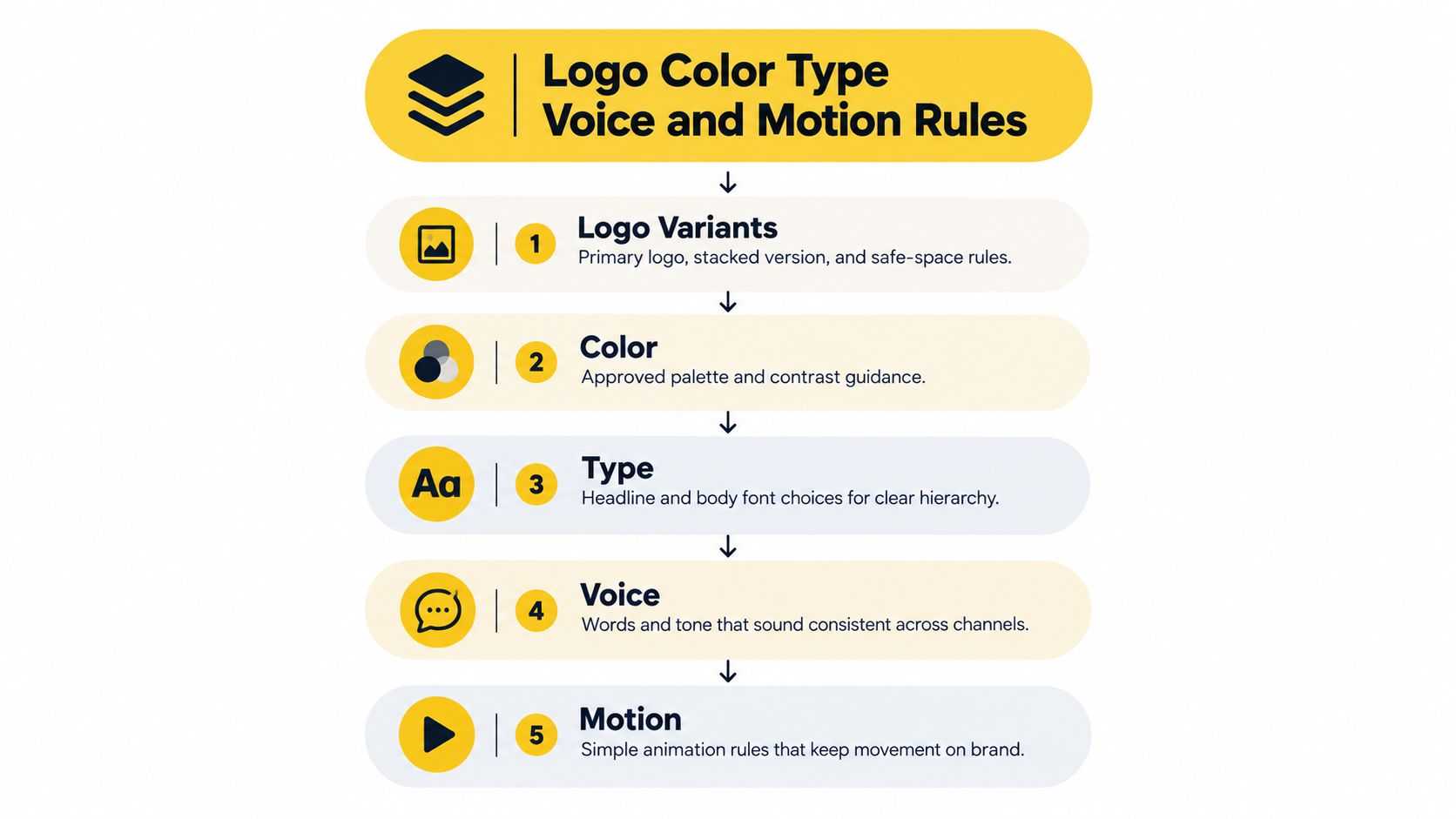 Build the guideline in the order a viewer encounters the video. Start with the brand mark, then its colors and type, then the language and movement that give the tour its character. For each element, document what a producer should choose and what they should avoid.
Make the rules visible on screen
- Logo: Show approved variants, placement, minimum clear space, and minimum onscreen size. Include a light-background example, a reversed logo on dark footage, and a clear “don't distort this” example.
- Color: Record exact values such as HEX and RGB, then show which foreground and background combinations are permitted. Color tokens help producers select the same shades instead of approximating them.
- Typography: Assign fonts and roles, such as headline, address, and supporting detail. Set rules for weight, minimum size, line height, tracking, and capitalization. For captions, specify a maximum amount of text per frame so a property detail doesn't become a hard-to-read block.
- Voice and audio: Describe the writing tone in practical terms, such as warm and direct, and show a sample listing caption that sounds right. Define the intended music mood and how voiceover should feel.
- Motion: Set expectations for logo animation, opening and closing sequences, transitions, watermark behavior, thumbnail composition, and channel-specific exports.
A logo is exempt from WCAG contrast requirements, but ordinary branded text isn't. Captions, prices, agent names, and calls to action still need to be readable. A pale caption over a bright window may disappear; test it over representative footage and add a controlled background plate or shadow if the image changes too much behind the text. Don't use color alone to communicate a status or meaning.
Practical rule: Test a caption over the actual footage, not just a blank brand-colored background.By the time a producer opens a template, the guideline should already answer which logo to use, what text style to choose, how much to put in a caption, what audio mood fits, and where the branding belongs. That's a working system, not just a design glossary.
Explore examples of dimensional logo treatments and how they can inform an on-screen brand mark.
How Branding Guidelines Help Listing Marketing
Guidelines earn their keep when they help people publish coherent marketing repeatedly. Agents, brokerages, agencies, hotel marketers, short-term rental hosts, and commercial property teams often have different people working on each listing. Without shared rules, every handoff can introduce another round of improvisation and review.
The adoption gap is important. Industry reporting says approximately 95% of companies have brand guidelines, but only about 25% to 30% actively use them across their organizations. A 2019 summary of a study of more than 400 brand-management professionals linked consistent presentation with potential revenue gains of 10% to 20%. A related 2016 edition surveyed more than 200 professionals and reported potential uplift of up to 33%. These findings and adoption figures are summarized by Omnibound's reporting on brand consistency.
A reusable approach can spare a producer from remaking those decisions for every property. A team can begin with an approved video style, then adjust the property details and presentation to fit the listing. Static photo galleries may be harder to follow on social; movement, captions, music, and pacing can make a tour feel more suited to the format while remaining recognizable as brokerage content.
This matters when a team sends many tours through review. If each agent makes different choices, reviewers have to judge every logo placement, font, color, caption, thumbnail, music mood, and aspect-ratio version anew. When a standard is clear, review can focus on whether the specific listing is represented well and accurately, rather than reopening the same design debate.
A guideline pays off only when someone uses it across the actual work: listing videos, social edits, thumbnails, and supporting materials. If it lives only in a folder, it can't create a consistent impression in the channels where buyers and sellers encounter the brand.
The adoption gap is important. Industry reporting says approximately 95% of companies have brand guidelines, but only about 25% to 30% actively use them across their organizations. A 2019 summary of a study of more than 400 brand-management professionals linked consistent presentation with potential revenue gains of 10% to 20%. A related 2016 edition surveyed more than 200 professionals and reported potential uplift of up to 33%. These findings and adoption figures are summarized by Omnibound's reporting on brand consistency.
Apply consistency to the work itself
The numbers don't promise that a brokerage will achieve those outcomes just by publishing a guide. They underline the difference between owning a standard and using one. A stored logo file won't settle how to handle a watermark, choose a caption style, or adapt a tour for a different screen shape.A reusable approach can spare a producer from remaking those decisions for every property. A team can begin with an approved video style, then adjust the property details and presentation to fit the listing. Static photo galleries may be harder to follow on social; movement, captions, music, and pacing can make a tour feel more suited to the format while remaining recognizable as brokerage content.
This matters when a team sends many tours through review. If each agent makes different choices, reviewers have to judge every logo placement, font, color, caption, thumbnail, music mood, and aspect-ratio version anew. When a standard is clear, review can focus on whether the specific listing is represented well and accurately, rather than reopening the same design debate.
A guideline pays off only when someone uses it across the actual work: listing videos, social edits, thumbnails, and supporting materials. If it lives only in a folder, it can't create a consistent impression in the channels where buyers and sellers encounter the brand.
Fixed Rules and Flexible Listing Choices
Consistency doesn't require every property video to feel identical. A brokerage can hold onto recognizable brand signals while letting an agent show what makes each home or neighborhood distinct. The useful task is to mark the boundary before production begins.
Research summarized by CMSWire on customer trust and brand consistency reports that 21% of customer-experience leaders considered service standards the most important element of cross-channel brand consistency. The same reporting says 68% said brand consistency contributed at least 10% to revenue growth, and Kearney's 2025 Consumer Institute research found 90% of consumers trust brands that consistently deliver.
Those findings support a practical distinction: viewers may care less about strict visual sameness than whether a brand reliably keeps its promises. A brokerage can let agents personalize a neighborhood introduction while keeping property claims responsible and lead handoffs dependable.
Before building a template, mark each decision as fixed or flexible. If a rule doesn't help a producer make a clear choice, clarify it rather than asking the team to guess.
| Element | Must Stay Fixed | May Vary by Listing or Channel |
|---|---|---|
| Logo and colors | Approved logo treatment and permitted color pairings | Placement within the approved safe area |
| Captions and type | Font roles, legibility rules, and caption style | Listing details and caption wording |
| Opening and close | Brokerage identity and required call to action | Property-specific introduction |
| Music and motion | Approved mood and motion principles | Track or pacing within those limits |
| Property story | Accurate, supportable claims | Photos, neighborhood script, and agent introduction |
| Service experience | Response expectations, revision handoffs, and accessibility checks | Listing-specific coordination |
Consistency includes the service
A strong guide should reach beyond visuals. It can define how the team phrases property claims, handles revisions, responds to leads, checks captions, and hands a project from an agent to a marketer. The goal isn't to make every interaction sound scripted; it's to make the experience dependable.Research summarized by CMSWire on customer trust and brand consistency reports that 21% of customer-experience leaders considered service standards the most important element of cross-channel brand consistency. The same reporting says 68% said brand consistency contributed at least 10% to revenue growth, and Kearney's 2025 Consumer Institute research found 90% of consumers trust brands that consistently deliver.
Those findings support a practical distinction: viewers may care less about strict visual sameness than whether a brand reliably keeps its promises. A brokerage can let agents personalize a neighborhood introduction while keeping property claims responsible and lead handoffs dependable.
Before building a template, mark each decision as fixed or flexible. If a rule doesn't help a producer make a clear choice, clarify it rather than asking the team to guess.
Putting Branding Guidelines into VideoTour.ai
Once the rules are clear, connect them to the production workflow. VideoTour.ai turns photo sets into share-ready HD property tours, with support for up to 60 photos per listing. The platform automates motion, captions, music, and branding, and provides a preview and revisions before download.
Some treatments, including logo intros and cinematic 3D text, use optional AI credits. Paid plans offer watermark removal and watermark-free HD exports. Custom thumbnails help extend the visual system to the moment when someone decides whether to open a tour.
Then decide what should change per listing. An agent or marketer can adjust the script, image order, timing, layout, and aspect ratio to suit the property and channel while keeping the recurring brand signals intact. VideoTour.ai supports vertical social reels for Instagram, TikTok, and YouTube Shorts, along with horizontal and square outputs and MLS-safe presets.
Before sharing, compare the rendered video with the guideline. Check the logo, captions, and end card against the decisions the team marked as fixed, then review the listing-specific edits for accuracy and fit.
Make the template carry the standard
Start by choosing the elements that should recur: approved fonts and colors, caption treatment, logo placement, watermark behavior, and thumbnail style. A reusable branding asset can help keep the same decisions in place from one property tour to another. The VideoTour.ai guide to reusable branding assets explains how teams can approach saved branding elements for repeat production.Some treatments, including logo intros and cinematic 3D text, use optional AI credits. Paid plans offer watermark removal and watermark-free HD exports. Custom thumbnails help extend the visual system to the moment when someone decides whether to open a tour.
Then decide what should change per listing. An agent or marketer can adjust the script, image order, timing, layout, and aspect ratio to suit the property and channel while keeping the recurring brand signals intact. VideoTour.ai supports vertical social reels for Instagram, TikTok, and YouTube Shorts, along with horizontal and square outputs and MLS-safe presets.
Keep creative choices inside the guardrails: If a team uses voiceover, voice cloning, AI-selected music, or uploaded tracks, define the acceptable mood and approval process in the guideline instead of treating those choices as automatic.The platform has an Independent plan for solo users, while Agency and Enterprise plans include additional seats. Optional credits for premium animation and logo intros roll over and don't expire, and the first video is free. Those plan details may help a team choose how to organize production, but they don't replace the brand decisions: the template still needs a clear standard and someone accountable for checking the final tour.
Before sharing, compare the rendered video with the guideline. Check the logo, captions, and end card against the decisions the team marked as fixed, then review the listing-specific edits for accuracy and fit.
Your Next Step for Consistent Listing Videos
Pick one active listing and use it as a practical test. Write the fixed rules from your matrix onto a single template, create the tour, and compare the logo, captions, and end card against the sheet before sharing. If something is ambiguous, revise the instruction while the example is still fresh.
Add an AI-use note to that template, too. Edelman's 2025 Brand Trust research found that 55% of respondents use generative AI platforms; among those users, 91% use them for shopping-related activities such as researching brands, comparing products, or summarizing reviews. The same research found 80% trust brands they use, and 73% say their trust would increase when a brand authentically reflects contemporary culture, according to Edelman's special report on brand trust.
For property video, turn those audience behaviors into straightforward approval questions. Should the team disclose AI-generated motion, voiceovers, avatars, music, or copy? Who checks property facts and fair-housing-sensitive language? Which listing details may be entered into an AI tool? How will the team document consent and approval for cloned voices, synthetic people, or enhanced photos?
The distinction to protect is creative enhancement versus fabrication. Motion can help bring a still image to life, but the finished tour should still represent the property accurately. Keep a short approval note for synthetic elements so the next person handling the video can tell what was generated and who reviewed it.
Try the approach on one listing, then make the template easier to follow before rolling it out more widely. VideoTour.ai offers a free first video, so you can test your rules against an actual property tour and see where producers still need clearer guidance.
Build a reusable listing-video template with VideoTour.ai, then use it to keep the brand recognizable while each property retains its own story. Visit VideoTour.ai to create a tour from listing photos and test your branding rules on your next listing.