

A professional staging service has a 2025 median cost of about $1,500, compared with about $500 when the agent handles it, while vacant-home furniture rental can run $500 to $600 per staged room per month. The right budget depends less on the label “staging” than on whether you need furniture, design labor, transport, storage, and extra rental time.
That's why the question “how much is it to stage a house” has no responsible one-number answer. A lightly occupied home may need editing, rearranging, and photography. A vacant property may need furniture delivered, installed, rented for several months, and removed after closing.
My advice is simple: treat staging as a marketing investment with a measurable break-even point, not as automatic decoration. Spend enough to make the home easy to understand in person and online, but don't furnish every room just because a staging company offers to do so.
That's why the question “how much is it to stage a house” has no responsible one-number answer. A lightly occupied home may need editing, rearranging, and photography. A vacant property may need furniture delivered, installed, rented for several months, and removed after closing.
My advice is simple: treat staging as a marketing investment with a measurable break-even point, not as automatic decoration. Spend enough to make the home easy to understand in person and online, but don't furnish every room just because a staging company offers to do so.
Summary
Create an AI Video Tours from PhotosTry it For Free

What Home Staging Really Costs in 2026
The clearest current benchmark puts professional staging at about $1,500, while agent-managed staging costs about $500. Those figures come from the National Association of REALTORS® 2025 staging survey, and they represent different service levels rather than competing quotes.
A professional stager may manage design decisions, furniture selection, delivery, installation, removal, and sometimes insurance. Agent-led staging usually relies on the seller's furniture, with recommendations about what to remove, rearrange, or supplement. The lower fee generally means less rented inventory and more furniture or labor supplied by the seller.
Vacant homes carry the greatest cost risk because furniture rental continues while the property is listed. Delivery, pickup, accessories, design labor, storage, and contract extensions may appear outside the initial service fee.
Decide whether the presentation work will improve buyer understanding or reduce carrying time enough to justify the expense.
A professional stager may manage design decisions, furniture selection, delivery, installation, removal, and sometimes insurance. Agent-led staging usually relies on the seller's furniture, with recommendations about what to remove, rearrange, or supplement. The lower fee generally means less rented inventory and more furniture or labor supplied by the seller.
The number most sellers miss
The headline fee may not be the final bill. NAR staging guidance lists typical service fees of $800 to $1,000, staging charges of $400 to $700 per room for the first month, and furniture rental of approximately $500 to $600 per room per month. These categories can overlap, so request an itemized estimate instead of adding every benchmark together.Vacant homes carry the greatest cost risk because furniture rental continues while the property is listed. Delivery, pickup, accessories, design labor, storage, and contract extensions may appear outside the initial service fee.
Practical rule: Set the budget by occupancy status, rooms needing help, and expected rental duration. Approve the quote only after identifying every recurring monthly charge.
A realistic planning anchor
For a $300,000 property, a two- to three-month staging period can equal about 1% of the listing price, or roughly $3,000, based on cost guidance compiled by Homes.com. Use that figure for planning, not as a guaranteed invoice. Local labor rates, property size, room count, delivery logistics, and inventory duration determine the actual total.Decide whether the presentation work will improve buyer understanding or reduce carrying time enough to justify the expense.
Breaking Down the Cost Structure
Read a staging quote like an accountant. Separate charges paid once from costs that continue while furniture remains in the property. That distinction matters more than the headline service fee.
The table's ranges come from the NAR staging resource. Treat them as planning anchors, not a promised invoice. Ask for a written quote that separates initial charges, monthly charges, minimum terms, and the cost of early removal.
Ask one direct question before signing: “What will I owe if the home sells quickly, and what will I owe if it takes another rental month?”
That answer shows whether the budget works across the likely listing period, not just on day one.
One-time charges
These cover the work needed to prepare and install the presentation:- Consultation: A walk-through, room assessment, and recommendations for furniture, repairs, editing, or layout.
- Design and selection: Choosing inventory that fits the home's scale, architecture, and likely buyer.
- Delivery: Transporting furniture and accessories to the property.
- Installation: Arranging furniture, artwork, lighting, textiles, and decorative elements.
- Removal: Packing and collecting the inventory after the sale or contract ends.
Recurring charges
These continue as long as the staging inventory occupies the home:- Furniture rental: Usually charged by staged room and rental month.
- Storage: Applies when the seller's furniture is removed but cannot yet move elsewhere.
- Extensions: Extra rental periods if the property remains unsold.
- Minimum terms: A required commitment that may apply even if the home sells quickly.
| Cost Component | Type | Typical Range |
|---|---|---|
| Professional staging service | Usually one-time or initial service | About $1,500 median |
| Agent-managed staging | Usually initial service | About $500 median |
| Furniture rental | Recurring | $500 to $600 per staged room per month |
| Service fee | Often one-time | $800 to $1,000 |
| First-month room staging charge | Initial staging period | $400 to $700 per room |
| Delivery and removal | Usually one-time | Varies by provider and logistics |
| Storage or extension | Recurring | Varies by duration and contract |
Ask one direct question before signing: “What will I owe if the home sells quickly, and what will I owe if it takes another rental month?”
That answer shows whether the budget works across the likely listing period, not just on day one.
Factors That Drive Your Staging Price Up or Down
Two homes with similar asking prices can receive very different staging quotes. Room count, inventory volume, access, design complexity, and time on site often influence the bill more than the property's price.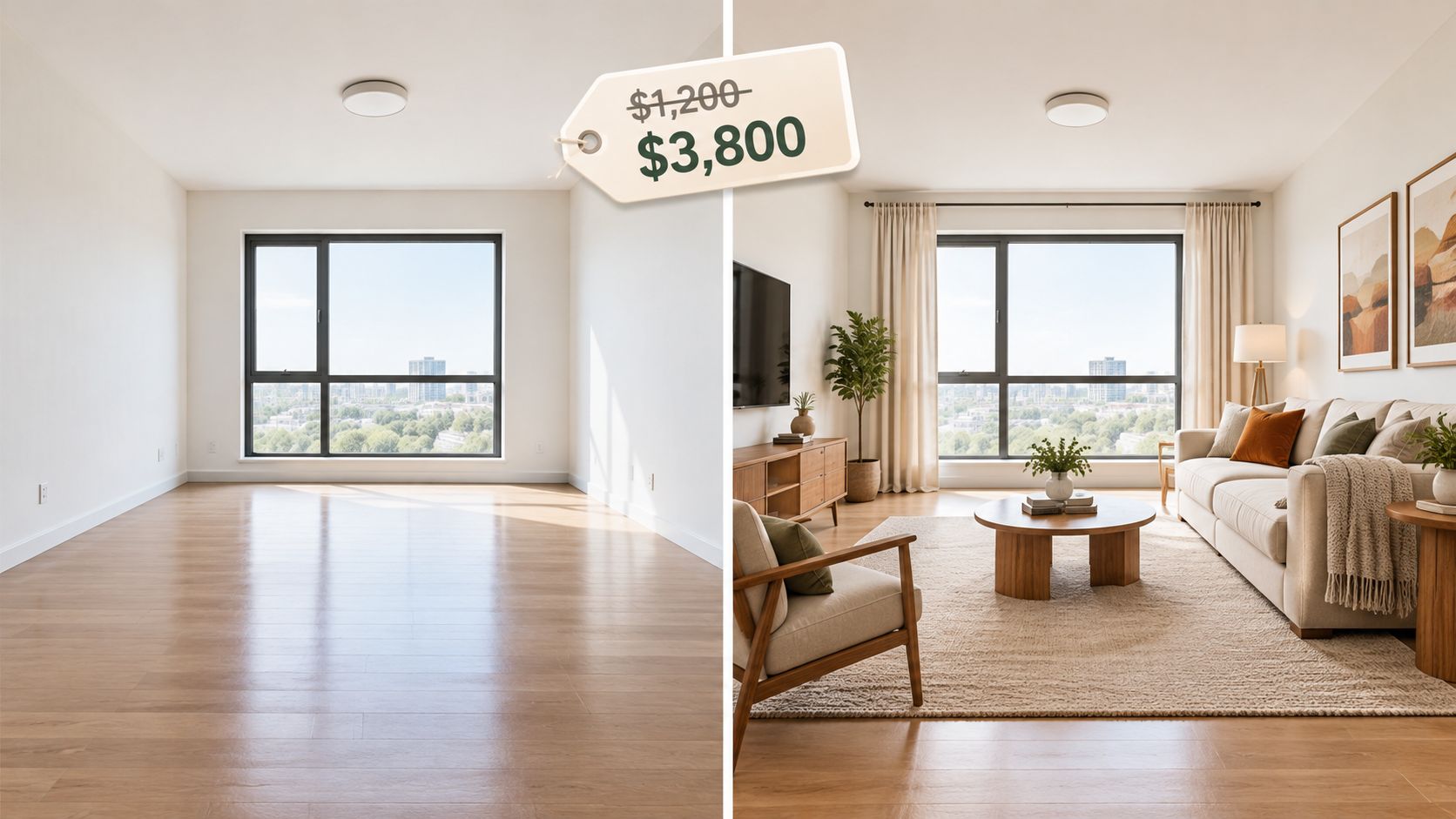
The NAR Profile of Home Staging reports average costs of about $800 for occupied staging and about $2,000 for vacant staging. That gap reflects inventory, labor, transport, and logistics, not only design advice.
Other factors can move the quote in either direction:
Before requesting quotes, record whether the home is occupied, which rooms look empty or confusing, whether existing furniture must be removed, and how long you expect the listing to remain active. Ask providers to price that specific scope, including delivery, removal, monthly rental, storage, and any minimum term. A lower initial quote can cost more if it covers fewer rooms or excludes recurring charges.
The biggest pricing levers
Occupancy is the first dividing line. An occupied home already contains beds, sofas, tables, lamps, and artwork. The stager may only need to edit the contents, improve the flow, and add selected pieces. A vacant home needs furniture and accessories for each major room, along with delivery and removal.The NAR Profile of Home Staging reports average costs of about $800 for occupied staging and about $2,000 for vacant staging. That gap reflects inventory, labor, transport, and logistics, not only design advice.
Other factors can move the quote in either direction:
- Local labor rates: Teams in high-cost markets may charge more for design, transport, and installation.
- Property size: Larger homes require more furniture, artwork, accessories, and installation time.
- Number of staged rooms: Prioritizing the living room, kitchen, and primary bedroom usually controls inventory better than furnishing every room.
- Access and logistics: Stairs, long walkways, elevator restrictions, gated communities, and limited parking can increase delivery effort.
- Design labor: Unusual layouts, luxury finishes, and empty open-plan areas may require more planning.
- Rental duration: A longer listing keeps furniture and storage charges running.
Before requesting quotes, record whether the home is occupied, which rooms look empty or confusing, whether existing furniture must be removed, and how long you expect the listing to remain active. Ask providers to price that specific scope, including delivery, removal, monthly rental, storage, and any minimum term. A lower initial quote can cost more if it covers fewer rooms or excludes recurring charges.
Professional Staging Versus Doing It Yourself
The professional-versus-DIY choice isn't only about paying more for better taste. It's a trade-off between cash, time, inventory access, execution risk, and accountability.
The professional median of about $1,500 generally buys a coordinated service. The provider decides what belongs in each room, sources appropriate inventory, schedules delivery, installs the setup, and removes it later. The seller is paying to transfer decisions and physical work to someone who does this repeatedly.
Agent-managed staging, with a median near $500, usually depends more heavily on the seller's furniture and the agent's recommendations. The agent may identify clutter, suggest a furniture layout, and make cosmetic changes without bringing a full rental package. The seller keeps more responsibility, but the upfront expense is lower.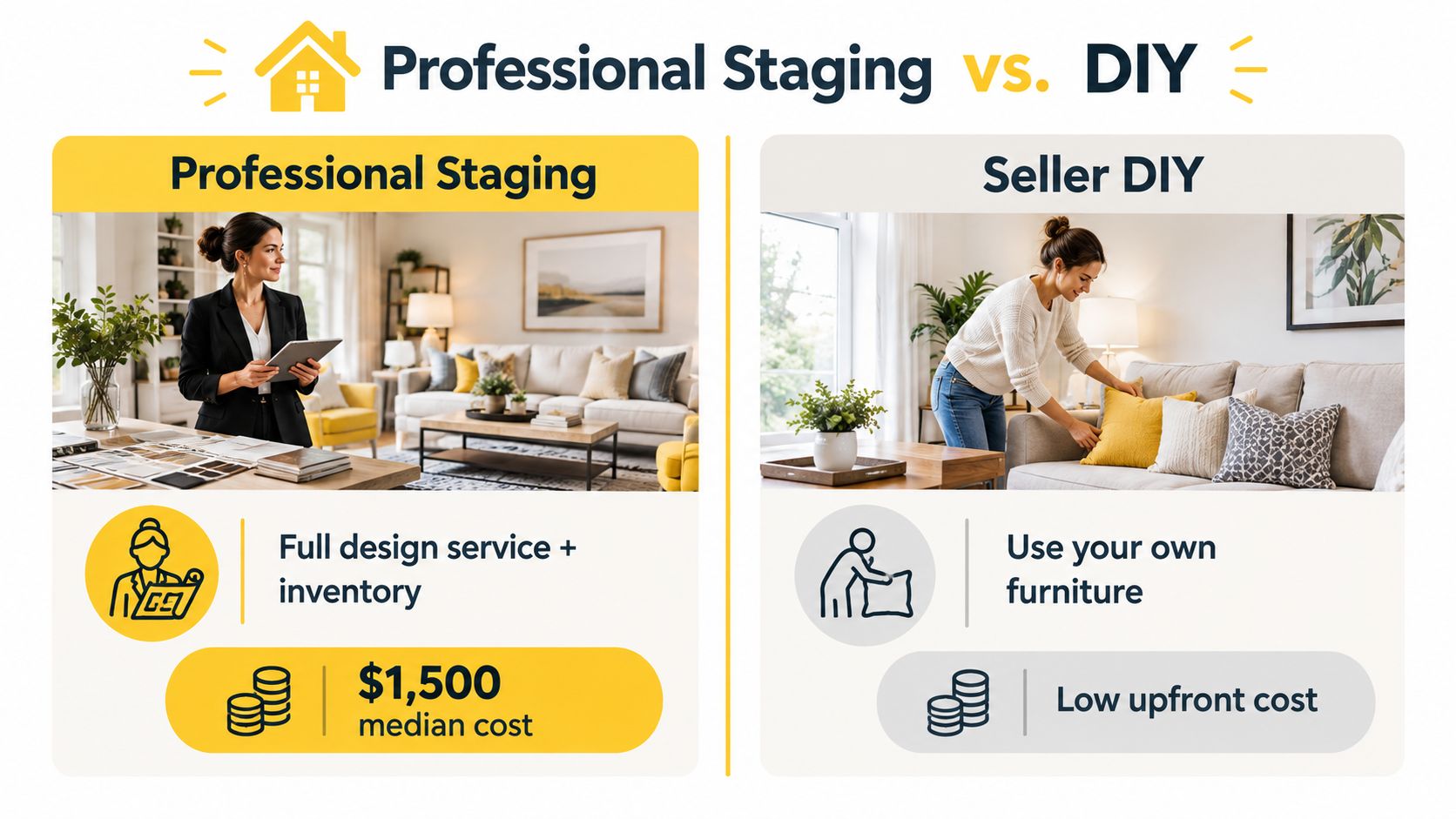
The service can include access to inventory that a seller couldn't reasonably assemble alone. It may also reduce arguments about whether a room looks finished, because one person owns the design plan and the installation standard.
Don't confuse low cost with no effort. Seller-led staging can consume time through packing, hauling, cleaning, repairs, and repeated adjustments after feedback. A seller should also ask who pays if rented or borrowed items are damaged.
For a broader household budget, it helps to account for overlooked moving expenses alongside the listing plan. A practical resource on budgeting beyond the removalists can help sellers separate staging from other transition costs.
A polished video can also extend the value of the presentation work across listing pages and social channels. For sellers comparing formats, sell faster with AI property videos explains how photo-based property marketing fits into a wider launch plan.
The right choice is not the cheapest option in isolation. It's the lowest-cost option that produces a coherent, buyer-friendly presentation without delaying the listing.
The professional median of about $1,500 generally buys a coordinated service. The provider decides what belongs in each room, sources appropriate inventory, schedules delivery, installs the setup, and removes it later. The seller is paying to transfer decisions and physical work to someone who does this repeatedly.
Agent-managed staging, with a median near $500, usually depends more heavily on the seller's furniture and the agent's recommendations. The agent may identify clutter, suggest a furniture layout, and make cosmetic changes without bringing a full rental package. The seller keeps more responsibility, but the upfront expense is lower.
Choose professional help when
Professional staging is usually the stronger decision when the home is vacant, the rooms are unusually large, the furniture is dated or mismatched, or the seller needs the property ready on a fixed timeline. It also makes sense when the seller can't manage deliveries, moving, storage, and removal personally.The service can include access to inventory that a seller couldn't reasonably assemble alone. It may also reduce arguments about whether a room looks finished, because one person owns the design plan and the installation standard.
Choose agent-led staging when
Agent-led staging fits an occupied home with decent furniture, a seller who can remove excess belongings, and a listing that doesn't require a dramatic visual transformation. It's especially sensible when the main work is subtraction: pack personal items, open walkways, clear counters, and make room functions obvious.Don't confuse low cost with no effort. Seller-led staging can consume time through packing, hauling, cleaning, repairs, and repeated adjustments after feedback. A seller should also ask who pays if rented or borrowed items are damaged.
For a broader household budget, it helps to account for overlooked moving expenses alongside the listing plan. A practical resource on budgeting beyond the removalists can help sellers separate staging from other transition costs.
A polished video can also extend the value of the presentation work across listing pages and social channels. For sellers comparing formats, sell faster with AI property videos explains how photo-based property marketing fits into a wider launch plan.
The right choice is not the cheapest option in isolation. It's the lowest-cost option that produces a coherent, buyer-friendly presentation without delaying the listing.
Lower-Cost Alternatives to Full Staging
Full staging is not the default choice. Start with the lowest-cost presentation work that addresses the property's visible weaknesses, then add services only when the home needs them.
Paint can compete directly with staging for the same budget. Sellers should compare repaint cost estimates before booking furniture rental, especially when worn walls are the first presentation problem buyers will notice.
A living room establishes scale and traffic flow. A primary bedroom shows whether a bed fits comfortably. A kitchen may need restrained accessories and clear counters rather than a complete furniture package. Spend where furniture helps buyers judge proportion, function, or lifestyle.
A photo-to-video tour adds another low-cost presentation layer by reusing existing listing photos. It fits a property that is already clean and visually coherent but needs a stronger format for social feeds and listing promotion. The virtual staging meaning guide explains how digital furnishing differs from physically preparing a property.
Use digital presentation after the physical work is complete. Fix obvious defects, clean, declutter, and capture strong photos first. Technology can improve distribution and interpretation, but it cannot substitute for repairs, truthful representation, or a room buyers can understand when they walk through it.
Start with subtraction
If the home is already furnished, decluttering and deep cleaning may produce more value than renting additional furniture. Remove oversized pieces, personal collections, excess countertop items, and anything that hides the floor plan. Buyers should understand each room's purpose and dimensions as soon as they enter.Paint can compete directly with staging for the same budget. Sellers should compare repaint cost estimates before booking furniture rental, especially when worn walls are the first presentation problem buyers will notice.
Use selective physical staging
Stage the rooms that carry the property's story. As the NAR staging data cited earlier shows, agents most often prioritize the living room, kitchen, and primary bedroom. Selective staging gives partially furnished or vacant homes a clearer presentation without paying to furnish every room.A living room establishes scale and traffic flow. A primary bedroom shows whether a bed fits comfortably. A kitchen may need restrained accessories and clear counters rather than a complete furniture package. Spend where furniture helps buyers judge proportion, function, or lifestyle.
Consider virtual presentation carefully
Virtual staging can help buyers understand an empty room in online photos, but disclose it appropriately and use it transparently. Digital furniture cannot show the physical condition of floors, walls, windows, or fixtures. It also cannot help an in-person visitor move through an empty space.A photo-to-video tour adds another low-cost presentation layer by reusing existing listing photos. It fits a property that is already clean and visually coherent but needs a stronger format for social feeds and listing promotion. The virtual staging meaning guide explains how digital furnishing differs from physically preparing a property.
Use digital presentation after the physical work is complete. Fix obvious defects, clean, declutter, and capture strong photos first. Technology can improve distribution and interpretation, but it cannot substitute for repairs, truthful representation, or a room buyers can understand when they walk through it.
The Break-Even Math Sellers Should Run
Staging only needs to produce a small gross price improvement to recover a modest fee, but sellers shouldn't confuse break-even math with a guaranteed return.
Use this formula:
Break-even price lift = staging cost ÷ listing price
For a $1,500 staging service on a $300,000 home, the required gross improvement is about 0.5%. On a $1 million home, the same fee requires about 0.15%. Those examples show why a fixed staging fee has a different financial weight at different price points.
The Florida Realtors summary of the 2025 staging findings reports that 29% of agents observed a 1% to 10% increase in offered value, while 20% of sellers' agents said staging increased offered dollar value by 1% to 5%. Those are reported observations, not a promise that every staged property will achieve a price lift.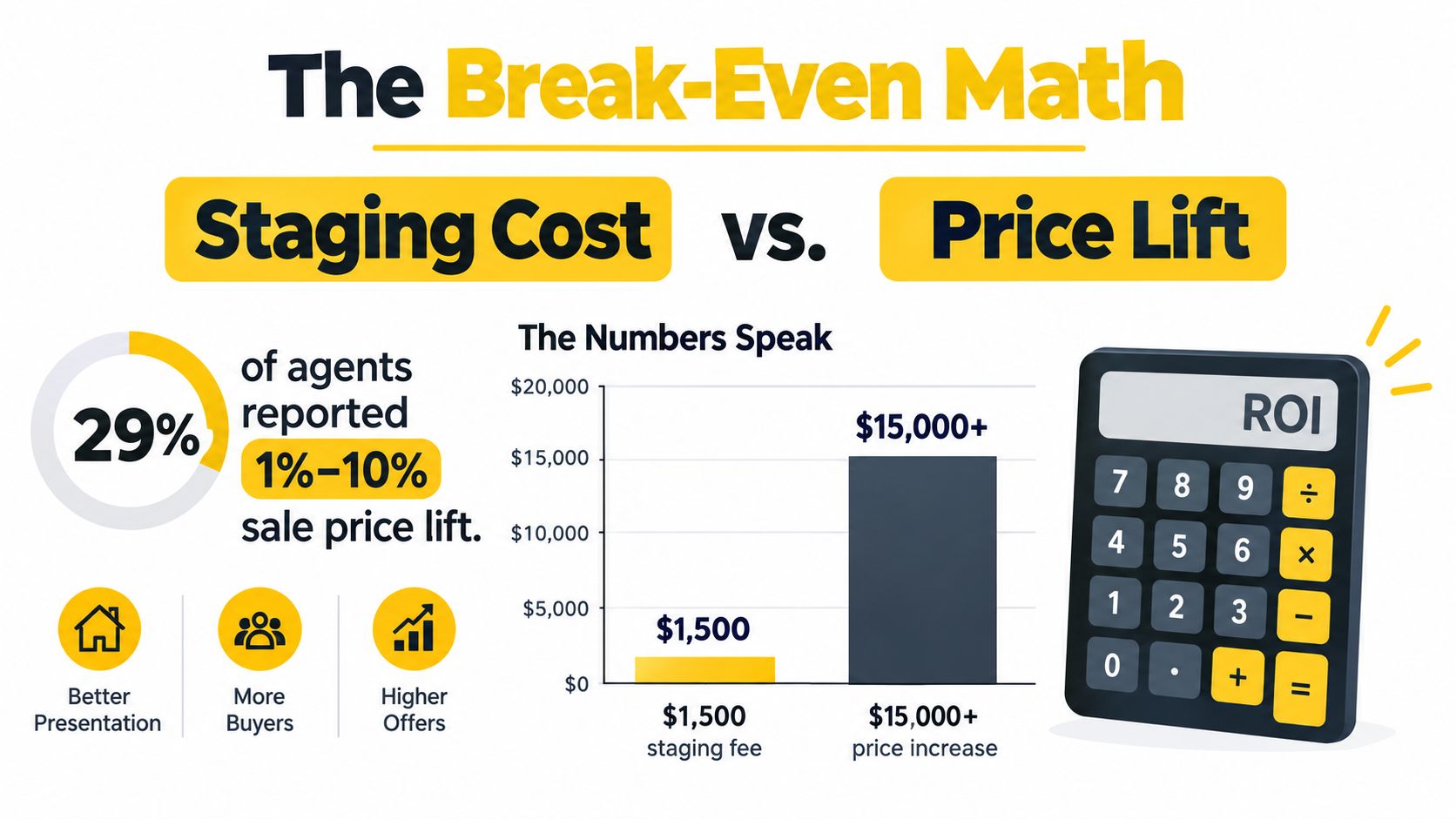
Then compare:
Use this formula:
Break-even price lift = staging cost ÷ listing price
For a $1,500 staging service on a $300,000 home, the required gross improvement is about 0.5%. On a $1 million home, the same fee requires about 0.15%. Those examples show why a fixed staging fee has a different financial weight at different price points.
The Florida Realtors summary of the 2025 staging findings reports that 29% of agents observed a 1% to 10% increase in offered value, while 20% of sellers' agents said staging increased offered dollar value by 1% to 5%. Those are reported observations, not a promise that every staged property will achieve a price lift.
Add the value of time
Price is only half the calculation. If staging helps a home sell sooner, estimate the daily carrying cost of mortgage interest, property taxes, insurance, utilities, maintenance, and vacancy. Don't assign a value to “selling faster” until you know what one additional day costs you.Then compare:
- Staging expense: Service, delivery, rental, removal, and extensions.
- Potential price improvement: A conservative lift required to recover the expense.
- Carrying-cost savings: Daily ownership costs multiplied by plausible days saved.
- Risk of no impact: The possibility that staging changes buyer perception without changing the offer.
When Staging Is Not Worth the Money
Staging is not automatically the best use of a seller's cash. As noted earlier, only a minority of sellers' agents stage every home, while some reserve staging for properties that may be harder to sell. That pattern supports a selective approach, not a universal rule.
Use this decision tree:
The disciplined seller identifies what buyers struggle to understand. If the issue is room scale or function, stage physically. If it is clutter, edit the home. If the online presentation is weak, improve the media package. If none of those problems applies, keep the staging budget limited and protect the money for costs that directly improve the sale.
Use this decision tree:
- The home is vacant or its scale is difficult to understand: Physically stage the living room and any other rooms that need furniture to show their function.
- The home is occupied but crowded: Declutter, remove oversized pieces, and improve the existing furniture layout before renting inventory.
- The home looks tired: Prioritize repairs, deep cleaning, paint, lighting, and professional photography.
- The home is presentable but underexposed: Use strong photos, a floor plan, and video to distribute the listing effectively.
- The property is easy to understand and likely to attract buyers quickly: Skip automatic full staging and reserve funds for pricing, preparation, and launch quality.
The disciplined seller identifies what buyers struggle to understand. If the issue is room scale or function, stage physically. If it is clutter, edit the home. If the online presentation is weak, improve the media package. If none of those problems applies, keep the staging budget limited and protect the money for costs that directly improve the sale.
Your Staging Budget Decision Framework
Start by identifying whether the home is occupied, partially furnished, or vacant. Then list the rooms that need help, separate one-time charges from recurring rental costs, and ask how a minimum rental period changes the total.
Next, price the highest-impact work first. Compare repairs, cleaning, decluttering, photography, selective staging, virtual presentation, and video. Run the break-even calculation against your listing price, then include the carrying cost of additional time on the market.
Choose the lowest presentation tier that solves the property's actual problem:
VideoTour.ai turns your existing property photos into ready-to-share video tours with automated motion, captions, music, branding, and MLS-friendly formats, without a camera crew or manual editing. If you're using selective staging or a lower-cost presentation plan, visit VideoTour.ai to turn that preparation into polished listing and social media content.
Next, price the highest-impact work first. Compare repairs, cleaning, decluttering, photography, selective staging, virtual presentation, and video. Run the break-even calculation against your listing price, then include the carrying cost of additional time on the market.
Choose the lowest presentation tier that solves the property's actual problem:
- Full professional staging for vacant, high-value, unusually scaled, or visually challenging homes.
- Selective staging for the living room, kitchen, and primary bedroom when the rest of the home reads clearly.
- Agent-led or seller-led preparation when existing furniture is usable.
- Decluttering plus professional photography and video when the home is already presentable.
- Repairs and cleaning first when staging would only disguise unfinished work.
VideoTour.ai turns your existing property photos into ready-to-share video tours with automated motion, captions, music, branding, and MLS-friendly formats, without a camera crew or manual editing. If you're using selective staging or a lower-cost presentation plan, visit VideoTour.ai to turn that preparation into polished listing and social media content.