
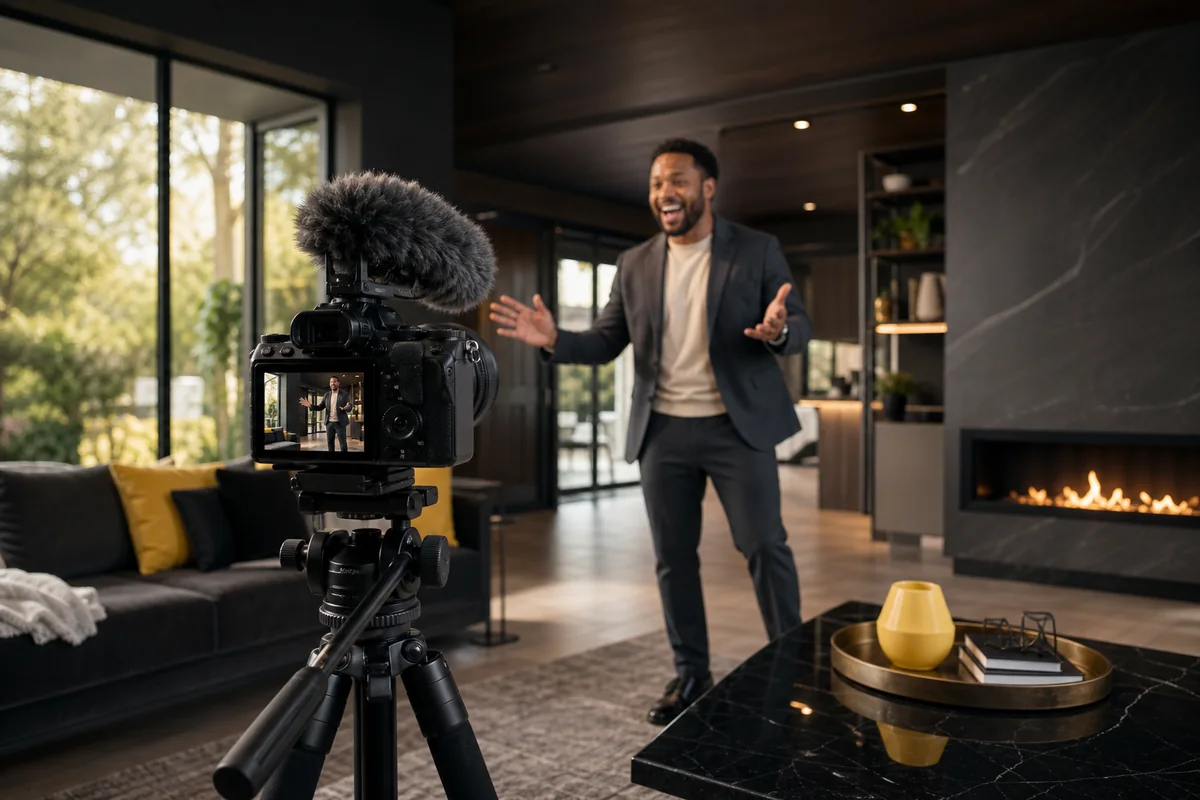
A useful real estate comedy video makes a familiar moment recognizable: a stubborn lockbox, an overlong script or an agent preparing for a two-minute clip. You do not need to embarrass a buyer or promise a viral result.
Below are 15 original concepts with a hook, lines to adapt, a shot list and a relevant next step. The suggested lengths are creative starting points. All scenarios are fictional; use props or consenting colleagues and replace any sample listing detail with a verified fact.
Below are 15 original concepts with a hook, lines to adapt, a shot list and a relevant next step. The suggested lengths are creative starting points. All scenarios are fictional; use props or consenting colleagues and replace any sample listing detail with a verified fact.
Summary
Create an AI Video Tours from PhotosTry it For Free
Pick a concept you can film with what you have
| Available material | Start with | Keep the setup simple |
|---|---|---|
| Just you and a phone | The one-take introduction; the 37-tab agent | Use one fixed camera angle |
| A permitted empty property | The lockbox audition; the light-switch mystery | Avoid revealing access codes or security details |
| Listing photos | The kitchen wins the argument | Pair a short introduction with approved property views |
| A willing colleague | The open-house rehearsal | Agree on the joke and lines before filming |
Aim the joke at a recognizable task or your own habits. Let the property remain accurately represented. If the joke needs a long explanation, shorten the setup before adding effects.
1. The lockbox audition
Suggested length: 15–20 seconds
Opening hook: “Every showing starts with my least convincing performance.”
Script: You, calmly: “I open these all the time.” Cut to three increasingly serious facial expressions. End: “And we’re in. Completely as planned.”
Shot list: A close shot of your face; hands using a prop or obscured lockbox; the open doorway. Keep any real code and access method out of view.
Useful ending: End with a real property feature after the joke.
Before posting: Use acting, not an actual access problem that delays a client.
Opening hook: “Every showing starts with my least convincing performance.”
Script: You, calmly: “I open these all the time.” Cut to three increasingly serious facial expressions. End: “And we’re in. Completely as planned.”
Shot list: A close shot of your face; hands using a prop or obscured lockbox; the open doorway. Keep any real code and access method out of view.
Useful ending: End with a real property feature after the joke.
Before posting: Use acting, not an actual access problem that delays a client.
2. The one-take introduction
Suggested length: 15–25 seconds
Opening hook: “A quick listing introduction. One take.”
Script: Take one: forget the room name. Take two: say your own name twice. Take three: “Let me show you the kitchen.” Cut to a clean room shot.
Shot list: A fixed phone position; three short takes; one clear kitchen view.
Useful ending: “The kitchen deserved a better introduction. Here it is.”
Before posting: Make the mistake your own; do not include someone else’s blooper without permission.
Opening hook: “A quick listing introduction. One take.”
Script: Take one: forget the room name. Take two: say your own name twice. Take three: “Let me show you the kitchen.” Cut to a clean room shot.
Shot list: A fixed phone position; three short takes; one clear kitchen view.
Useful ending: “The kitchen deserved a better introduction. Here it is.”
Before posting: Make the mistake your own; do not include someone else’s blooper without permission.
3. The kitchen wins the argument
Suggested length: 15–20 seconds
Opening hook: “I came prepared with talking points. Then I saw the kitchen.”
Script: Start reading your notes: “Location, layout, storage…” Look off screen. Cut to the actual kitchen: “Okay. We’ll start here.”
Shot list: You holding notes; a reaction; two approved kitchen photos or clips.
Useful ending: Invite viewers to see the complete floor plan or listing.
Before posting: Describe only features shown in the current listing.
Opening hook: “I came prepared with talking points. Then I saw the kitchen.”
Script: Start reading your notes: “Location, layout, storage…” Look off screen. Cut to the actual kitchen: “Okay. We’ll start here.”
Shot list: You holding notes; a reaction; two approved kitchen photos or clips.
Useful ending: Invite viewers to see the complete floor plan or listing.
Before posting: Describe only features shown in the current listing.
4. The dramatic tape measure
Suggested length: 15–20 seconds
Opening hook: “The most important supporting actor at a showing.”
Script: Give a tape measure a grand introduction. Cut to a normal measurement. “Because ‘it feels like it fits’ is not a measurement.”
Shot list: A close-up of the tool; measuring a permitted doorway or recess; the result recorded on a note.
Useful ending: “Bring your furniture measurements to the viewing.”
Before posting: Do not invent dimensions; demonstrate the habit without making an unverified size claim.
Opening hook: “The most important supporting actor at a showing.”
Script: Give a tape measure a grand introduction. Cut to a normal measurement. “Because ‘it feels like it fits’ is not a measurement.”
Shot list: A close-up of the tool; measuring a permitted doorway or recess; the result recorded on a note.
Useful ending: “Bring your furniture measurements to the viewing.”
Before posting: Do not invent dimensions; demonstrate the habit without making an unverified size claim.
5. The open-house rehearsal
Suggested length: 20–30 seconds
Opening hook: “Practicing my relaxed welcome.”
Script: Try “Welcome!” too loudly, then too formally. A colleague walks in: “Hi.” You: “Hi. Kitchen is this way.”
Shot list: Two greeting takes at the same doorway; a consenting colleague entering; a clean room view.
Useful ending: Show the actual open-house time, if confirmed.
Before posting: Stage the visitor role instead of secretly filming attendees.
Opening hook: “Practicing my relaxed welcome.”
Script: Try “Welcome!” too loudly, then too formally. A colleague walks in: “Hi.” You: “Hi. Kitchen is this way.”
Shot list: Two greeting takes at the same doorway; a consenting colleague entering; a clean room view.
Useful ending: Show the actual open-house time, if confirmed.
Before posting: Stage the visitor role instead of secretly filming attendees.
6. The 37-tab agent
Suggested length: 15–20 seconds
Opening hook: “I only need one quick fact before I post.”
Script: Pretend to open another note. “Was that the old price? Which photo is approved? Why do I have four final versions?” Close everything except one checklist.
Shot list: You at a desk; a dummy checklist; the approved asset folder with fictional filenames.
Useful ending: “One approved fact sheet before every video.”
Before posting: Use a dummy screen so client information never appears.
Opening hook: “I only need one quick fact before I post.”
Script: Pretend to open another note. “Was that the old price? Which photo is approved? Why do I have four final versions?” Close everything except one checklist.
Shot list: You at a desk; a dummy checklist; the approved asset folder with fictional filenames.
Useful ending: “One approved fact sheet before every video.”
Before posting: Use a dummy screen so client information never appears.
7. The listing voice versus the real voice
Suggested length: 15–25 seconds
Opening hook: “My video voice has its own real estate license.”
Script: In an exaggerated announcer voice: “Behold… a pantry.” Switch to your normal voice: “There’s useful storage beside the kitchen.”
Shot list: Two takes in the same position; an accurate pantry or storage view.
Useful ending: Ask which delivery makes the feature easier to understand.
Before posting: The clearer line should remain factual; humor does not justify an exaggerated property claim.
Opening hook: “My video voice has its own real estate license.”
Script: In an exaggerated announcer voice: “Behold… a pantry.” Switch to your normal voice: “There’s useful storage beside the kitchen.”
Shot list: Two takes in the same position; an accurate pantry or storage view.
Useful ending: Ask which delivery makes the feature easier to understand.
Before posting: The clearer line should remain factual; humor does not justify an exaggerated property claim.
8. The light-switch mystery
Suggested length: 20 seconds
Opening hook: “A very serious investigation before filming.”
Script: Flip an ordinary switch. Look at the lamp. Nothing. Cut to a fan moving. “Progress.” Finish with the correct light switched on.
Shot list: Your reaction; the relevant light or fan; a bright finished room shot.
Useful ending: “Good light makes the room easier to see.”
Before posting: Only use accessible, ordinary controls with permission; avoid electrical advice or staged defects.
Opening hook: “A very serious investigation before filming.”
Script: Flip an ordinary switch. Look at the lamp. Nothing. Cut to a fan moving. “Progress.” Finish with the correct light switched on.
Shot list: Your reaction; the relevant light or fan; a bright finished room shot.
Useful ending: “Good light makes the room easier to see.”
Before posting: Only use accessible, ordinary controls with permission; avoid electrical advice or staged defects.
9. The five-second room tour
Suggested length: 15–20 seconds
Opening hook: “When I try to show the entire house in five seconds.”
Script: First take: rapidly point in four directions. Stop. “Let’s do that at a speed a human can follow.” Show two slow, clear views.
Shot list: One exaggerated fast take; two steady room clips.
Useful ending: Link to the full tour.
Before posting: Do not make the usable property footage fast or disorienting just to extend the gag.
Opening hook: “When I try to show the entire house in five seconds.”
Script: First take: rapidly point in four directions. Stop. “Let’s do that at a speed a human can follow.” Show two slow, clear views.
Shot list: One exaggerated fast take; two steady room clips.
Useful ending: Link to the full tour.
Before posting: Do not make the usable property footage fast or disorienting just to extend the gag.
10. The invisible tripod assistant
Suggested length: 15–20 seconds
Opening hook: “My camera crew is extremely reliable.”
Script: Thank an imaginary crew. Cut wide to one phone on a tripod. “Small team. Strong attendance record.”
Shot list: A close introduction; a wide reveal; a short finished shot.
Useful ending: Offer one practical filming tip in the caption.
Before posting: Keep the setup safely out of walkways.
Opening hook: “My camera crew is extremely reliable.”
Script: Thank an imaginary crew. Cut wide to one phone on a tripod. “Small team. Strong attendance record.”
Shot list: A close introduction; a wide reveal; a short finished shot.
Useful ending: Offer one practical filming tip in the caption.
Before posting: Keep the setup safely out of walkways.
11. The acronym translator
Suggested length: 20–30 seconds
Opening hook: “When my first draft sounds like alphabet soup.”
Script: Read a fictional line packed with abbreviations. Pause. “Or I could say: here’s what happens before closing.” Replace one term with a plain-language explanation.
Shot list: Two desk takes; a simple text card with the term and explanation.
Useful ending: Invite viewers to suggest the next term to explain.
Before posting: Check the explanation for your local process; keep the joke about your wording.
Opening hook: “When my first draft sounds like alphabet soup.”
Script: Read a fictional line packed with abbreviations. Pause. “Or I could say: here’s what happens before closing.” Replace one term with a plain-language explanation.
Shot list: Two desk takes; a simple text card with the term and explanation.
Useful ending: Invite viewers to suggest the next term to explain.
Before posting: Check the explanation for your local process; keep the joke about your wording.
12. The almost-perfect exterior take
Suggested length: 15–25 seconds
Opening hook: “The house was ready. My timing wasn’t.”
Script: Begin a confident introduction. A staged phone timer rings. Reset. Wind blows your notes. Final take: a simple exterior with a short voiceover.
Shot list: Two safe staged interruptions; an uninterrupted exterior view.
Useful ending: “Here’s the take that made the final tour.”
Before posting: Do not stage unsafe road activity or include identifiable passersby.
Opening hook: “The house was ready. My timing wasn’t.”
Script: Begin a confident introduction. A staged phone timer rings. Reset. Wind blows your notes. Final take: a simple exterior with a short voiceover.
Shot list: Two safe staged interruptions; an uninterrupted exterior view.
Useful ending: “Here’s the take that made the final tour.”
Before posting: Do not stage unsafe road activity or include identifiable passersby.
13. The listing bag inventory
Suggested length: 20–30 seconds
Opening hook: “Things in my bag that have earned their place.”
Script: Present a tape measure, charger and spare batteries like luxury products. Reveal one unnecessary item: “This is emotional support stationery.”
Shot list: Overhead bag layout; three close-ups; your reaction to the unnecessary item.
Useful ending: Ask viewers which practical item they would add.
Before posting: Keep keys, access codes and documents out of the frame.
Opening hook: “Things in my bag that have earned their place.”
Script: Present a tape measure, charger and spare batteries like luxury products. Reveal one unnecessary item: “This is emotional support stationery.”
Shot list: Overhead bag layout; three close-ups; your reaction to the unnecessary item.
Useful ending: Ask viewers which practical item they would add.
Before posting: Keep keys, access codes and documents out of the frame.
14. The final-final export
Suggested length: 15–20 seconds
Opening hook: “The file name says final. My inbox disagrees.”
Script: Read fictional filenames: “final, final-two, actually-final.” Stop, rename clearly: “property-vertical-approved.”
Shot list: A dummy screen with fictional files; your reaction; a clean naming example.
Useful ending: Share the naming pattern viewers can copy.
Before posting: Make this about your process rather than blaming a real client.
Opening hook: “The file name says final. My inbox disagrees.”
Script: Read fictional filenames: “final, final-two, actually-final.” Stop, rename clearly: “property-vertical-approved.”
Shot list: A dummy screen with fictional files; your reaction; a clean naming example.
Useful ending: Share the naming pattern viewers can copy.
Before posting: Make this about your process rather than blaming a real client.
15. The room-label test
Suggested length: 15–20 seconds
Opening hook: “Can you read my beautifully designed caption?”
Script: Show a deliberately tiny label on a neutral demo slide. Squint. Replace it with a short readable label over a permitted room photo. “Much better.”
Shot list: Phone held at normal viewing distance; the demo slide; the clear room label.
Useful ending: “Watch your next video on a phone before posting.”
Before posting: Use a made-up demo for the bad example, not another agent’s work.
Opening hook: “Can you read my beautifully designed caption?”
Script: Show a deliberately tiny label on a neutral demo slide. Squint. Replace it with a short readable label over a permitted room photo. “Much better.”
Shot list: Phone held at normal viewing distance; the demo slide; the clear room label.
Useful ending: “Watch your next video on a phone before posting.”
Before posting: Use a made-up demo for the bad example, not another agent’s work.
Turn one funny opening into a useful property video
Choose one concept, write three lines and film a clean version before experimenting. Keep the opening, punchline and useful next step distinct. Add captions, watch the result muted, and remove any line that explains a joke the viewer already understood.
For the kitchen idea, use this simple structure:
These timings are a storyboard example, not a platform rule. If you already have listing photos, create the property portion in VideoTour.ai and assemble it with your filmed introduction in an editor. Check that the transition feels natural.
For more straightforward formats, use our short real estate video ideas with scripts. Track relevant replies and listing visits alongside views. A funny clip can start a conversation; it does not guarantee a lead or sale.
For the kitchen idea, use this simple structure:
| Beat | What viewers see | Purpose |
|---|---|---|
| 0–3 seconds | Your prepared notes | Set up the expectation |
| 3–6 seconds | Your reaction to the kitchen | Deliver the change in direction |
| 6–16 seconds | Two or three real kitchen views | Make the post useful |
| Final seconds | A readable next step | Invite a relevant action |
These timings are a storyboard example, not a platform rule. If you already have listing photos, create the property portion in VideoTour.ai and assemble it with your filmed introduction in an editor. Check that the transition feels natural.
For more straightforward formats, use our short real estate video ideas with scripts. Track relevant replies and listing visits alongside views. A funny clip can start a conversation; it does not guarantee a lead or sale.
FAQ
What makes a real estate video funny?
A recognizable setup, an unexpected but understandable turn, and a concise payoff. These scripts use the agent’s process as the subject.Can I make one without showing my face?
Yes. Try the bag inventory, a fictional file-naming demonstration or a caption readability example using your own voice and permitted images.Should I use real clients in a comedy video?
Only with informed permission for the specific use. Staged scenarios with consenting colleagues are simpler. Avoid jokes about someone’s budget, background or personal situation.Do I need trending audio?
No. An understandable script, original audio and captions can carry the idea. Check usage rights if you add music.Conclusion
Start with one small, recognizable moment and make yourself the willing subject of the joke. Finish with something viewers can use: a clear property view, a practical tip or a real invitation to learn more.
To choose an editor for the filming or photo-based concept, compare video apps for each real estate workflow.
To choose an editor for the filming or photo-based concept, compare video apps for each real estate workflow.